Mount Coleman (Alberta)
From Wikipedia, the free encyclopedia
| Mount Coleman | |
|---|---|
 Mount Coleman (centered in distance) seen from Icefields Parkway | |
| Highest point | |
| Elevation | 3,135 m (10,285 ft)[1][2] |
| Prominence | 775 m (2,543 ft)[1] |
| Parent peak | Cirrus Mountain (3270 m)[1] |
| Listing | Mountains of Alberta |
| Coordinates | 52°07′08″N 116°55′17″W / 52.11889°N 116.92139°W[3] |
| Geography | |
  Mount Coleman Location in Alberta  Mount Coleman Location in Canada | |
| Country | Canada |
| Province | Alberta |
| Parent range | Cloister Mountains[4] |
| Topo map | NTS 83C2 Cline River[3] |
| Geology | |
| Rock type | Sedimentary |
Mount Coleman is a 3,135-metre (10,285 ft) mountain summit located in the upper North Saskatchewan River valley in Banff National Park, in the Canadian Rockies of Alberta, Canada.[3] Its nearest higher peak is Cirrus Mountain, 4.46 km (2.77 mi) to the north.[5] Mount Coleman is situated along the east side the Icefields Parkway midway between Saskatchewan Crossing and Sunwapta Pass.
Mount Coleman was named in 1898 after Arthur P. Coleman (1852-1939), a Canadian geologist and among the first white men to explore the area that is now Jasper National Park.[6][2]
Geology
Like other mountains in Banff Park, Mount Coleman is composed of sedimentary rock laid down from the Precambrian to Jurassic periods.[7] Formed in shallow seas, this sedimentary rock was pushed east and over the top of younger rock during the Laramide orogeny.[8]
Climate
Based on the Köppen climate classification, Mount Coleman is located in a subarctic climate with cold, snowy winters, and mild summers.[9] Temperatures can drop below -20 °C with wind chill factors below -30 °C. Precipitation runoff from Mount Coleman drains into tributaries of the North Saskatchewan River.
Gallery

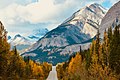 Mount Coleman (left) from Icefields Parkway


