Nishitetsu 9000 series
From Wikipedia, the free encyclopedia
| Nishitetsu 9000 series | |
|---|---|
 A 2-car 9000 series set leading an express service in January 2024 | |
| Manufacturer | Kawasaki Heavy Industries |
| Family name | efACE |
| Replaced | 5000 series |
| Constructed | 2016– |
| Entered service | 20 March 2017 |
| Number built | 25 vehicles (10 sets) |
| Number in service | 25 vehicles (10 sets) |
| Formation | 2/3 cars per trainset |
| Operators | Nishi-Nippon Railroad |
| Lines served | Nishitetsu Tenjin Ōmuta Line |
| Specifications | |
| Car body construction | Stainless steel |
| Car length | 19,500 mm (64 ft 0 in) |
| Width | 2,760 mm (9 ft 1 in) |
| Height | 4,165 mm (13 ft 8.0 in) |
| Floor height | 1,180 mm (3 ft 10 in) |
| Doors | 3 pairs per side |
| Maximum speed |
|
| Traction system | Variable frequency (IGBT/SiC Hybrid module) |
| Acceleration | 2.5 km/(h⋅s) (1.6 mph/s) |
| Deceleration | 3.5 km/(h⋅s) (2.2 mph/s) (service brake) 4.0 km/(h⋅s) (2.5 mph/s) (emergency brake) |
| Power supply | 1,500 V DC overhead catenary |
| Current collector(s) | Pantograph |
| Track gauge | 1,435 mm (4 ft 8+1⁄2 in) |
The Nishitetsu 9000 series (西鉄9000形) is an electric multiple unit (EMU) train type operated by the private railway operator Nishi-Nippon Railroad (Nishitetsu) in Japan on the Nishitetsu Tenjin Ōmuta Line since 20 March 2017.
Ten sets of five three-car and five two-car formations are in service as of 2021.[1]
The 9000 series trains were built by Kawasaki Heavy Industries in Kobe, with two three-car sets and two two-car sets (10 vehicles) entering service in March 2017, and a further two three-car sets and one two-car set (eight vehicles) entering service in May 2017.[2][3]
Based on the earlier 3000 series trains, externally, the new trains carry a livery with a "royal red" waist-line stripe.[2]
Operations
The 9000 series trains operate on Nishitetsu Tenjin Ōmuta Line express and all-stations local services.
Formations
2-car sets
The two-car sets are formed as follows with one motored ("M") car and one non-powered trailer ("T") car.[4]
| Designation | M | Tc |
|---|---|---|
| Numbering | 91xx | 95xx |
| Weight (t) | 36.3 | 27.2 |
| Capacity (Seated/total) | 40/124 | 40/124 |
The motored car has two single-arm pantographs.[4]
3-car sets
The three-car sets are formed as follows with one motored ("M") car and two non-powered trailer ("T") cars.[4]
| Designation | Tc | M | Tc |
|---|---|---|---|
| Numbering | 90xx | 93xx | 95xx |
| Weight (t) | 26.0 | 34.6 | 27.2 |
| Capacity (Seated/total) | 40/124 | 38/138 | 40/124 |
The motored car has two single-arm pantographs.[4]
Interior
Passenger accommodation consists of longitudinal bench seating with a seat width of 470 mm (19 in) per person.[5] LED lighting is used in the interiors, and two 17-inch LCD passenger information screens are provided above each of the doorways with information provided in four different languages (Japanese, English, Korean, and Chinese).[2]
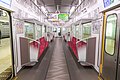 Interior
 Priority seating with wheelchair space at left
 LCD information displays
 Driver's cab


