November 14 (Eastern Orthodox liturgics)
Day in the Eastern Orthodox liturgical calendar
From Wikipedia, the free encyclopedia
November 13 - Eastern Orthodox liturgical calendar - November 15

All fixed commemorations below celebrated on November 27 by Orthodox Churches on the Old Calendar.[note 1]
For November 14th, Orthodox Churches on the Old Calendar commemorate the Saints listed on November 1.
Saints
- Holy and All-Praised Apostle Philip (c. 81â96)[1][2][3][4][note 2]
- Saint Stachys, Bishop of Hierapolis (in Phrygia) (1st century)[5][6][note 3]
- Saint Justinian the Emperor[7] (565) and his wife St. Theodora[8] (548)[1][9][10] (see also: November 15)
- Saint Thomas II the New, Ecumenical Patriarch of Constantinople (668â669)[11] (see also: November 15 and November 16)
- Virgin Martyrs of Emesa, Syria (779)[1][note 4]
- Saint Fantinus the Younger, of Calabria (c. 1000)[1]
Pre-Schism Western saints
- Saint Veneranda (Venera), an early martyr in France (2nd century)[13][note 5]
- Saint Venerandus, an influential citizen of Troyes in France martyred under Aurelian (275)[13][note 6]
- Saint Jucundus of Bologna, Bishop of Bologna in Italy (485)[13][note 7]
- Saint Dubricius (Dubric, Dyfrig), Bishop in Hereford and Gwent, hermit, of Bardsey Island (c. 550)[1][9][13][14][15][note 8]
- Saint Sidonius of Saint-Saëns, a monk at Jumièges Abbey, later the first abbot of Saint-Säens (c. 690)[13][note 9]
- Saint Malo of Brittany (7th century)[1][9] (see also: November 15)
- Saint Alberic (Alberik) I of Utrecht, Bishop of Utrecht (784)[1][9][13][note 10]
- Saint Modanic, a bishop in Scotland (8th century)[13]
Post-Schism Orthodox saints
- Saint Euphemianos the Wonderworker, of Cyprus (12th century)[6][16][note 11]
- Saint Gregory Palamas the Wonderworker, Archbishop of Thessaloniki (1360)[1][2][9][10][19][20]
- Saint Philip, founder of Irap Monastery, Novgorod (1527)[1][10][21][note 12]
- New Martyr Constantine of Hydra, at Rhodes (1800)[1][2][6][9][22][23]
- New Martyr Panteleimon the Youth, of Spetses, in Crete (1848)[1][6][9][24][note 13]
New martyrs and confessors
- Priests: Demetrius Benevolensky;[27][28][note 14] Alexander Bykov;[29][note 15] Victor Ilyinsky;[30] Alexis Nechayev;[31] Michael Belyustin; Michael Nekrasov; Theodore Bakkalinsky; Peter Titov; Alexis Nikologorsky;[32] Sergius Znamensky; Nicholas Dunayev; Basil Likharev;[33] Alexander Pokrovsky;[34] Nicholas Vinogradov;[note 16] Demetrius Lebedev;[35] Porphirius Kolosovsky; Basil Nikolsky;[36] George Izvekov;[37][note 17] Basil Rozanov;[38] Sergius Spassky; Alexander Chekalov;[39] Sergius Rufitsky;
- Nicholas Bogorodsky, Deacon;
- Aristarchus (Zaglodin-Kokorev),[note 18] Hieromonk of St. Nicholas Peshnosha Monastery,[note 19] Moscow.[1][40]
- Martyr Gabriel Bezfamilnov;[41]
- Martyr Demetrius Rudakov;[42]
- Virgin-martyr Anna Zertsalova.[43][note 20]
Other commemorations
- Repose of St. Alexander Nevsky (Alexis in schema), Great Prince of Novgorod (1263)[1][9]
- Repose of Archimandrite Lazarus (Moore) of Eagle River, Alaska (1992).[1]
Icon gallery
 Martyrdom of the Apostle Philip.
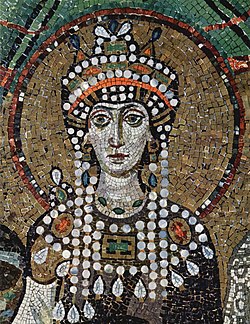 St. Theodora.
 Saint Dubricius.
 St. Philip, founder of Irap Monastery, Novgorod.
 New Hieromartyr Alexander Bykov.
 New Hieromartyr George Izvekov.

.jpg)


Notes
- The notation Old Style or (OS) is sometimes used to indicate a date in the Julian Calendar (which is used by churches on the "Old Calendar").
The notation New Style or (NS), indicates a date in the Revised Julian calendar (which is used by churches on the "New Calendar"). - In the Synaxarion of St Nicodemus, and in the biography of the Apostle Philip, it is stated that after the death of the Apsotle Philip, the Apostle Bartholomew who was accompanying him ordained Stachys as the Bishop of Hierapolis (in Phrygia). However other Synaxaristes do not mention this fact.
- One of the founders of monastic life in Wales. His main monastic centres were at Henllan and Moccas. However, he founded many other monasteries in Gwent and in England in what is now Herefordshire and the Wye Valley. He had jurisdiction over Caldey Island where he appointed St Samson abbot and later consecrated him bishop. A late tradition makes him Archbishop of Caerleon. He reposed on the Isle of Bardsey.
- Born in Ireland, Sidonius became a monk at Jumièges in the north of France with St Philibert (644). Later he became the first abbot of a small monastery which that bishop had founded near Rouen. This monastery was later called Saint-Säens.
- Nephew of St Gregory of Utrecht, he became a priest and, on his uncle's repose in 775, Bishop of St Martin's in Utrecht in the Netherlands. Highly educated, his work among the pagan Teutons was very fruitful.
- Saint Euphemianos the Wonderworker was one of the "300 Allemagne Saints" in Cyprus. The 300 Allemagne Saints came to Cyprus from Palestine, and lived as ascetics in various parts of the island. Included among the "300 Allemagne Saints" are:
- Venerable Anastasios the Wonderwoker of Cyprus, September 17
- Venerable Abbacum the Ascetic of Cyprus, Wonderworker, December 2
- Venerable Cassian the Martyr (Kassianos), December 4
- Venerable Calantius of Tamassos (Kalandios), April 26
- Martyr Constantine of Cyprus (Constantine of Allemagne), Wonderworker, July 1
- See: (in Russian) Филипп ÐÑапÑкий. Ðикипедии. (Russian Wikipedia).
- See: (in Russian) ÐеневоленÑкий, ÐмиÑÑий ÐÐ¸Ñ Ð°Ð¹Ð»Ð¾Ð²Ð¸Ñ. Ðикипедии. (Russian Wikipedia).
- See: (in Russian) ÐÑков, ÐлекÑÐ°Ð½Ð´Ñ Ð¯ÐºÐ¾Ð²Ð»ÐµÐ²Ð¸Ñ. Ðикипедии. (Russian Wikipedia).
- See: (in Russian) ÐиногÑадов, Ðиколай ÐÐ²Ð°Ð½Ð¾Ð²Ð¸Ñ (ÑвÑÑенник). Ðикипедии. (Russian Wikipedia).
- See: (in Russian) Ðзвеков, ÐеоÑгий ЯковлевиÑ. Ðикипедии. (Russian Wikipedia).
- See: (in Russian) ÐÑиÑÑаÑÑ (Ðаглодин-ÐокоÑев). Ðикипедии. (Russian Wikipedia).
- See: (in Russian) Ðиколо-ÐеÑноÑÑкий монаÑÑÑÑÑ. Ðикипедии. (Russian Wikipedia).
- See: (in Russian) ÐеÑÑалова, Ðнна Ðвановна. Ðикипедии. (Russian Wikipedia).