November 15 (Eastern Orthodox liturgics)
Day in the Eastern Orthodox liturgical calendar
From Wikipedia, the free encyclopedia
November 14 - Eastern Orthodox liturgical calendar - November 16

All fixed commemorations below are observed on November 28 by Orthodox Churches on the Old Calendar.[note 1]
For November 15, Orthodox Churches on the Old Calendar commemorate the Saints listed on November 2.
Saints
- Martyr Demetrius of Thrace, from the village Davoudio (Dabuda), close to town Amapasos (Amapas), by beheading (298)[1][2][3][4][note 2]
- Holy Martyrs and Confessors Gurias (299), Samonas (306), and Habibus (Abibus) (322), of Edessa.[1][2][4][6][7]
- Saint Quinctian (Kyntion), Bishop of Seleucia (4th century)[1][2][4][8][note 3]
- Martyrs Eupsychios, Nearchos and Karterios.[4][9][note 4] (see also: November 5)
- Martyrs Elpidius, Marcellus, and Eustochius, who suffered under Julian the Apostate (361)[1][2][4][10][11] (see also: November 16 - West)
- Saint Thomas II the New, Ecumenical Patriarch of Constantinople (668â669)[1][2][4][12][13][14] (see also: November 14 and November 16)
Pre-Schism Western saints
- Saint Eugene, preached the Gospel with St Denis, Bishop of Paris in France, and was martyred.[15][note 5]
- Saint Felix of Nola, first Bishop of Nola near Naples in Italy, martyred with thirty companions (287)[15][note 6]
- Twenty Martyrs (Fidentian, Valerian, Victoria, etc.) in North Africa.[15][16]
- Saint Luperius, Bishop of Verona and Confessor (6th or 8th century)[15][16]
- Saint Malo (Maclovius, Machutis, Maclou, Machulus), first Bishop of Aleth (c. 640)[15][17][note 7][note 8] (see also: November 14)
- Saint Desiderius (Didier), who succeeded his own brother, St Rusticus, as Bishop of Cahors in France (655)[15]
- Saint Machudd (Machell), founder of the monastery of Llanfechell in Anglesey in Wales (7th century)[15]
- Saint Paduinus (Pavin), a monk at the monastery of St Vincent in Le Mans in France, then first Abbot of St Mary's near Le Mans (c. 703)[15]
- Saint Arnulf, Bishop of Toul in France (871)[15]
- Saint Findan (Fintan), hermit (879)[15][note 9]
Post-Schism Orthodox saints
Other commemorations
- Beginning of the Nativity Fast.
- Commemoration of the pious Emperor Justin and Theodora.[24][note 13]
- "Kupyatich" Icon (1180) of the Most Holy Theotokos.[1][2][13][22][25]
- "Fragrant Flower" Icon of the Mother of God[26]
- Repose of St. Herman of Alaska, Wonderworker of Alaska (1836)[1][2] (Commemorates actual day of his repose, see also: August 13)
Icon gallery
 Martyr Abibus of Edessa.
 St. Felix of Nola.
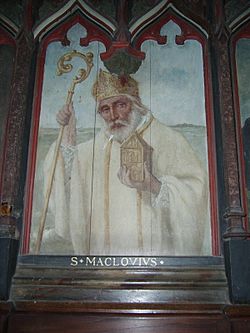 St. Malo (Maclovius), first Bishop of Aleth.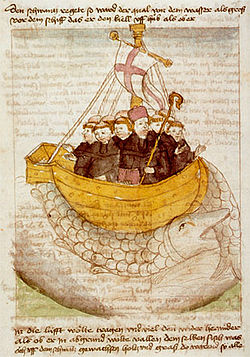
 Venerable Paisius Velichkovsky.
.jpg)


Notes
- The notation Old Style or (OS) is sometimes used to indicate a date in the Julian Calendar (which is used by churches on the "Old Calendar").
The notation New Style or (NS), indicates a date in the Revised Julian calendar (which is used by churches on the "New Calendar"). - He was one of the 318 Fathers of the First Ecumenical Council of Nicaea, in Bithynia. He became an ascetic and also a wonderworker. He reposed peacefully.
- The memory of these three martyrs is preserved in Parisian Codex 1578 and in Patmian Codex 266, along with their companions.
- Born in Wales, he moved to Brittany and settled at a place called Aleth, now St Malo, where he was the first bishop.
- Born in Leinster in Ireland, he was taken as a slave to the Orkney Islands by Norse raiders, but managed to escape to Scotland. He then went on pilgrimage to Rome and became a monk in Farfa Abbey in Italy. From there he went to the monastery of Rheinau Abbey in Switzerland, where he lived as a hermit for twenty-two years. His relics still exist.
- See: (in Russian) Филипп РабангÑкий. Ðикипедии. (Russian Wikipedia).
- St. Paisius was one of the greatest teachers of the spirituality of the Jesus Prayer and translator of Patristic texts on prayer, St Paisius renewed monastic life in several Orthodox lands and had disciples from ten nationalities. His disciples prayed up to 14 hours per day as they united prayer with reading and physical work.[21]
- See: (in Russian) https://pravenc.ru/text/166597.html ÐÐ ÐÐÐÐ ÐÐ]. ÐÑавоÑÐ»Ð°Ð²Ð½Ð°Ñ ÐнÑÐ¸ÐºÐ»Ð¾Ð¿ÐµÐ´Ð¸Ñ Ð¿Ð¾Ð´ ÑедакÑией ÐаÑÑиаÑÑ Ð° ÐоÑковÑкого и вÑÐµÑ Ð ÑÑи ÐиÑилла (ÑлекÑÑÐ¾Ð½Ð½Ð°Ñ Ð²ÐµÑÑиÑ). (Orthodox Encyclopedia - Pravenc.ru).
- There is some confusion in the sources as to whether this refers to 'Justinian and Theodora' or to 'Justin and Euphemia'.