November 17 (Eastern Orthodox liturgics)
Day in the Eastern Orthodox liturgical calendar
From Wikipedia, the free encyclopedia
November 16 - Eastern Orthodox liturgical calendar - November 18

All fixed commemorations below are observed on November 30 by Orthodox Churches on the Old Calendar.[note 1]
For November 17, Orthodox Churches on the Old Calendar commemorate the Saints listed on November 4.
Saints
- Saint Gregory the Wonderworker of Neo-Caesarea (266)[1][2][3][4][5][note 2]
- Hieromartyr Basil, Bishop of Hamah (282)[1][2]
- Martyrs Zachariah (Zacharias) the Cobbler and his wife, Mary (3rd century)[1][2][7][8]
- Martyrs Gregory, Victor, and Geminus of Heracleon in Thrace (304)[1][2]
- 150 philosophers converted by St. Catherine, and who suffered in Alexandria (305)[1][2]
- Venerable Longinus of Egypt (4th century)[1][2][4][9]
- Martyr Sak (Saktus, Sanctus) the Persian.[4][10][note 3]
- Saint Maximus (Maximian), Archbishop of Constantinople (434)[1][2] (see also: April 21)
- Saint Gennadius I, Patriarch of Constantinople (471)[4][11][12]
- Saint John the Cobbler of Olumba, Cairo, and Sinai (7th century)[1][2][7][8]
- Venerable Lazarus the iconographer of Constantinople (857)[1][2][4][13][14][15]
- Great-Martyr Gobron (Michael) and 133 soldiers of Georgia (914)[1][2][14][16][17]
- Venerable John of Olympus (John Dermokaitis), in Bithynia (c. 919â944)[4][17][18][note 4]
- Venerable Justin[4][19]
Pre-Schism Western saints
- Martyrs Acisclus and Victoria, at Córdoba in Hispania (304)[14][20][note 5][note 6]
- Saint Eugene, a deacon of the Church of Florence with Bishop Zenobius (422)[20][note 7]
- Saint Anianus of Orleans (Aignan), fifth Bishop of Orleans in France (453)[20][note 8][note 9]
- Saint Gregory of Tours, Bishop of Tours (594),[1] and with him Venerable Aredius, Abbot of Limoges and Venerable Vulfolaic, stylite of Trier,[1] Gaul.[2][20][note 10]
- Saint Namasius (Naamat, Namat, Namatius), twenty-second Bishop of Vienne in France (c. 599)[20]
- Venerable Hilda, Abbess of Whitby Abbey (680)[1][2][20][21][22][note 11]
Post-Schism Orthodox saints
- Venerable Gennadius, Abbot of Vatopedi, Mount Athos (14th century)[1][2][4][23][24]
- Venerable Nikon, Abbot of Radonezh, disciple of St. Sergius of Radonezh (1426)[1][2][4][14][25][26][note 12]
- Saint Maximus III, Ecumenical Patriarch of Constantinople (1482)[11][12]
- Venerable Archimandrite Sevastijan DaboviÄ (Sebastian Dabovich) of San Francisco and Jackson, Enlightener and Apostle of the Church in America (1940)[1][27][28][note 13] (see also: November 30)
Other commemorations
- Translation of the relics (1935) of St. Gregory, Bishop of Assos near Ephesus (1150), to Lesvos.[note 14] (On the Sunday between November 11â17 each year.)
- Repose of Hieroschemamonk Daniel (Sandu Tudor), poet of Romania (1962) (see also: November 4 - Old Calendar)
Icon gallery
 St. Gregory the Wonderworker of Neo-Caesarea.
 Deposition of the Robe of Virgin Mary by Gennadius and Emperor Leon.
 Empress Theodora and monk Lazarus the iconographer.
 St. Anianus of Orleans.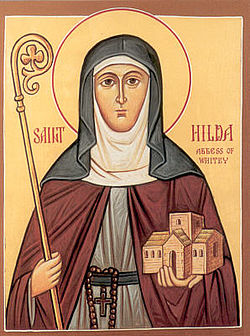
 Venerable Nikon, Abbot of Radonezh.
 Venerable Archimandrite Sebastian (Dabovich) of San Francisco and Jackson.
 Sandu Tudor (Brother Agathon, Father Daniil Teodorescu).

.jpg)
.jpg)
.JPG)
.jpg)


Notes
- The notation Old Style or (OS) is sometimes used to indicate a date in the Julian Calendar (which is used by churches on the "Old Calendar").
The notation New Style or (NS), indicates a date in the Revised Julian calendar (which is used by churches on the "New Calendar"). - "AT Neocaesarea, in Pontus, the birthday of St. Gregory, bishop, illustrious by his learning and sanctity. The prodigies and miracles which he wrought to the great glory of the Church gained for him the surname of Wonder-worker."[6]
- His memory is preserved in the Synaxarion of Delahaye, noting that he was an ascetic on Mt. Olympos in Bithynia. He may be the same individual as John the Monk, who was known for the sanctity of his life, under Emperor Romanos I Lekapenos (919â944). Emperor Romanos, after his death, sent a sealed epistle to this John the Monk, containing a confession of his sins.
- Brother and sister, they were born in Cordoba in Spain and were martyred, probably under Diocletian. Their home was turned into a church. They are the main patron-saints of Cordoba and were venerated throughout Spain and the south of France.
- He is famous for organising the defence of his city during the invasion of the Huns under Attila. He interceded with the latter on his approach to Orleans, thus saving it.
- Born in Auvergne in France, he was baptised George Florentius, but took the name Gregory when he became Bishop of Tours in 573. He was a fine bishop and excelled as a historian.
- Born in Northumbria, she was a relative of King Edwin. Baptised as a child by St. Paulinus in 631, at the age of thirty-three she joined the nuns of Hartlepool in Northumberland where soon after she became abbess. Later she became Abbess of Whitby. Her influence was one of the most decisive factors in uniting the Church in seventh century England. Five of her monks became bishops.
- See: (in Russian) Ðикон РадонежÑкий. Ðикипедии. (Russian Wikipedia).
- Canonized in 2015.
- His feast day is on March 4. The Translation of his Relics to Lesvos took place on November 16, 1935. Based on the proposal of the Metropolitan of Mytilene, the Ecumenical Patriarchate appointed the feast day for the 'Translation of the relics of Saint Gregory, Bishop of Assos (1150), to be celebrated each year on the 1st Sunday after November 10.