November 30 (Eastern Orthodox liturgics)
Day in the Eastern Orthodox liturgical calendar
From Wikipedia, the free encyclopedia
November 29 - Eastern Orthodox liturgical calendar - December 1

All fixed commemorations below are observed on December 13 by Eastern Orthodox Churches on the Old Calendar.[note 1]
For November 30, Orthodox Churches on the Old Calendar commemorate the Saints listed on November 17.
Saints
- Holy and All-Praised Apostle Andrew the First-Called (62)[1][2][3][4][5][note 2][note 3][note 4]
- Saint Frumentius, Archbishop of Abyssinia (380)[1][3][5][8][9]
- Saint Alexander, first Bishop of Methymna on Lesbos, Wonderworker, and member of the First Ecumenical Council (fl. 325)[3][10][11]
- Saint Vakhtang I Gorgasali, King of Georgia (502)[1][11][12]
- Saints Peter I[13] and Samuel I,[14] Catholicoi of Georgia (6th centuries)[1][11][note 5]
Pre-Schism Western saints
- Saints Castulus and Euprepis, martyrs in Rome[6][15]
- Saint Constantius, a priest in Rome who opposed the Pelagians and at whose hands he suffered a great deal (5th century)[15][note 6]
- Saint Trojanus of Saintes (Troyen), a priest in Saintes in France where he later became bishop after St Vivien (533)[15][note 7]
- Saint Tudwal (Tugdual), monk from Wales who became Bishop of Tréguier, Brittany (c. 564)[1][11][15][16][note 8](see also: December 1)
Post-Schism Orthodox saints
- Saint Andrew (Andrei) Șaguna, Metropolitan of Transylvania (1873)[1]
- Saint Elias, Schemamonk of Valaam and Verkhoturye (1900)[1][11]
- Venerable Archimandrite Sevastijan Dabović (Sebastian Dabovich) of San Francisco and Jackson, Enlightener and Apostle of the Church in America (1940)[17][18][19][note 9] (see also: November 17)
New martyrs and confessors
Other commemorations
- Entrance of the Apostle Andrew into Georgia (1st century)[21]
Icon gallery
 Holy and All-Praised Apostle Andrew the First-Called.
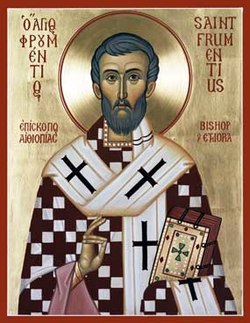 Saint Frumentius.
 Saint Tudwal.
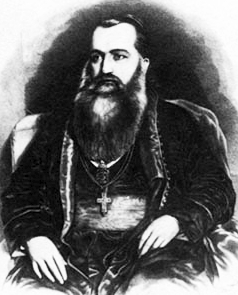 St. Andrei Șaguna.


Notes
- The notation Old Style or (OS) is sometimes used to indicate a date in the Julian Calendar (which is used by churches on the "Old Calendar").
The notation New Style or (NS), indicates a date in the Revised Julian calendar (which is used by churches on the "New Calendar"). - His major shrine is The Cathedral of Agios Andreas in Patras, Achaea, Greece. Name days celebrated today include:
- Andrew, Andreas (Ἀνδρέας);
- Adriana (Ἀνδριανή).
- "AT Patras, in Achaia, the birthday of the apostle St. Andrew, who preached the gospel of Christ in Thrace and Scythia. Being apprehended by the proconsul Aegaeas, he was shut up in prison, severely scourged, and finally, being suspended on a cross, he lived two days on it, teaching the people. Having besought our Lord not to permit that he should be taken down from the cross, he was surrounded with a great brightness from heaven, and when the light disappeared he breathed his last."[6]
- St Andrew’s Cathedral in Kiev (Rastrelli) keeps the cross which he is said to have planted on the Kievan hills as he blessed them and foretold that the city would have many churches.[7]
- The Holy Synod of the Georgian Apostolic Orthodox Church canonized the holy catholicos Peter and the holy catholicos Samuel on October 17, 2002.
- A monk from Wales who went to Brittany and became Bishop of Tréguier. Three places in the Lleyn peninsula in Gwynedd recall him and his relics are still honoured in Tréguier.
- Canonized in 2015.