November 22 (Eastern Orthodox liturgics)
Day in the Eastern Orthodox liturgical calendar
From Wikipedia, the free encyclopedia
November 21 - Eastern Orthodox liturgical calendar - November 23

All fixed commemorations below are observed on December 5 by Eastern Orthodox Churches on the Old Calendar.[note 1]
For November 22, Orthodox Churches on the Old Calendar commemorate the Saints listed on November 9.
Feasts
- Afterfeast of the Entry of the Most Holy Theotokos into the Temple.[1][2][3]
Saints
- Apostles of the 70 Philemon and Archippus, Martyr Apphia (wife of Philemon and Equal to the Apostles), and St. Onesimus, disciple of Saint Paul (c. 109)[1][2][4][5][6][note 2][note 3]
- Martyrs Cecilia, Valerian, Tiburtius, and Maximus[8][note 4] at Rome (c. 230 or 288)[1][2][5][9][10][note 5][note 6]
- Martyr Menignus at Parium, the Tanner, by beheading (250)[1][2][5][12][13]
- Martyrs Stephen, Mark, and Mark at Antioch in Pisidia, by beheading (290)[1][2][5][14][note 7]
- Martyr Procopius the Reader at Caesarea in Palestine, by the sword (303)[1][2][5][15][note 8]
- Martyr Agapion of Greece (Agapionos the Roman) (304)[1][2][5][17][note 9]
- Martyr Agapios of Cappadocia, by the sword.[5][18][note 10]
- Martyr Thaddeus.[5][19][20][note 11]
- Martyrs Christopher and Euphemia, by the sword.[5][21][note 12]
- Martyrs Thalalaeus[dubious – discuss] and Anthimus, by the sword.[5][22][note 13] (see also: November 19)
- Hieromartyr Sisinius, by the sword.[5][23] (see also: November 23)
- Venerable Agabbas (Abbas) of Syria (5th century)[1][2][5][24][25]
- Righteous Michael the Soldier of Potuka, Bulgaria (866)[1][2][20][26]
- Venerable Germanus, founder of the Holy Monastery of the Theotokos Eikoiphinissa, in the Metropolis of Drama, Greece (Macedonia) (9th century)[1][2][27]
- Saint Clement of Ochrid, Bishop of Ohrid (Achrida), Enlightener of Bulgaria and Wonderworker (916)[1][2][5][28] (see also: July 27)
Pre-Schism Western saints
- Martyr Maurus, born of Christian parents in North Africa, he was martyred in Rome under Numerian.[11][note 14]
- Saint Pragmatius, Bishop of Autun in France (c. 520)[11][note 15]
- Saint Deyniolen (Deiniol the Younger), Abbot of Bangor Abbey in Wales (621)[11][note 16]
- Saint Sabinian, Third Abbot of Moutier-Saint-Chaffre in France (c. 720)[11]
- Saint Christian, thirty-seventh Bishop of Auxerre in France (c. 873)[11]
- Saint Tigridia (Trigidia), Abbess of San Salvador de Oña, which her father Count Sancho Garcia founded for her to direct (c. 925)[11]
Post-Schism Orthodox saints
- Blessed Yaropolk-Peter, Prince of Vladimir in Volhynia (1086)[1][2][30]
- Martyrdom of Saint Michael (Mikhail), Prince of Tver (1318)[1][2][5][31]
- Venerable Callistus II Xanothopoulos, Hesychast monk of Mount Athos and Ecumenical Patriarch of Constantinople (1397)[2][5][32][33]
- Venerable Iakovos Tsalikis of Euboea (Evia) the New Ascetic, Igumen of the Monastery of Saint David the Elder in Euboea (1991)[34][35][36][37][38][note 17][note 18]
New martyrs and confessors
- New Hieromartyr Vladimir Ryasensky of Tver, Priest (1932)[2][39][40]
- New Hieromartyr Joasaph Zhevakhov, Bishop of Mogilev (1937)[1][2][39][41][note 19]
- New Hieromartyr Gerasim Mochalov, Hieromonk of the Zosima Hermitage, Smolensk (1937)[1][2][39][42]
- New Hieromartyrs Alexis Benemanskii (Benemansky)[43][note 20] and Elias (Elijah) Gromoglasov,[44][45][note 21] Archpriests of Tver, and Athanasius Milov,[46] Priest of Chimkent (1937)[1][2][39][20][47]
- New Monk-martyrs Eutychius Didenko, Abner Sinitsyn, Sava Suslov, and Mark Makhrov, of Optina Monastery, and with them New Martyr Boris Kozlov (1937)[1][39]
- New Hieromartyrs John Smirnov, Basil Bov,[48] Paul Evdokimov, Jacob Sokolov,[49] Theodore Gusiev, John Baranov,[50] Priests (1937)[2][39][47]
- Venerable Paraskeva (Matieshina), Confessor (1953)[2][39][47]
Icon gallery

 St. Cecilia of Rome.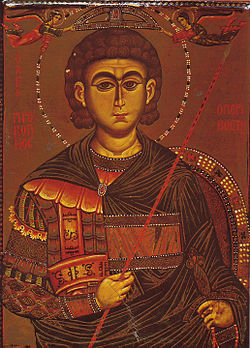
 Saint Clement of Ochrid.
 St. Michael of Tver.
 New Hieromartyr Joasaph (Zhevakhov), Bishop of Mogilev.
 New Hieromartyr Elias Gromoglasov.


.jpg)


.jpg)

Notes
- The notation Old Style or (OS) is sometimes used to indicate a date in the Julian Calendar (which is used by churches on the "Old Calendar").
The notation New Style or (NS), indicates a date in the Revised Julian calendar (which is used by churches on the "New Calendar"). - "At Colossae, in Phrygia, during the reign of Nero, Saints Philemon and Apphias, disciples of St. Paul. When the Gentiles rushed into the church on the feast of Diana, they were arrested whilst the other Christians fled, and by the command of the governor Artocles, were scourged, let down into a pit up to their waist, and overwhelmed with stones."[7]
- "AT Rome, St. Cecilia, virgin and martyr, who brought to the faith of Christ her spouse Valerian and his brother Tiburtius, and encouraged them to martyrdom. After their death, being arrested by order of Almachius, prefect of the city, and exposed to the fire, from which she came out uninjured, she terminated her glorious sufferings by the sword, in the time of the emperor Marcus Aurelius Severus Alexander."[7]
- "At Antioch, in Pisidia, the martyrdom of the Saints Mark and Stephen, under the emperor Diocletian."[7]
- "The Holy Martyr Procopius was a reader in the Church of Jerusalem. He led a strict ascetic life, for which he received from the Lord the ability to cast out demons. The zealous preacher of the Word of God was arrested and brought to trial in Palestinian Caesarea. For his refusal to offer sacrifice to idols, he was beheaded."[16]
- Because he confessed Christ, they threw him as food for the wild beasts. But miraculously he was delivered unharmed and reposed in peace.
- Parisian Codex 1578 records that he was from Cappadocia.
- Tied up and left to die on a downward slope (declivity).
- They are likely the same martyrs as those commemorated on November 19.
- They are likely the same martyrs as those commemorated on November 19.
- With the approval and recommendation of the Church of Greece, on November 27, 2017, the Sacred and Holy Synod of the Ecumenical Patriarchate formally glorified Archimandrite Elder Iakovos (Tsalikis) (†1991), Igumen of the Monastery of Saint David the Elder in Euboea. His feast day was set on November 22 each year:
- (in Greek) "Κατ᾿ αὐτήν, ἡ Ἁγία καί Ἱερά Σύνοδος ὁμοφώνως ἀποδεχθεῖσα εἰσήγησιν τῆς Κανονικῆς Ἐπιτροπῆς ἀνέγραψεν εἰς τό Ἁγιολόγιον τῆς Ὀρθοδόξου Ἐκκλησίας τόν μακαριστόν Ἀρχιμανδρίτην Ἰάκωβον Τσαλίκην, ἐκ Λιβισίου Μικρᾶς Ἀσίας, Ἡγούμενον τῆς ἐν Β. Εὐβοίᾳ Ἱερᾶς Μονῆς Ὁσίου Δαυΐβ τοῦ Γέροντος, τῆς μνήμης αὐτοῦ ὁρισθείσης διά τήν 22αν Νοεμβρίου ἑκάστου ἔτους."[36]
- See: (in Greek) Άγιος Ιάκωβος Τσαλίκης. Βικιπαίδεια. (Greek Wikipedia).
- See: (in Russian) Иоасаф (Жевахов). Википедии. (Russian Wikipedia).
- See: (in Russian) Бенеманский, Алексей Константинович. Википедии. (Russian Wikipedia).
- See: (in Russian) Громогласов, Илья Михайлович. Википедии. (Russian Wikipedia).