November 21 (Eastern Orthodox liturgics)
Day in the Eastern Orthodox liturgical calendar
From Wikipedia, the free encyclopedia
November 20 - Eastern Orthodox liturgical calendar - November 22

All fixed commemorations below are observed on December 4 by Eastern Orthodox Churches on the Old Calendar.[note 1]
For November 21, Orthodox Churches on the Old Calendar commemorate the Saints listed on November 8.
Feasts
Saints
- —
Pre-Schism Western saints
- Saint Rufus of Rome, the disciple whom Saint Paul greets in Romans 16:13 (c. 90)[8][note 4][note 5]
- Martyrs Celsus and Clement, in Rome[8][note 6]
- Martyrs Demetrius and Honorius, in Ostia in Italy[8][note 7] (see also: December 22)
- Martyrs Honorius, Eutychius and Stephen, in Asta in Andalusia in Spain under Diocletian (c. 300)[8][note 8]
- Saint Gelasius I, Pope of Rome (496)[8][note 9][note 10]
- Saint Digain, son of Constantine Corneu, King of Dumnonia (5th century)[8][note 11]
- Saint Maurus of Verona, twelfth Bishop of Verona, Confessor (c. 600)[8][note 12]
- Venerable Columbanus of Bobbio, Abbot and founder of Luxeuil Abbey in Gaul, and Bobbio Abbey in Italy (615)[1][2][8][9][note 13] (see also: November 23)
- Saint Amelberga of Susteren, Benedictine Abbess of Susteren Abbey in the Netherlands (c. 900)[8]
- Saint Hilary, Benedictine Abbot of San Vincenzo in Volturno (1011–1045), who revived the monastic life there (c. 1045)[8]
Post-Schism Orthodox saints
- Saint Yaropolk-Peter, Prince of Vladimir in Volhynia (11th century)[9] (see also: November 22)
- Venerable Sozomenos, Bishop of Karpaseia in Cyprus, and Wonderworker (12th century)[4][10][note 14] (see also: November 20)
New martyrs and confessors
- New Hieromartyr Alexis Benemansky of Tver, Priest (1937)[2] (see also: November 22)
Other commemorations
- Synaxis of churches that are dedicated to the Entrance of the Most Holy Theotokos[13]
- "Everlasting Hope"[1][2][9] and "Eikonistria" (Swinging one)[14] Icons of the Mother of God
- Glorification of the New Hieromartyr Alexander Hotovitzky, Priest of New York and Protopresbyter of Moscow, Missionary of America, Hieromartyr of the Bolshevik yoke (1937)[1][2][9] (see also: August 7, December 4)
- Repose of Blessed Pasha of Birsk, Fool-for-Christ (1891)[1]
- Repose of Metropolitan Philaret Voznesensky of New York (1985) (see also: November 8)
Icon gallery

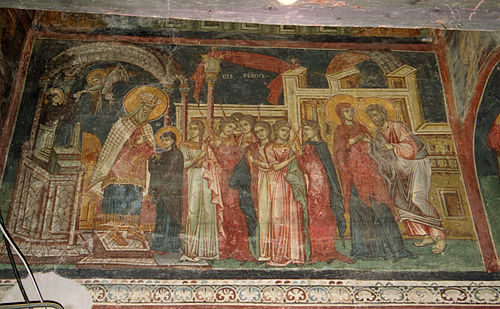 Entry of the Most Holy Theotokos into the Temple
(14th century)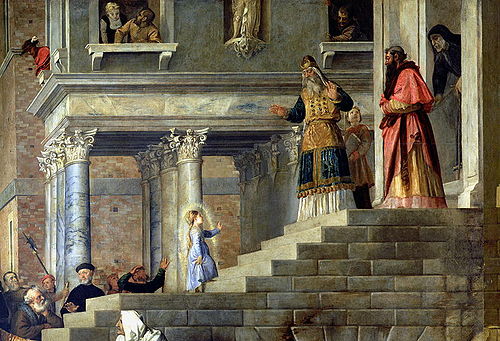 Entry of the Most Holy Theotokos into the Temple
(Titian)
.jpg)


Notes
- The notation Old Style or (OS) is sometimes used to indicate a date in the Julian Calendar (which is used by churches on the "Old Calendar").
The notation New Style or (NS), indicates a date in the Revised Julian calendar (which is used by churches on the "New Calendar"). - "IN the temple at Jerusalem, the Presentation of the Blessed Virgin Mary, Mother of God."[7]
- St. Mark says in his Gospel (xv, 21) that Simon of Cyrene was the father of Rufus, and as Mark wrote his Gospel for the Roman Christians, this Rufus is probably the same as the one to whom Paul sent a salutation [cf. Cornely, "Commentar. in Epist. ad Romanos" (Paris, 1896), 778 sq.].
- Born in Africa, he became Pope of Rome in 492. He was one of the most energetic bishops of his time.
- A son of Constantine, a lord in Cornwall. Llangernw in Clwyd in Wales is named after him.
- Venerable Sozomenos is possibly one of the "300 Allemagne Saints" in Cyprus. The 300 Allemagne Saints came to Cyprus from Palestine, and lived as ascetics in various parts of the island. Included among the "300 Allemagne Saints" are:
- Venerable Anastasios the Wonderwoker of Cyprus, September 17
- Venerable Abbacum the Ascetic of Cyprus, Wonderworker, December 2
- Venerable Cassian the Martyr (Kassianos), December 4
- Venerable Calantius of Tamassos (Kalandios), April 26
- Martyr Constantine of Cyprus (Constantine of Allemagne), Wonderworker, July 1