8-cube
8-dimensional hypercube
From Wikipedia, the free encyclopedia
In geometry, an 8-cube is an eight-dimensional hypercube. It has 256 vertices, 1024 edges, 1792 square faces, 1792 cubic cells, 1120 tesseract 4-faces, 448 5-cube 5-faces, 112 6-cube 6-faces, and 16 7-cube 7-faces.
| 8-cube Octeract | |
|---|---|
 Orthogonal projection inside Petrie polygon | |
| Type | Regular 8-polytope |
| Family | hypercube |
| Schläfli symbol | {4,36} |
| Coxeter-Dynkin diagrams |    
|
| 7-faces | 16 {4,35}  |
| 6-faces | 112 {4,34}  |
| 5-faces | 448 {4,33}  |
| 4-faces | 1120 {4,32}  |
| Cells | 1792 {4,3}  |
| Faces | 1792 {4}  |
| Edges | 1024 |
| Vertices | 256 |
| Vertex figure | 7-simplex  |
| Petrie polygon | hexadecagon |
| Coxeter group | C8, [36,4] |
| Dual | 8-orthoplex  |
| Properties | convex, Hanner polytope |

It is represented by Schläfli symbol {4,36}, being composed of 3 7-cubes around each 6-face. It is called an octeract, a portmanteau of tesseract (the 4-cube) and oct for eight (dimensions) in Greek. It can also be called a regular hexadeca-8-tope or hexadecazetton, being an 8-dimensional polytope constructed from 16 regular facets.
It is a part of an infinite family of polytopes, called hypercubes. The dual of an 8-cube can be called an 8-orthoplex and is a part of the infinite family of cross-polytopes.
Cartesian coordinates
Cartesian coordinates for the vertices of an 8-cube centered at the origin and edge length 2 are
- (±1,±1,±1,±1,±1,±1,±1,±1)
while the interior of the same consists of all points (x0, x1, x2, x3, x4, x5, x6, x7) with −1 < xi < 1.
As a configuration
This configuration matrix represents the 8-cube. The rows and columns correspond to vertices, edges, faces, cells, 4-faces, 5-faces, 6-faces, and 7-faces. The diagonal numbers say how many of each element occur in the whole 8-cube. The nondiagonal numbers say how many of the column's element occur in or at the row's element.[1][2]
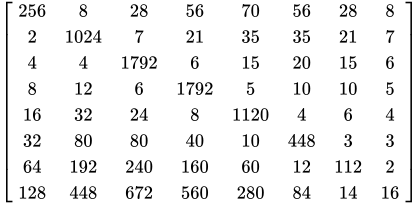
The diagonal f-vector numbers are derived through the Wythoff construction, dividing the full group order of a subgroup order by removing one mirror at a time.[3]
| B8 | | k-face | fk | f0 | f1 | f2 | f3 | f4 | f5 | f6 | f7 | k-figure | Notes |
|---|---|---|---|---|---|---|---|---|---|---|---|---|---|
| A7 |   | ( ) | f0 | 256 | 8 | 28 | 56 | 70 | 56 | 28 | 8 | {3,3,3,3,3,3} | B8/A7 = 2^8·8!/8! = 256 |
| A6A1 | | { } | f1 | 2 | 1024 | 7 | 21 | 35 | 35 | 21 | 7 | {3,3,3,3,3} | B8/A6A1 = 2^8·8!/7!/2 = 1024 |
| A5B2 | | {4} | f2 | 4 | 4 | 1792 | 6 | 15 | 20 | 15 | 6 | {3,3,3,3} | B8/A5B2 = 2^8·8!/6!/4/2 = 1792 |
| A4B3 | | {4,3} | f3 | 8 | 12 | 6 | 1792 | 5 | 10 | 10 | 5 | {3,3,3} | B8/A4B3 = 2^8·8!/5!/8/3! = 1792 |
| A3B4 | | {4,3,3} | f4 | 16 | 32 | 24 | 8 | 1120 | 4 | 6 | 4 | {3,3} | B8/A3B4 = 2^8·8!/4!/2^4/4! = 1120 |
| A2B5 | | {4,3,3,3} | f5 | 32 | 80 | 80 | 40 | 10 | 448 | 3 | 3 | {3} | B8/A2B5 = 2^8·8!/3!/2^5/5! = 448 |
| A1B6 | | {4,3,3,3,3} | f6 | 64 | 192 | 240 | 160 | 60 | 12 | 112 | 2 | { } | B8/A1B6 = 2^8·8!/2/2^6/6! = 112 |
| B7 | | {4,3,3,3,3,3} | f7 | 128 | 448 | 672 | 560 | 280 | 84 | 14 | 16 | ( ) | B8/B7 = 2^8·8!/2^7/7! = 16 |
Projections

| B8 | B7 | ||||
|---|---|---|---|---|---|
 |
 | ||||
| [16] | [14] | ||||
| B6 | B5 | ||||
 |
 | ||||
| [12] | [10] | ||||
| B4 | B3 | B2 | |||
 |
 |
 | |||
| [8] | [6] | [4] | |||
| A7 | A5 | A3 | |||
 |
 |
 | |||
| [8] | [6] | [4] | |||
Derived polytopes
Applying an alternation operation, deleting alternating vertices of the octeract, creates another uniform polytope, called an 8-demicube, (part of an infinite family called demihypercubes), which has 16 demihepteractic and 128 8-simplex facets.
Related polytopes
The 8-cube is 8th in an infinite series of hypercubes:
 |
|
 |
|
|
|
|
|
 |
 |
| Line segment | Square | Cube | 4-cube | 5-cube | 6-cube | 7-cube | 8-cube | 9-cube | 10-cube |