October 10 (Eastern Orthodox liturgics)
Day in the Eastern Orthodox liturgical calendar
From Wikipedia, the free encyclopedia
October 9 - Eastern Orthodox liturgical calendar - October 11

All fixed commemorations below celebrated on October 23 by Orthodox Churches on the Old Calendar.[note 1]
For October 10th, Orthodox Churches on the Old Calendar commemorate the Saints listed on September 27.
Saints
- Saint Pinytus (Gr. Î Î¹Î½Ï ÏÏÏ), Bishop of Knossos in Crete (c. 180)[1][2][3][note 2][note 3]
- Martyr Theotecnus of Antioch (3rd-4th century)[1][2][6][7][note 4]
- Martyrs Eulampius and Eulampia and 200 martyrs with them,[8] at Nicomedia (303-311)[1][9][10][11][12][13][note 5][note 6]
- Saint Maharsapor (or Sapor; died 421), an early Persian martyr.[14]
- Saint Bassian of Constantinople (c. 458)[1][10][11][15][16]
- Venerables Theophilus the Confessor and Longinus the Stylite (716)[1][10][11][17][18]
Pre-Schism Western saints
- Martyrs of the Theban Legion, along the Rhine (c. 287):[1][2]
- Saint Clarus of Nantes (Clair), Bishop of Nantes in France (3rd century)[19]
- Saint Cerbonius, Bishop of Verona in Italy (c. 400)[4][19]
- Saint Patrician, a bishop in Scotland who was driven out by heathen and spent the remainder of his life on the Isle of Man (5th century)[19]
- Saint Cerbonius, Bishop of Populonia in Tuscany, during the Barbarian invasions (c. 580)[19][21][note 13][note 14]
- Saint Tanca, a young girl near Troyes in France who was martyred defending her virginity (c. 637)[19][22]
- Saint Paulinus of York, Archbishop of York (644)[1][2][11][19][23][24][note 15][note 16]
- Saint Aldericus (Aldric, Audri), Archbishop of Sens (841)[19][note 17]
- Saint Paulinus of Capua, Bishop of Capua (843)[4][19][note 18]
- Saint Fulk of Fontenelle, twenty-first Abbot of Fontenelle Abbey in France (845)[19]
Post-Schism Orthodox saints
- Saint Amphilochius, Bishop of Vladimir, Volhynia (1122)[2][7][25][26] (see also: August 28 )
- Martyrdom of the 26 Martyrs of Zographou Monastery on Mount Athos by the Latins (1284):[1][2][11][27][28][29] (see also: September 22)
- Abbot Thomas, Monks Barsanuphius, Cyril, Micah, Simon, Hilarion, Job, James, Cyprian, Sabbas, James, Martinian, Cosmas, Sergius, Paul, Menas, Ioasaph, Ioannicius, Anthony, Euthymius, Dometian, and Parthenius, and four laymen.
- Saint Dionysios the Philosopher (1611)[11][30][31][note 19]
- Blessed Andrew of Totma in Vologda, Fool-for-Christ (1673)[1][2][7][11][32][33]
- Saint Innocent, Bishop of Penza (1819)[1][2][7][note 20]
- Venerable Ambrose of Optina, Elder of Optina Monastery (1891)[1][2][7][11][34][35]
New Martys and Confessors
- New Hieromartyr Theodore (Pozdeyevsky), Archbishop of Volokolamsk (1937)[1][2][note 21] (see also: March 21)
Other commemorations
- Saints Stephen (1094)[37] and Amphilochius (1122),[25] Bishops of Vladimir in Volhynia
- Saint Yaropolk-Peter, Prince of Vladimir in Volhynia (1086)
- St. Theodore (in monasticism Theodosius) of the Kiev Caves, Prince of Ostrog in Volhynia (1483)[38]
- St. Juliana, Princess of Olshansk (c. 1540)[39]
- St. Job of Pochaev, Abbot and Wonderworker of Pochaev (1651)[40]
- Hieromartyr Macarius of Kanev, Archimandrite, of Obruch and Pinsk (1678)[41]
Icon gallery
 Martyrs Eulampius and Eulampia.
 St. Bassian of Constantinople.
 St. Clair of Nantes, destroying a pagan temple.
 Saint Innocent, Bishop of Penza.
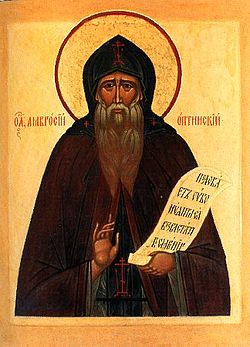 'Venerable Ambrose of Optina.
 New Hieromartyr Theodore (Pozdeyevsky), Archbishop of Volokolamsk.

.jpg)
_5994.JPG)
.jpg)

._ФоÑо_из_аÑÑ
ива_ÐÐÐ,_1937_год..jpg)
Notes
- The notation Old Style or (OS) is sometimes used to indicate a date in the Julian Calendar (which is used by churches on the "Old Calendar").
The notation New Style or (NS), indicates a date in the Revised Julian calendar (which is used by churches on the "New Calendar"). - "In the island of Crete, blessed Pinytus, most noble among the bishops. He was bishop of Gnosia, and flourished under Marcus Antoninus Verus and Lucius Aurelius Commodus. He left in his writings, as in a mirror, a vivid delineation of himself."[4]
- "EUSEBIUS speaks of Pinitus, Bishop of Gnossus, in Crete, who lived at the time of Dionysius of Corinth. Dionysius wrote to Pinitus, "not to impose on the brethren, without necessity, too severe a burden in regard to purity, but to pay regard to the infirmity of the great bulk of the people." To which Pinitus, writing in reply, said that he admired and applauded Dionysius, but exhorted him, at the same time, to impart some time or other food which was stronger to his flock, and to feed them with writings abounding in more perfect doctrine, so that they might not remain constantly imbibing the mere milk of doctrine, and grow old under a discipline calculated for children. "In this epistle also, the correct views which Pinitus cherished, and his solicitude for those committed to his care, also his learning and intelligence in divine matters, appear evidently.""[5]
- He may be the same saint commemorated on December 10, although the Greek sources state he was martyred by the sword, while the Slavic sources affirm he was drowned.
- "At Nicomedia, the holy martyrs Eulampius, and his sister, the virgin Eulampia, who, hearing that her brother was tortured for Christ, rushed through the crowd, embraced him and became his companion. Both were cast into a caldron of boiling oil, but being quite uninjured, they terminated their martyrdom by decapitation with two hundred others, who, impressed by the miracle, had believed in Christ."[4]
- Cassius, Florentius and Companions. Martyrs under the Emperor Maximian Herculeus in Bonn in Germany.
- Gereon. A soldier martyred in Germany, either in Xanten or else in Bonn.
- Victor and Companions. A group of three hundred and thirty soldiers connected with the Theban Legion in Switzerland.
- "At Piombino, in Tuscany, St. Cerbonius, bishop and confessor, who, as St. Gregory relates, was renowned for miracles, both during life and after death."[4]
- Born in Rome, he was sent to England with Sts Mellitus and Justus (601) to help St Augustine. He spent twenty-four years in Kent and in 625 was consecrated Bishop of York and sent to enlighten Northumbria, where he baptised King Edwin in York. After the King's martyrdom, he returned to Kent, where he became Bishop of Rochester.
- Born in the Gâtinais in France, he became a monk at Ferrières. The Archbishop of Sens took him into his clergy and he became Archbishop himself in 828.
- A pilgrim, perhaps from England, who stayed in Capua in Italy and was forced by the inhabitants to become their bishop. After an episcopate of eight years he reposed in Sicopolis where he had fled during the invasion of the Saracens.
- See: (in Italian) Paolino di Capua. Wikipedia. (Italian Wikipedia).
- See: (in Russian) ÐннокенÑий (СмиÑнов). ÐикипеÌдиÑ. (Russian Wikipedia).
- See: (in Russian) Ð¤ÐµÐ¾Ð´Ð¾Ñ (ÐоздеевÑкий). ÐикипеÌдиÑ. (Russian Wikipedia).
- СобоÑом Ð ÑÑÑкой пÑавоÑлавной ÑеÑкви за гÑаниÑей в 1981 Ð³Ð¾Ð´Ñ Ð±Ñл канонизован как ÑвÑÑенномÑÑеник и иÑповедник.
- See: (in Russian) Ð¡Ð¾Ð±Ð¾Ñ ÐолÑнÑÐºÐ¸Ñ Ð¡Ð²ÑÑÑÑ . ÐикипеÌдиÑ. (Russian Wikipedia).