October 13 (Eastern Orthodox liturgics)
Day in the Eastern Orthodox liturgical calendar
From Wikipedia, the free encyclopedia
October 12 - Eastern Orthodox liturgical calendar - October 14

All fixed commemorations below celebrated on October 26 by Eastern Orthodox Churches on the Old Calendar.[note 1]
For October 13th, Orthodox Churches on the Old Calendar commemorate the Saints listed on September 30.
Saints
- Martyr Florentius of Thessalonica (1st-2nd centuries)[1][2][3][4][5][note 2][note 3] (see also: March 14)
- Saint Martyrius.[4][8][note 4]
- Saint Diocletian.[2][4][9][note 5]
- Hieromartyrs Carpus, Bishop at Thyateira, and Papylus the Deacon, and Martyrs Agathadorus and Agathonica, at Pergamus (251)[1][2][10][11][12][note 6]
- Saint Dioscorus the Martyr, by decapitation (288)[2][4][13][note 7]
- Martyr Antigonus, by fire.[2][4][14]
- Holy Two Children-Martyrs, by fire.[15]
- Hieromartyr Saint Benjamin the Deacon and Martyr, of Persia (421â424)[1][2][16][17][note 8]
- Saint Nicetas the Confessor and Patrician, of Paphlagonia (c. 838)[1][2][18][19]
- Saint Luke of Demena, Sicily (984)[1][note 9]
Pre-Schism Western saints
- Saints Faustus, Januarius and Martial, martyrs in Cordoba in Spain under Diocletian, called "The Three Crowns of Cordoba" (304)[20][note 10][note 11]
- Saints Fyncana and Fyndoca, two martyrs in Scotland.[20][note 12]
- Saint Venantius, Abbot of the monastery of St. Martin in Tours, Confessor (end of 5th century)[1][6][20][23]
- Saint Romulus of Genoa, Bishop of Genoa in Italy (c. 641)[20][note 13]
- Saint Berthoald, Fifth Bishop of Cambrai-Arras in France (7th century)[20]
- Saint Comgan, Abbot of Lochalsh (8th century)[20][23][24][note 14]
- Saint Simpert (Simbert, Sinthert), Bishop of Augsburg in Germany (c. 809)[20][note 15][note 16]
- Saint Gerald of Aurillac, Count of Aurillac in France, founder of a church and abbey on his estate of Aurillac (909)[20][note 17]
- Saint Coloman of Stockerau, an Irish pilgrim en route to the Holy Land, tortured and hanged at Stockerau, near Vienna, Austria (1012)[6][20][26][note 18]
- Saint Regimbald (Reginbald, Regimbaut), Bishop of Speyer (1039)[20][note 19]
Post-Schism Orthodox saints
- Monk-martyr Jacob of Hamatoura Monastery, Lebanon (late 13th century)[1][27]
- Venerable Benjamin of the Kiev Caves (14th century)[1][4][23][28][29][30][note 20]
- Saint Meletius I Pegas, Archbishop of Alexandria (1601)[2][23][28][31] (see also: September 13)
- New martyr Chryse (Zlata) of Meglen (1795)[1][2][23][32][33][34]
- Saint Anthony, Metropolitan of Chkondidi (Martvili Monastery), Georgia (1815), and his disciple James the Elder, Hieromonk.[1][23][35]
New Martys and Confessors
Other commemorations
- Translation to Moscow of the Iveron Icon of the Most Holy Theotokos (1648)[1][23][28][39][40]
- Kazan Icon of the Most Holy Theotokos "Of the Seven Lakes" (17th century)[1][23][28][41][note 25]
- Repose of Monk Athanasius of Valaam Monastery (1852)[1]
- Translation of the relics (1965) of Venerable Sabbas the Sanctified (532), from the church of Sant'Antonin, Venice, to the Holy Lavra of Saint Sabbas the Sanctified, Jerusalem.[42][note 26]
- Uncovering of the Relics (1993) of New Hieromartyr Thaddeus (Uspensky), Archbishop of Tver (1937)[28][31][note 27]
Icon gallery
 Martyr Florentius of Thessaloniki.
 Hieromartyrs Carpus, Papylus, Agathadorus and Agathonica, at Pergamus.
 Hieromartyr Saint Benjamin the Deacon and Martyr, of Persia.
 St. Gerald of Aurillac.
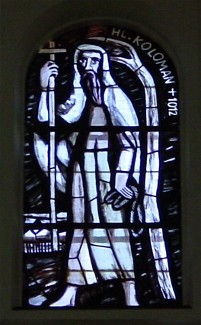 St. Coloman of Stockerau.
 Venerable Benjamin of the Kiev Caves.
 New martyr Chryse (Zlata) of Meglin.
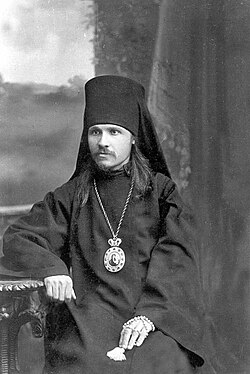 New Hieromartyr Thaddeus (Uspensky), Archbishop of Tver.
 Reliquary of New Hieromartyr Thaddeus (Uspensky), Archbishop of Tver.
.jpg)
.jpg)


.jpg)
.jpg)
Notes
- The notation Old Style or (OS) is sometimes used to indicate a date in the Julian Calendar (which is used by churches on the "Old Calendar").
The notation New Style or (NS), indicates a date in the Revised Julian calendar (which is used by churches on the "New Calendar"). - He is not present in the Synaxarion. His memory is referenced in the Patmiako Codex 266, together with St. Florentius of Thessalonica. However he may be the same as St, Martyrius the Notary of Constantinople (October 25).
- He is not present in the Synaxarion. His memory is referenced in the Lavreotiko Codex Î23, together with St. Florentius of Thessalonica, where their service can be found.
- He originated from the so-called Skinopolites, and he held office as a councillor. He abandoned all worldly goods and honours, and presented himself to the governor, Lucian, whom he roundly held to account for the persecutions against the Christians. The archon being stunned at Dioscorus' attitude, attempted to convert his opinion through flattery and threats. However because he did not succeed, he tortured the Saint fiercely and in the end decapitated him.
- See: (in Italian) Luca di Demenna. Wikipedia. (Italian Wikipedia).
- "Faustus, Januarius, and Martial, three Christians of Cordova, were brought before the governor Eulogius, and when they refused to sacrifice were slung on the " little horse," but without the pain shaking their confidence and faith. Eulogius then ordered the ears and noses of Faustus and Januarius to be cut off, and as they remained steadfast, the three martyrs were consumed by fire. The "invention" of their relics took place in the year 1575. The church of S. Peter in Cordova was being repaired, when a stone sarcophagus was dug up containing bones and skulls of eighteen bodies. Popular opinion at once concluded that these were the bodies of the three martyrs, with some extra sufferers. This pious conjecture was affirmed to be true by a papal bull of Gregory XIII."[21]
- "The Aberdeen Breviary says that Fyncana and Findoch died respectively in 526 and 716. But Hector Boece says that they were daughters of S. Donevald, or Donald (July 12), who, with his nine daughters, is said by local tradition to have led a religious life in the glen of Ogilvy, in Forfarshire, where they are still remembered as the Nine Maidens. After his death they are said to have gone to Abernethy. Boece, however, makes only seven maidens. The church of Finaven was dedicated to the Nine Maidens, so also was Strathmartin. There is a Nine Maiden Well there, and in the park at Glamis. But there were other nine maidens brought over by S. Bridget â chief of whom was S. Mazota (Dec. 23) â who are often confounded with the daughters of S. Donald. In the Breviary of Aberdeen is a note or rubric that Fyncana was venerated at Echt in the diocese of Aberdeen, and Findocha at the archidiaconate of the diocese of Dunblane, this is probably Findo-Gask. At Bendochy, near Cupar Angus, there was anciently a chapel at S. Phink, dedicated to that saint; a small part of the ruins remain."[22]
- He reposed at the coastal town of Matuziano, since renamed San Remo after him.
- Born in Ireland, he was the brother of St Kentigern. He became a monk in Scotland and was buried on Iona.
- A monk and Abbot of Murbach near Colmar in Alsace in France. In 778 he became Bishop of Augsburg in Germany.
- "S. Simpert, or Sindebert, was a nephew of Charles the Great, according to some modern authors, but no good grounds for such a statement can be produced. He spent his early life in the abbey of Murbach, near Colmar, and on the death of Tasso, Bishop of Augsburg, in 778, Charlemagne selected him to be his successor. After the death of Abbot Amicho of Murbach he was elected abbot in his room, so that he ruled at the same time an extensive diocese and an important monastery. He rebuilt the church of S. Afra at Augsburg, and greatly benefited by endowments the abbey of Fussen."[25]
- Gerald, Count of Aurillac in France, led virtuous life as a layman. He founded a monastery on his estate and endowed it. He is the patron-saint of Upper Auvergne.
- Born in Ireland, he was going through Austria on his way to the Holy Land, when he was arrested as a spy, tortured and hanged with evildoers in Stockerau near Vienna. Miracles were worked by his relics and he was venerated as a saint. He is honoured as one of the patron-saints of Austria.
- A monk at the monastery of Sts Ulric and Afra in Augsburg in Germany. In 1015 he moved to the monastery of Edersberg. In 1022 he became Abbot of Lorsch and later founded the monastery of Heiligenberg and in 1032 he became Bishop of Speyer.
- See: (in Russian) Ðениамин ÐеÑеÑÑкий. ÐикипеÌдиÑ. (Russian Wikipedia).
- "Bosiljka RajiÄiÄ (18th C.) was 17 when Albanians kidnapped her. She flatly refused to marry an Albanian and to convert to Islam, and endured all manners of torments. Then she was taken out of the village and torn to pieces, and her relatives were forbidden to bury her remains. Amongst the people, the place of her death became known as "The Girlâs Grave," and a fresco of her soon appeared in PeÄ Monastery. Her memory will be celebrated on October 13/26."[36]
- See: (in Serbian) СвеÑа новомÑÑениÑа ÐоÑиÑка ÐаÑÑанÑка. ÐикипедиÑÑ. (Serbian Wikipedia).
- See: (in Russian) Ðикин, ÐннокенÑий ÐÑÑенÑевиÑ. ÐикипеÌдиÑ. (Russian Wikipedia).
- See: (in Russian) ÐÑмолов, Ðиколай ÐлекÑÐµÐµÐ²Ð¸Ñ (ÑвÑÑенноÑлÑжиÑелÑ). ÐикипеÌдиÑ. (Russian Wikipedia).
- See: (in Russian) СедмиозеÑÐ½Ð°Ñ Ð¸ÐºÐ¾Ð½Ð° Ðожией ÐаÑеÑи. ÐикипеÌдиÑ. (Russian Wikipedia).
- Saint Sabbas' relics had been stolen by the Crusaders of the First Crusade (1096-1099), along with many other relics, and were brought to Venice and placed in the Church of Sant'Antonin.[43] The delegation from the Patriarchate of Jerusalem in 1965 included Archbishop Vasilios of Jordan (later the Matropolitan of Caesarea); Archimandrite Theodosios - Igumen of Bethany; Archimandrite Serapheim Savvaitis - Igumen of the Holy Lavra of Saint Sabbas the Sanctified; and Hierodeacon Kyriakos (later the Metropolitan of Nazareth).[43] Elder Serapheim Savvaitis (â 2003) had written in his memoirs that:
- "the Pope did not return the holy relics to us because he loved us, but because Saint Sabbas the Sanctified would often appear to him and troubled him to return his relics back to his monastery (i.e. Holy Lavra of Saint Sabbas the Sanctified). When the Pope died without having taken into account the Saint, Saint Sabbas appeared again to his successor. Moreover, in the church where his holy relics were kept within a glass reliquary, the Saint would hit the glass, making trouble and upsetting the guards and the Latin monks."[43]
- See: (in Russian) Фаддей (УÑпенÑкий). ÐикипеÌдиÑ. (Russian Wikipedia).