October 5 (Eastern Orthodox liturgics)
Day in the Eastern Orthodox liturgical calendar
From Wikipedia, the free encyclopedia
October 4 - Eastern Orthodox liturgical calendar - October 6

All fixed commemorations below celebrated on October 18 by Eastern Orthodox Churches on the Old Calendar.[note 1]
For October 5th, Orthodox Churches on the Old Calendar commemorate the Saints listed on September 22.
Saints
- Hieromartyrs Dionysius of Alexandria, Bishop of Alexandria,[1][2][3] and the Deacons Gaius and Faustus (264-265)[4]
- Martyr Charitina of Amisus (304)[4][5][6][7][8][note 2][note 3] (see also: September 4, January 15)
- Hieromartyr Hermogenes the Wonderworker, Bishop of Samos, whose relics are in Cyprus.[6][10][11][note 4]
- Martyr Mamelta (Mamelchtha) of Persia (344)[4][6][12][13]
- Saint Gregory (Grigol), Archimandrite of Khandzta in the Klarjeti desert, Georgia (861)[1][2][4][14]
- St. Cosmas, Abbot, in Bithynia (10th century)[2][4][15]
Pre-Schism Western saints
- Saint Palmatius and Companions, martyrs in Trier in Germany under Maximian Herculeus (c. 287)[16][note 5]
- Saint Boniface, one of the martyrs with St Palmatius and Companions in Trier in Germany (c. 287)[16]
- Saint Alexander, one of the 'innumerable multitude' martyred in Trier in Germany under Diocletian (3rd century)[16]
- Saint Marcellinus of Ravenna, the second or third Bishop of Ravenna in Italy (3rd century)[16][note 6]
- Saints Firmatus, a Deacon, and Flaviana, a virgin, venerated as martyrs in Auxerre in France.[16][note 7]
- Saint Apollinaris of Valence (Aiplonay), Bishop of Valence (c. 520)[16][17][note 8]
- Saint Galla of Rome, a lady in Rome who, as a widow, led the life of an anchoress on the Vatican Hill, where she died of breast cancer (c. 550)[16][18][note 9]
- Saint Magdalveus (Madalveus, Mauvé), a monk at St Vannes and later (c 736) Bishop of Verdun (776)[16]
- Saint Meinulph, founder of the monastery of Böddeken in Westphalia in Germany (c. 859)[16][19]
- Saint Aymard of Cluny, Abbot of Cluny in France (965)[16][note 10]
- Saint Attilanus, a Spanish Benedictine and Bishop of Zamora, he was prior of Moreruela Abbey (1009)[9][16][note 11]
Post-Schism Orthodox saints
- Saints Damian the Healer (1071),[20][note 12] and Saints Jeremiah (c. 1070)[21][note 13] and Matthew (c. 1085),[note 14] clairvoyants, of the Kiev Caves.[1][2][4][22]
- Saint John (Mavropos), Metropolitan of Euchaita (1100)[2][4][6][23]
- Saint Charitina, Princess of Lithuania (1281)[1][2][4][24][25]
- Saint Sabbas the Fool-for-Christ, of Vatopedi monastery, Mount Athos (1350)[2][4][26] (see also: June 15 )
- Saint Varlaam, desert-dweller of Chikoysk (1846)[2][4][11]
- Venerable Methodia, recluse, of Kimolos (1908)[2][4][6][27]
- Saint Seraphim (Amelin), schema-archimandrite of Glinsk Hermitage (1958)[4]
New Martys and Confessors
Other commemorations
- Synaxis of the Venerable Fathers and Mothers of the Klarjeti Wilderness, holy fellow-strugglers of St. Gregory of Khandzta (9th century)[2][4][29]
- Synaxis of the Hierarchs of Moscow:[1][2][4][25]
- Saints Peter (1326),[6][30][31] Theognostus (1353),[32] Alexis (1378),[6][30][33]Cyprian (1406), Photius (1431), Jonah (1461),[6][30][34] Gerontius (1489), Ioasaph (1555), Macarius (1563), Philip (1569),[35] Job (1607), Hermogenes (1612),[36] Philaret (1867), Innocent (Veniaminov) (1879), Tikhon (1925), Macarius II (1926), and Peter (Polyansky) (1937), Hierarchs of Moscow.[37]
- Synaxis of All Saints Who Shone Forth in the Iberian Peninsula (established 2018) — (On the Sunday before October 12 — between October 5-11 )[38][39]
- Uncovering of the relics (1841) of Venerable Eudocimus the Unknown, monk of Vatopedi monastery, Mount Athos.[2][4][6][40]
- Uncovering of the relics (1985) of New Hiero-confessor Basil (Preobrazhensky), Bishop of Kineshma (1945)[2][4]
- Repose of Nun Agnia (Countess Anna Orlova-Chesmenskaya) of Novgorod (1848)[4]
- Repose of Hieroschemamonk Paisius (Olaru) of Sihastria, Romania (1990)[4][note 15]
Icon gallery
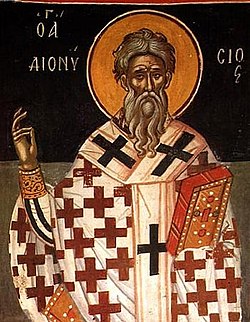 Hieromartyr Dionysius of Alexandria, Patriarch of Alexandria.
 Martyr Charitina of Amisus.
 Martyr Mamelta (Mamelchtha) of Persia.
 St. Gregory of Khandzta.
 St. Damian the Healer of the Kiev Caves.
 St. Jeremiah of the Kiev Caves.
 St. Matthew of the Kiev Caves.
 Nun Agnia (Countess Anna Orlova-Chesmenskaya) of Novgorod.

.jpg)
_of_Persia_(Menologion_of_Basil_II).jpg)
.JPG)


.jpg)

Notes
- The notation Old Style or (OS) is sometimes used to indicate a date in the Julian Calendar (which is used by churches on the "Old Calendar").
The notation New Style or (NS), indicates a date in the Revised Julian calendar (which is used by churches on the "New Calendar"). - "At Treves, the holy martyrs Palmatius and his companions, who suffered martyrdom in the persecution of Diocletian, under the governor Rictiovarus."[9]
- He succeeded St Odo as Abbot of Cluny in France in 942. However, after about ten years he became blind and resigned his office to St Majolus, setting for all an example of resignation for the rest of his life.
- Born in Tarazona near Saragossa in Spain, he became a monk at Moreruela with St Froilan. The two dioceses of Leon and Zamora vacant, Froilan was appointed to the former and Attilanus to the latter and they were consecrated together at Pentecost 990.
- See: (in Russian) Дамиан Целебник. Википедии. (Russian Wikipedia).
- See: (in Russian) Иеремия Печерский. Википедии. (Russian Wikipedia).
- See: (in Russian) Матфей Прозорливый. Википедии. (Russian Wikipedia).
- See: (in Romanian) Paisie Olaru. Wikipedia. (Romanian Wikipedia).