Offshore crane shock absorber
From Wikipedia, the free encyclopedia
An offshore crane shock absorber is a gas spring with hydraulic damping used to reduce dynamic loads during offshore lifting. The lifting capacity of the offshore crane can be increased significantly during lifting in high sea states if a shock absorber is fitted. [1]
Offshore lifting capacity is governed by classification society rules. The fundamental rule is that the design load should not be exceeded. The design load is given by:
Where:
- Crane design load
- Dynamic coefficient
- Safe working load
- Acceleration of gravity
The classification societies require that ≥1.3 for offshore cranes. This means that cannot exceed even for platform lifts.[2][3][4]


Dynamic load
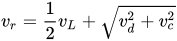
To calculate the dynamic load the classification societies use energy equations. The kinetic energy of the load is expressed as:
, or alternatively as potential energy .
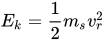

Where:
- Kinetic energy of the load
- Relative velocity between crane hook and load


- Free fall distance of payload (typically due to slack slings)
Energy absorbed by the crane is given by:


Where:
- Spring energy stored in crane structure
- Stiffness of offshore crane
- Vertical displacement of crane hook
The spring force is given by:


Combining the two previous equations yields an alternative description of the energy stored in the crane structure:
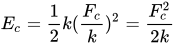
During an offshore lift the crane does not start to absorb energy from the load before the force in the crane wire exceeds the static weight of the load, which means that we can write the energy absorption of the crane as:
Setting equal to :
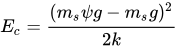
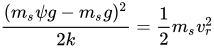
And solving for :
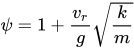
The dynamic factor will always be larger than 1 because there will always be a velocity difference between the crane hook and the load during offshore lifts. The value of determines the lifting capacity as a function of which is dependent on the significant wave height.
If the offshore crane has a shock absorber mounted it will absorb energy according to:[1]

Where:
- Energy absorbed by shock absorber
- Stroke utilization (safety factor), standard value 0.9
- Efficiency of shock absorber, typically 0.5 to 0.7 and depending on payload speed, and 0.9 and beyond for pure shock absorbers
- Stroke length
Adding this to the energy balance yields:



Again solving for ψ:
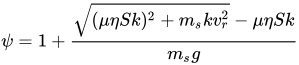
The plot to the right shows the effect of the shock absorber stroke length.