Passive heave compensation
From Wikipedia, the free encyclopedia
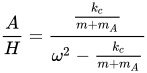
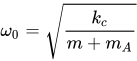
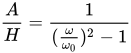
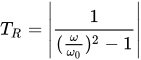
Passive heave compensation is a technique used to reduce the influence of waves upon lifting and drilling operations.[1] A simple passive heave compensator (PHC) is a soft spring which utilizes spring isolation to reduce transmissibility to less than 1.[2] PHC differs from AHC by not consuming external power.
The main principle in PHC is to store the energy from the external forces (waves) influencing the system and dissipate them or reapply them later. Shock absorbers or drill string compensators are simple forms of PHC, so simple that they are normally named heave compensators, while "passive" is used about more sophisticated hydraulic or mechanical systems.
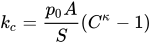
A typical PHC device consists of a hydraulic cylinder and a gas accumulator. When the piston rod extends it will reduce the total gas volume and hence compress the gas that in turn increases the pressure acting upon the piston. The compression ratio is low to ensure low stiffness. A well designed PHC device can achieve efficiencies above 80 percent, and in some cases above 90%, especially if the submerged weight is low compared to the weight in air.[3]