Persoonia marginata
From Wikipedia, the free encyclopedia
| Clandulla geebung | |
|---|---|
 | |
| Persoonia marginata in the ANBG | |
Scientific classification  | |
| Kingdom: | Plantae |
| Clade: | Tracheophytes |
| Clade: | Angiosperms |
| Clade: | Eudicots |
| Order: | Proteales |
| Family: | Proteaceae |
| Genus: | Persoonia |
| Species: | P. marginata |
| Binomial name | |
| Persoonia marginata | |
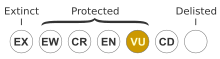
Persoonia marginata, commonly known as the Clandulla geebung, is a plant in the family Proteaceae and is endemic to New South Wales, Australia. It is a low, spreading shrub with elliptic to egg-shaped leaves and small groups of cylindrical yellow flowers.
Persoonia marginata is a low, spreading shrub which grows to a height of 0.5 m (2 ft) and a width of 1 m (3 ft). Its young branches and leaves are moderately hairy but become glabrous with age. The leaves are arranged alternately and are elliptic to egg-shaped with the narrower end towards the base. They are 20–40 mm (0.8–2 in) long, 6–23 mm (0.2–0.9 in) wide and both surfaces are the same colour. The flowers are arranged in groups of between two and four mostly at the base of leaves. The groups have a stalk up to 6 mm (0.2 in) long, each flower with a moderately hairy pedicel which is 2–7 mm (0.08–0.3 in) long. The flower is composed of four yellow, slightly hairy tepals which are 8–12 mm (0.3–0.5 in) long, which are fused at the base but with the tips rolled back. The central style is surrounded by four yellow anthers which are also joined at the base with the tips rolled back, so that it resembles a cross when viewed end-on. The ovary is densely covered with grey hairs. Flowering occurs in January and February and is followed by fruit which are smooth green drupes.[2][3][4]
Taxonomy and naming
Persoonia marginata was first formally described in 1830 by Robert Brown from an unpublished description by Allan Cunningham. Brown's description was published in Supplementum primum Prodromi florae Novae Hollandiae.[1][5] The specific epithet (marginata) is a Latin word meaning "furnished with a border".[6]