Portal:Washington, D.C.
Wikipedia portal for content related to Washington, D.C.
From Wikipedia, the free encyclopedia

The Washington, D.C. portal

Washington, D.C., officially the District of Columbia and commonly known as simply Washington or D.C., is the capital city and federal district of the United States. The city is on the Potomac River across from Virginia and shares land borders with Maryland to its north and east. It was named after George Washington, a Founding Father and the first president of the United States. The district is named for Columbia, the female personification of the nation, through which human form and attributes are applied to the United States.
The U.S. Constitution in 1789 called for the creation of a federal district under exclusive jurisdiction of the U.S. Congress. As such, Washington, D.C., is not part of any state, and is not one itself. The Residence Act, adopted on July 16, 1790, approved the creation of the capital district along the Potomac River, and is considered the city's founding date. In 1800, when the capital was moved from Philadelphia, the 6th Congress started meeting in the then-unfinished Capitol Building, and the second president, John Adams, moved into the newly finished White House. In 1801, the District of Columbia, formerly part of Maryland and Virginia and including the existing settlements of Georgetown and Alexandria, was officially made the federal district; initially, the city was a separate settlement within the larger district. In 1846, Congress reduced the size of the district when it returned the land that Virginia had ceded, including the city of Alexandria. In 1871, it made the entire district into a single municipality. There have been several failed efforts to reduce the district further and admit the rest as a state since the 1880s, including a statehood bill that passed the House of Representatives in 2021 but was not adopted by the U.S. Senate.
Washington, D.C., anchors the southern end of the Northeast megalopolis. As the seat of the U.S. federal government, the city is an important world political capital. The city hosts buildings that house federal government headquarters, including the White House, U.S. Capitol, Supreme Court Building, and multiple federal departments and agencies. The city is home to many national monuments and museums, located most prominently on or around the National Mall, including the Jefferson Memorial, Lincoln Memorial, and Washington Monument. It hosts 177 foreign embassies and the global headquarters of the World Bank, International Monetary Fund, Organization of American States, and other international organizations. Home to many of the nation's largest industry associations, non-profit organizations, and think tanks, the city is known as a lobbying hub, which is centered on and around K Street. It is also among the country's top tourist destinations; in 2022, it had an estimated 20.7 million domestic and 1.2 million international visitors, the seventh-most among U.S. cities. (Full article...)
 Featured article

![Image 1 Jordan in 2014Michael Jeffrey Jordan (born February 17, 1963), also known by his initials MJ, is an American businessman and retired professional basketball player who is a minority owner of the Charlotte Hornets of the National Basketball Association (NBA). He played 15 seasons in the NBA between 1984 and 2003, winning six NBA championships with the Chicago Bulls. Widely considered to be one of the greatest basketball players of all time, he was integral in popularizing basketball and the NBA around the world in the 1980s and 1990s. He is the wealthiest athlete of all time, and one of the world's richest celebrities, with a $4.3 billion net worth as of 2026[update]. (Full article...)](//upload.wikimedia.org/wikipedia/en/d/d2/Blank.png)
Michael Jeffrey Jordan (born February 17, 1963), also known by his initials MJ, is an American businessman and retired professional basketball player who is a minority owner of the Charlotte Hornets of the National Basketball Association (NBA). He played 15 seasons in the NBA between 1984 and 2003, winning six NBA championships with the Chicago Bulls. Widely considered to be one of the greatest basketball players of all time, he was integral in popularizing basketball and the NBA around the world in the 1980s and 1990s. He is the wealthiest athlete of all time, and one of the world's richest celebrities, with a $4.3 billion net worth as of 2026[update]. (Full article...)
Andrew Jackson (March 15, 1767 – June 8, 1845) was the seventh president of the United States from 1829 to 1837. He rose to fame as a U.S. Army general and served in both houses of the U.S. Congress. His political philosophy, which dominated his presidency, became the basis for the rise of Jacksonian democracy. His legacy is controversial: he has been praised as an advocate for white working Americans and preserving the union of states, and criticized for his racist policies, particularly towards Native Americans. (Full article...)
The Georgetown Car Barn, historically known as the Capital Traction Company Union Station, is a building in the Georgetown neighborhood of Washington, D.C., in the United States. Designed by the architect Waddy Butler Wood, it was built between 1895 and 1897 by the Capital Traction Company as a union terminal for several Washington and Virginia streetcar lines. The adjacent Exorcist steps, later named after their appearance in William Friedkin's 1973 horror film The Exorcist, were built during the initial construction to connect M Street with Prospect Street. (Full article...)
James Abram Garfield (November 19, 1831 – September 19, 1881) was the 20th president of the United States, serving from March 1881 until his death in September that year after being shot in July. A preacher, lawyer, and Civil War general, Garfield served nine terms in the United States House of Representatives and is the only sitting member of the House to be elected president. Before he ran for president, the Ohio General Assembly had elected him to the U.S. Senate, a position he declined upon becoming president-elect. (Full article...)
Stanley Anthony Coveleski (born Stanislaus Kowalewski, July 13, 1889 – March 20, 1984) was an American right-handed pitcher in Major League Baseball who played for four American League (AL) teams between 1912 and 1928, primarily the Cleveland Indians. The star of the Indians pitching staff, he won over 20 games each year from the war-shortened 1918 season through 1921, leading the AL in shutouts twice and in strikeouts and earned run average (ERA) once each during his nine years with the club. The star of the 1920 World Series, he led the Indians to their first title with three complete-game victories, including a 3–0 shutout in the Game 7 finale. Traded to the Washington Senators after the 1924 season, he helped that club to its second AL pennant in a row with 20 victories against only 5 losses, including a 13-game winning streak, while again leading the league in ERA. (Full article...)
Bernard A. Maguire SJ (February 11, 1818 – April 26, 1886) was an Irish-American Catholic priest and Jesuit who served twice as the president of Georgetown University. Born in Ireland, he emigrated to the United States at the age of six, and his family settled in Maryland. Maguire attended Saint John's College in Frederick, Maryland, and then entered the Society of Jesus in 1837. He continued his studies at Georgetown University, where he also taught and was prefect, until his ordination to the priesthood in 1851. (Full article...)
Giovanni Antonio Grassi SJ (anglicized as John Anthony Grassi; 10 September 1775 – 12 December 1849) was an Italian Catholic priest and Jesuit who led many academic and religious institutions in Europe and the United States, including Georgetown College in Washington, D.C., and the Pontificio Collegio Urbano de Propaganda Fide in Rome. (Full article...)
Thomas F. Mulledy SJ (/mʌˈleɪdi/ muh-LAY-dee; August 12, 1794 – July 20, 1860) was an American Catholic priest and Jesuit who became the president of Georgetown College, a founder of the College of the Holy Cross, and a Jesuit provincial superior. His brother, Samuel Mulledy, also became a Jesuit and president of Georgetown. (Full article...)
Otto Everett Graham Jr. (December 6, 1921 – December 17, 2003) was an American professional football player who was a quarterback for the Cleveland Browns in the All-America Football Conference (AAFC) and National Football League (NFL) for 10 seasons. Graham is regarded by critics as one of the most dominant players of his era and one of the greatest quarterbacks of all time, having taken the Browns to league championship games every year between 1946 and 1955, making ten championship appearances, and winning seven of them. With Graham at quarterback, the Browns posted a record of 105 wins, 17 losses, and 4 ties, including a 9–3 win–loss record in the AAFC and NFL playoffs. Long-time New York Yankees owner George Steinbrenner, a friend of Graham's, once called him "as great of a quarterback as there ever was." (Full article...)
Francis Ignatius Neale SJ (June 3, 1756 – December 20, 1837), also known as Francis Xavier Neale, was an American Catholic priest and Jesuit who led several academic and religious institutions in Washington, D.C., and Maryland. He played a substantial role in the Jesuit order's resurgence in the United States. (Full article...)- On June 19, 1838, the Maryland Province of the Society of Jesus agreed to sell 272 slaves to two Louisiana planters, Henry Johnson and Jesse Batey, for $115,000 (equivalent to approximately $3.34 million in 2024). This sale was the culmination of a contentious and long-running debate among the Maryland Jesuits over whether to keep, sell, or free their slaves, and whether to focus on their rural estates or on their growing urban missions, including their schools. (Full article...)
Harmon Clayton Killebrew Jr. (/ˈkɪlɪbruː/; June 29, 1936 – May 17, 2011), nicknamed "the Killer" and "Hammerin' Harmon", was an American professional baseball player as a first baseman, third baseman, and left fielder. He spent most of his 22-year career in Major League Baseball (MLB) with the Minnesota Twins. A prolific power hitter, Killebrew had the fifth-most home runs in major league history at the time of his retirement. He was second only to Babe Ruth in American League (AL) home runs, and was the AL career leader in home runs by a right-handed batter. Killebrew was inducted into the National Baseball Hall of Fame in 1984. (Full article...)
Nativity, c. mid-1450s. Oil on wood, 127.6 cm × 94.9 cm (50.2 in × 37.4 in), National Gallery of Art, Washington, D.C.
The Nativity is a devotional mid-1450s oil-on-wood panel painting by the Early Netherlandish painter Petrus Christus. It shows a nativity scene with grisaille archways and trompe-l'œil sculptured reliefs. Christus was influenced by the first generation of Netherlandish artists, especially Jan van Eyck and Rogier van der Weyden, and the panel is characteristic of the simplicity and naturalism of art of that period. Placing archways as a framing device is a typical van der Weyden device, and here likely borrowed from that artist's Saint John Altarpiece and Miraflores Altarpiece. Yet Christus adapts these painterly motifs to a uniquely mid-15th century sensibility, and the unusually large panel – perhaps painted as a central altarpiece panel for a triptych – is nuanced and visually complex. It shows his usual harmonious composition and employment of one-point-perspective, especially evident in the geometric forms of the shed's roof, and his bold use of color. It is one of Christus's most important works. Max Friedländer definitely attributed the panel to Christus in 1930, concluding that "in scope and importance, [it] is superior to all other known creations of this master." (Full article...)
In Maryland and Washington, D.C., the effects of Hurricane Isabel were among the most damaging from a tropical cyclone in the respective metropolitan area. Hurricane Isabel formed from a tropical wave on September 6, 2003, in the tropical Atlantic Ocean. It moved northwestward, and within an environment of light wind shear and warm waters, it steadily strengthened to reach peak winds of 165 miles per hour (266 km/h) on September 11. After fluctuating in intensity for four days, Isabel gradually weakened and made landfall on the Outer Banks of North Carolina with winds of 105 miles per hour (169 km/h) on September 18. It quickly weakened over land and became extratropical over western Pennsylvania the next day. (Full article...)
James Madison (March 16, 1751 [O.S. March 5, 1750] – June 28, 1836) was an American statesman, diplomat, and Founding Father who served as the fourth president of the United States from 1809 to 1817. Madison was popularly acclaimed as the "Father of the Constitution" for his pivotal role in drafting and promoting the Constitution of the United States and the Bill of Rights. (Full article...)
William Feiner SJ (born Wilhelm Feiner; December 27, 1792 – June 9, 1829) was a German Catholic priest and Jesuit who became a missionary to the United States and eventually the president of Georgetown College, now known as Georgetown University. (Full article...)
Joseph Havens Richards SJ (born Havens Cowles Richards; November 8, 1851 – June 9, 1923) was an American Catholic priest and Jesuit who became a prominent president of Georgetown University, where he instituted major reforms and significantly enhanced the quality and stature of the university. Richards was born to a prominent Ohio family; his father was an Episcopal priest who controversially converted to Catholicism and had the infant Richards secretly baptized as a Catholic. (Full article...)- William Matthews (December 16, 1770 – April 30, 1854), occasionally spelled Mathews, was an American Catholic priest who was the fifth ordained in the United States and the first born in British America. (Full article...)
- Look Mickey (also known as Look Mickey!) is a 1961 oil on canvas painting by Roy Lichtenstein. Widely regarded as the bridge between his abstract expressionism and pop art works, it is notable for its ironic humor and aesthetic value as well as being the first example of the artist's employment of Ben-Day dots, speech balloons and comic imagery as a source for a painting. The painting was bequeathed to the Washington, D.C., National Gallery of Art upon Lichtenstein's death. (Full article...)
Juwan Antonio Howard (/dʒuːˈwɑːn/ joo-WAWN) (born February 7, 1973) is an American professional basketball coach and former player, currently an assistant coach for the Brooklyn Nets of the National Basketball Association (NBA). He was previously the head coach at the University of Michigan from 2019 until 2024. Howard played college basketball for the Michigan Wolverines as a member of the Fab Five, and was selected with the fifth overall pick in the 1994 NBA draft by the Washington Bullets. Howard had a 19-year NBA career with eight different teams, winning two NBA championships with the Miami Heat, as well as earned All-Star and All-NBA honors with the Bullets in 1996. (Full article...)
John William Beschter SJ (born Johann Wilhelm Beschter; German: [ˈjoːhan ˈvɪlhɛlm ˈbɛʃtɐ]; May 20, 1763 – January 6, 1842) was a Catholic priest and Jesuit from the Duchy of Luxembourg in the Austrian Netherlands. He emigrated to the United States as a missionary in 1807, where he ministered in rural Pennsylvania and Maryland. Beschter was the last Jesuit pastor of St. Mary's Church in Lancaster, as well as the pastor of St. John the Evangelist Church in Baltimore, Maryland. He was also a priest at several other German-speaking churches in Pennsylvania. (Full article...)
William McSherry SJ (July 19, 1799 – December 18, 1839) was an American Catholic priest and Jesuit who became the president of Georgetown College and a Jesuit provincial superior. The son of Irish immigrants, McSherry was educated at Georgetown College, where he entered the Society of Jesus. As one of the first Americans to complete the traditional Jesuit course of training, he was sent to Rome to be educated for the priesthood. There, he made several discoveries of significant, forgotten holdings in the Jesuit archives, which improved historians' knowledge of the early European settling of Maryland and of the language of Indian tribes there. (Full article...)
Charles Henry Stonestreet SJ (November 21, 1813 – July 3, 1885) was an American Catholic priest and Jesuit who served in prominent religious and academic positions, including as provincial superior of the Jesuit Maryland Province and president of Georgetown University. He was born in Maryland and attended Georgetown University, where he co-founded the Philodemic Society. After entering the Society of Jesus and becoming a professor at Georgetown, he led St. John's Literary Institution and St. John the Evangelist Church in Frederick, Maryland. He was appointed president of Georgetown University in 1851, holding the office for two years, during which time he oversaw expansion of the university's library. The First Plenary Council of Baltimore was held at Georgetown during his tenure. (Full article...)
On February 17, 1974, U.S. Army Private First Class Robert Kenneth Preston (1953–2009) took off in a stolen Bell UH-1B Iroquois "Huey" helicopter from Tipton Field, Maryland, and landed it on the South Lawn of the White House in a significant breach of security. Preston had enlisted in the Army to become a helicopter pilot. However, he did not graduate from the helicopter training course and lost his opportunity to attain the rank of warrant officer pilot. His enlistment bound him to serve four years in the Army, and he was sent to Fort Meade as a helicopter mechanic. Preston believed this situation was unfair and later said he stole the helicopter to show his skill as a pilot. (Full article...)
The first inauguration of Barack Obama as the 44th president of the United States took place on Tuesday, January 20, 2009, at the West Front of the United States Capitol in Washington, D.C. The 56th inauguration, which set a record attendance for any event held in the city, marked the commencement of the first term of Barack Obama as president and Joe Biden as vice president. Based on combined attendance numbers, television viewership, and Internet traffic, it was the most viewed inauguration since that of Ronald Reagan in 1981. (Full article...)
![Image 1 Jordan in 2014Michael Jeffrey Jordan (born February 17, 1963), also known by his initials MJ, is an American businessman and retired professional basketball player who is a minority owner of the Charlotte Hornets of the National Basketball Association (NBA). He played 15 seasons in the NBA between 1984 and 2003, winning six NBA championships with the Chicago Bulls. Widely considered to be one of the greatest basketball players of all time, he was integral in popularizing basketball and the NBA around the world in the 1980s and 1990s. He is the wealthiest athlete of all time, and one of the world's richest celebrities, with a $4.3 billion net worth as of 2026[update]. (Full article...)](#/media/File:Blank.png)

.jpg)
.jpg)


.jpg)


.jpg)


.jpg)


Neighboorhoods
Langdon is a neighborhood located in Ward 5 of Northeast Washington, D.C. Historical surveys of D.C. recognize Langdon as a neighborhood dating back to at least 1903. Langdon is bounded by Montana Ave. NE to the west/southwest, New York Ave. NE to the south, Bladensburg Rd. NE to the southeast, South Dakota Ave. NE to the northeast, and Rhode Island Ave. NE to the north/northwest. Langdon is adjacent to the Northeast D.C. neighborhoods of Brentwood (west), Woodridge (east), Fort Lincoln (southeast), Gateway (south), and Brookland (north). (Full article...)
Greenway is a residential neighborhood in Southeast Washington, D.C., in the United States. The neighborhood is bounded by East Capitol Street SE, Interstate 295 SE, Fairlawn Avenue SE, Minnesota Avenue SE, Pennsylvania Avenue SE, (Full article...)
Observatory Circle is a street and neighborhood in Washington, D.C. The street runs from Calvert Street to Massachusetts Avenue near 34th Street. Established in 1894, the street follows an incomplete loop, forming an arc rather than a circle. The street surrounds the grounds of the United States Naval Observatory, which includes Number One Observatory Circle, the official residence of the Vice President of the United States. Areas around the Observatory are also referred to as Observatory Circle, bounded on the northeast by Massachusetts Avenue; on the south by Calvert Street, the Observatory Circle property, and Whitehaven Street; and on the west by 37th Street. (Full article...)
Capitol View is a neighborhood located in southeast Washington, D.C., in the United States. It is bounded by East Capitol Street to the north, Central Avenue SE to the southwest and south, and Southern Avenue SE to the southeast. (Full article...)
Near Northeast, also known as Néné, is a neighborhood in Northeast Washington, D.C. It is bounded by North Capitol Street to the west, Florida Avenue to the north, F Street to the south, and 15th Street to the east. (Full article...)
Good Hope is a residential neighborhood in southeast Washington, D.C., near Anacostia. The neighborhood is generally middle class and is dominated by single-family detached and semi-detached homes. The year-round Fort Dupont Ice Arena skating rink and the Smithsonian Institution's Anacostia Museum are nearby. Good Hope is bounded by Fort Stanton Park(Fort Circle Hiker-Biker Trail) SE, Alabama Avenue SE, Naylor Road SE, and U Street SE. The proposed Skyland Shopping Center redevelopment project is within the boundaries of the neighborhood. (Full article...)
Kenilworth is a residential neighborhood in Northeast Washington, D.C., located on the eastern bank of the Anacostia River and just inside the D.C.–Maryland border. A large public housing complex, Kenilworth Courts, dominates the area. The neighborhood is famous for the Kenilworth Park and Aquatic Gardens, a national park whose centerpiece is a series of ponds carved out of Anacostia River marshland. Visitors come especially during June and July to see the beautiful blooming water lilies and lotus flowers. In 1895, the name "Kenilworth" was first applied to the area by real estate developer Allen Mallery, who named this neighborhood after Kenilworth Castle in England, the ruins of which can still be seen today in Warwickshire. Kenilworth Park, which includes the Kenilworth-Parkside Recreation Center, also carries the neighborhood name, though most of the park's area is actually located adjacent to the modern neighborhoods of Parkside and Eastland Gardens. (Full article...)
Woodland is a small residential and industrial neighborhood in Southeast Washington, D.C. Woodland lies in Washington's Ward 8, among the poorest and least developed of the city's wards. Like the neighborhoods around it, Woodland is almost exclusively African American. Woodland is bounded by Ainger Place SE to the north; Alabama Avenue SE and Knox Place SE to the east; Hartford Street SE to the south; and Langston Place SE, Raynolds Place SE, and Erie Street SE to the southwest. Fort Stanton Park forms the northwest and northern border of the neighborhood. (Full article...)
Stronghold. Intersection of North Capitol St. and Franklin St. NE, April 2019
Stronghold is a neighborhood in Ward 5 of Northeast Washington D.C. Stronghold is contained between Michigan Avenue N.E. to the north, North Capitol Street N.W. to the west, and Glenwood Cemetery to both the south and east. Stronghold borders the adjacent neighborhoods of Edgewood, University Heights, and Brookland in Ward 5 of Northeast Washington D.C. (Full article...)
Benning is a residential neighborhood located in Ward 7 of Northeast Washington, D.C. It is bounded by East Capitol Street to the south, Minnesota Avenue to the west, and Benning Road (for which the neighborhood is named) on the north and east. It is served by the Benning Road station on the Blue and Silver Lines of the Washington Metro. (Full article...)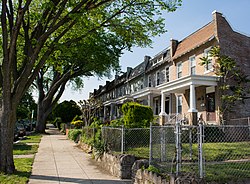
Hill East is a residential neighborhood in Washington, D.C. located in the Southeast quadrant of the city. It is bounded by the Kingman Park neighborhood at C Street to the north, by the Anacostia River to the east and south, and by Capitol Hill at 15th Street to the west. Hill East includes landmarks such as the Congressional Cemetery, the former RFK Stadium, and the D.C. Armory. It will be home to the future $3.7 billion New Commanders Stadium mixed-use development project. (Full article...)
Mount Pleasant is a neighborhood in Washington, D.C., located in Northwest D.C. The neighborhood is primarily residential, with restaurants and stores centered along a commercial corridor on Mt. Pleasant Street. Mount Pleasant is known for its unique identity and multicultural landscape, home to diverse groups such as the punk rock, the Peace Corps and Hispanic Washingtonian communities. (Full article...)
Deanwood is a neighborhood in Northeast Washington, D.C., bounded by Eastern Avenue to the northeast, Kenilworth Avenue to the northwest, Division Avenue to the southeast, and Nannie Helen Burroughs Avenue to the south. (Full article...)
Wakefield is a neighborhood in the Upper Northwest quadrant of Washington, D.C., bounded by Albemarle Street NW to the south, Nebraska Avenue NW to the west, and Connecticut Avenue to the east. It is served by the Van Ness-UDC and Tenleytown-AU station on the Washington Metro's Red Line. (Full article...)
Bellevue is a residential neighborhood in far Southeast and Southwest in Washington, D.C., United States. It is bounded by South Capitol Street, one block of Atlantic Street SE, and 1st Streets SE and SW to the north and east; Joliet Street SW and Oxon Run Parkway to the south; Martin Luther King Jr. Avenue SE, Shepherd Parkway, 2nd Street SW, and Xenia Street SW to the west. Bellevue was created from some of the earliest land patents in Maryland, and draws its name from a 1795 mansion built in the area. Subdivisions began in the 1870s, but extensive residential building did not occur until the early 1940s. Bellevue is adjacent to a number of federal and city agency buildings. (Full article...)
Pleasant Plains is a neighborhood in central Washington, D.C. largely occupied by Howard University. For this reason it is also sometimes referred to as Howard Town or, less frequently, Howard Village. (Full article...)


_(cropped).jpg)


Selected image
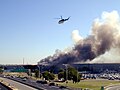 The Pentagon following the September 11 attacks with the Washington Monument visible in the background (from History of Washington, D.C.)
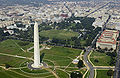 The Washington Monument (forefront) and White House (center) in September 2003. Since 1961, the city's residents can vote for the U.S. president and vice president, who also serves as President of the Senate. (from Washington, D.C.)
 The John A. Wilson Building on Pennsylvania Avenue, headquarters for much of the Government of the District of Columbia, including the offices of the mayor and D.C. Council (from Washington, D.C.)
 Map of the District of Columbia in 1835, prior to the retrocession (from History of Washington, D.C.)
 An aerial view of Northwest Washington, D.C. in June 2018 (from Washington, D.C.)
 The city's African American population has declined since the 1968 riots. (from Washington, D.C.)
 The Northeast Boundary No. 4 marker stone of the original border between the District of Columbia and Prince George's County, Maryland (from History of Washington, D.C.)
 The World War II Memorial, one of many popular tourist sites located on the National Mall (from Washington, D.C.)
 Eastward view of the National Mall from the top of the Washington Monument in 1918. The three structures and two chimneys crossing the Mall are temporary World War I buildings A, B and C and parts of their central power plant. (from National Mall)
 Demonstrators marching down Pennsylvania Avenue towards the United States Capitol on January 6, 2021 (from History of Washington, D.C.)
 The first inauguration of Barack Obama on January 20, 2009, facing west from the Capitol (from National Mall)
 One Franklin Square in Downtown houses the headquarters of The Washington Post, the nation's third-largest newspaper by circulation as of 2023 (from Washington, D.C.)
 The Washington Monument viewed from the Tidal Basin during the National Cherry Blossom Festival in April 2018 (from Washington, D.C.)

 Map of racial distribution in the Washington metropolitan area, according to the 2010 U.S. census; each dot represents 25 people: White, Black, Asian, Hispanic or Other (yellow) (from Washington, D.C.)
 The Eisenhower Executive Office Building, built between 1871 and 1888, was the world's largest office building until 1943, when it was surpassed by The Pentagon. (from Washington, D.C.)
 The West side of the U.S. Capitol building, March 2019 (from National Mall)
 Dupont Circle (from Washington, D.C.)
 1963 March on Washington for Jobs and Freedom on the National Mall facing east from the Lincoln Memorial (from National Mall)
 The Library of Congress, the world's largest library, has more than 173 million items. (from Washington, D.C.)
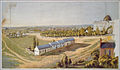 A portrait of the Mall and vicinity looking northwest from southeast of the U.S. Capitol, circa 1846–1855. Stables are in the foreground, the Washington City Canal behind them, the Capitol on the right and the Smithsonian "Castle", the Washington Monument and the Potomac River in the distant left. (from National Mall)
 After their victory at the Battle of Bladensburg in 1814, the British burned the White House and other federal buildings during a one-day occupation of Washington. (from Washington, D.C.)
 The Mall following a snow storm (from National Mall)
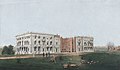 An 1814 watercolor illustration of the United States Capitol after the burning of Washington during the War of 1812 (from History of Washington, D.C.)
 City of Washington from Beyond the Navy Yard, an 1833 portrait by George Cooke in the Oval Office in the White House (from History of Washington, D.C.)
 Smithsonian Carousel after restoration, Washington, DC. April 27, 2026 (from National Mall)
 The Sylvan Theater in 2011 (from National Mall)
 The Washington Monument stood in this unfinished form for 25 years before being completed in 1884. Upon its completion, it was the tallest man-made structure in the world. (from History of Washington, D.C.)
 Looking east from the top of the Washington Monument towards the Mall and the U.S. Capitol, 2023 (from National Mall)
 The National Mall proper and adjacent areas, April 2002. The Mall had a grassy lawn flanked on each side by unpaved paths and rows of American elm trees as its central feature. Numbers in the image correspond to numbers in the list of landmarks, museums and other features below. (from National Mall)
 Construction of the Washington Metro on Connecticut Avenue in 1973 (from History of Washington, D.C.)
 The Washington Monument and various Smithsonian museums on the National Mall as viewed facing west from the United States Capitol (from National Mall)
 Facing east on the National Mall, as viewed near the 1300 block of Jefferson Drive, S.W. in April 2010. Rows of American elm trees line the sides of a path traversing the length of the Mall. (from National Mall)
 The Andrew Jackson Downing Urn in May 2012 (from National Mall)
 Lincoln Memorial Reflecting Pool before reconstruction (April 2010) (from National Mall)
 Axis undergoing restoration (October 2015) (from National Mall)
 Ben's Chili Bowl on U Street, known for its half-smoke, a historic staple of the city's cuisine (from Washington, D.C.)
 Washington Metro, the second-busiest rapid rail system in the U.S. based on average weekday ridership, is known for its iconic vaulted ceilings (from Washington, D.C.)
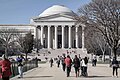 The National Gallery of Art, the fourth-most visited art museum in the United States in 2023 with nearly four million visitors (from Washington, D.C.)
 A map of the Mall in 1893 showing the Monument Grounds (with the Washington Monument), Agricultural Grounds (with the Dept. of Agriculture), Smithsonian Grounds (with the Castle and Arts and Industries museum), Armory Square, Public Grounds and Botanical Garden, and parts of the recently created "Tidal Reservoir" and "Proposed Park". (from National Mall)
 Protesters in front of the U.S. Supreme Court Building in June 2022 (from Washington, D.C.)
 Eisenhower Memorial at night, 2021 (from National Mall)
 Reserve area designated by the Commemorative Works Clarification and Revision Act (from National Mall)
 Civil rights marchers during the March on Washington at the Lincoln Memorial on August 28, 1963 (from History of Washington, D.C.)
 Westward view from the top of the Washington Monument in 1943 or 1944 during World War II. In the foreground, temporary buildings on the Washington Monument grounds house the Navy's Bureau of Ships. The Main Navy and Munitions Buildings stand to the right of the Lincoln Memorial Reflecting Pool. Temporary buildings to the left of the Reflecting Pool house the Navy's Bureau of Supplies and Accounts. (from National Mall)
 President Abraham Lincoln insisted that construction of the United States Capitol continue during the Civil War. (from History of Washington, D.C.)
 The L'Enfant Plan for the city (from History of Washington, D.C.)
- The Jefferson Memorial and many of the city's other major monuments are built in the Neoclassical style. (from Washington, D.C.)
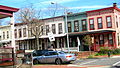 Anacostia (from Washington, D.C.)
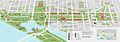 A map of the National Mall and vicinity(from National Mall)
 Logan Circle (from Washington, D.C.)
 National Mall, a landscaped park extending from the Lincoln Memorial to the United States Capitol (from Washington, D.C.)
 The southern portion of the National Mall in 1863 during the American Civil War (from History of Washington, D.C.)
 This view from the top of the Washington Monument shows rows of elm trees lining the Lincoln Memorial Reflecting Pool (November 2014). (from National Mall)
 The National Mall was the centerpiece of the 1902 McMillan Plan. A central open vista traversed the length of the Mall. (from National Mall)
 Britney Spears performs during the "NFL Kickoff Live from the National Mall Presented by Pepsi Vanilla" concert, September 4, 2003 (from National Mall)
- The National Mall, including a central pathway through it, the centerpiece of the 1901 McMillan Plan (from History of Washington, D.C.)

 The Eccles Building on Constitution Avenue, home of the Federal Reserve, the central bank of the United States (from Washington, D.C.)
 Edgewood (from Washington, D.C.)
 Pool after reconstruction (May 2016) (from National Mall)
 The Aqueduct Bridge crossing the Potomac River, with Northern Virginia in the background and the Chesapeake and Ohio Canal in the foreground (from History of Washington, D.C.)
 A major bus strike in May 1974 caused huge traffic jams throughout the city (from History of Washington, D.C.)
 The National Museum of Natural History, the third-most visited museum in the U.S. in 2023, with 4.4 million visitors (from Washington, D.C.)
 Chinatown (from Washington, D.C.)
 The National Building Museum (from Washington, D.C.)
 John F. Kennedy Center for the Performing Arts (from National Mall)
 With over 30,000 participants as of 2024, the annual Marine Corps Marathon, held annually in October in Washington, D.C. and Arlington County, is the largest non-prize money marathon in the country. (from Washington, D.C.)
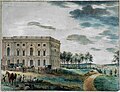 In 1800, the United States Congress began assembling in the new United States Capitol after the nation's capital was moved from Philadelphia, which served as the capital during the American Revolution and again from 1790 to 1800. (from Washington, D.C.)
 General Dwight D. Eisenhower received a hero's welcome in the city in June 1945 following the Allied victory in World War II (from History of Washington, D.C.)
 Territorial progression of Washington, D.C. (from History of Washington, D.C.)
 Muriel Bowser, the city's mayor since 2015 (from Washington, D.C.)
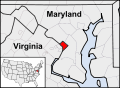 Washington, D.C. is located on the north side of the Potomac River. It is bordered on three sides by Maryland and by Northern Virginia to its southwest. (from Washington, D.C.)
 Capital One Arena in the city's Chinatown section hosts the Washington Capitals, an NHL team (pictured), and the Washington Wizards, an NBA team (from Washington, D.C.)
 The National Mall viewed from the Lincoln Memorial, July 2023 (from National Mall)
 Library of Congress(from National Mall)
The "Grand Avenue" or Mall as proposed by Pierre L'Enfant, 1791- Reading Room at the Library of Congress (from National Mall)
 The city's license plate, which calls for an end to taxation without representation (from Washington, D.C.)
 Constitution Gardens in 2016 (from National Mall)
 The French ambassador's residence in the Sheridan-Kalorama Historic District (from Washington, D.C.)
 Memorial Bridge, connecting the city across the Potomac River with Arlington County (from Washington, D.C.)
 Washington, D.C., police on Harley-Davidson motorcycles escorting the March for Life protest on Constitution Avenue in January 2018 (from Washington, D.C.)
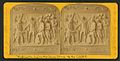 On September 18, 1793, an engraving of George Washington, known as the First Cornerstone, was placed as the corner stone of the United States Capitol. (from History of Washington, D.C.)
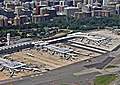 Reagan Washington National Airport in Arlington, Virginia is the closest airport to the city among the three major Washington metropolitan area airports. (from Washington, D.C.)
 The Concert for Valor on the National Mall on November 11, 2014, looking west from the U.S. Capitol grounds (from National Mall)
 The U.S. Capitol dome was under construction during Lincoln's first inauguration on March 4, 1861, five weeks before the start of the American Civil War. (from Washington, D.C.)
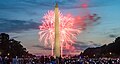 Independence Day fireworks display on the National Mall, July 4, 2022 (from National Mall)
 Due to limited dining options on the Mall, food trucks are often parked next to tourist-dense locations. (from National Mall)
 Axis after restoration (September 2016) (from National Mall)
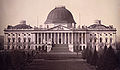 The United States Capitol in 1846, prior to the addition of the current rotunda (from History of Washington, D.C.)
 Georgetown University, founded in 1789, the city's oldest university (from Washington, D.C.)
 A performance of Moulin Rouge! at the Kennedy Center for the Performing Arts (from Washington, D.C.)
 The Vietnam Veterans Memorial, a two-acre (8,100 m2) site featuring two black granite walls engraved with the names of those service members who died or remain missing in the Vietnam War designed by Maya Lin, was initially controversial for its lack of heroic iconography, a departure from earlier memorial designs. (from Washington, D.C.)
 Navy Yard (from Washington, D.C.)
 Federal Triangle, a historic hub of executive departments of the U.S. federal government (from Washington, D.C.)
 Bloomingdale (from Washington, D.C.)
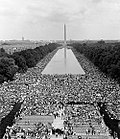 The March on Washington at the Lincoln Memorial Reflecting Pool on August 28, 1963 (from Washington, D.C.)
 Rows of young American elm trees on the National Mall, looking east from the top of the Washington Monument, circa 1942 (from National Mall)
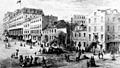
 The L'Enfant Plan for the city, developed in 1791 by Pierre Charles L'Enfant (from Washington, D.C.)
 The Blue Plains Advanced Wastewater Treatment Plant in D.C. is the largest advanced wastewater treatment facility in the world. (from Washington, D.C.)
 Pennsylvania Avenue, one of the city's most prominent streets, connects the U.S. Capitol and White House. (from Washington, D.C.)
 Columbia Heights (from Washington, D.C.)
 Capitol Hill (from Washington, D.C.)
 The April 9, 1939, concert by Marian Anderson, facing east from the Lincoln Memorial (from National Mall)
 An aerial photo of Washington, D.C. in 2007 (from History of Washington, D.C.)


.jpg)

_NE_4.jpg)


.jpg)


.png)
.jpg)
.jpg)


.jpg)


_satellite_image.jpg)


.jpg)

.jpg)


.jpg)
.jpg)


.jpg)


_(cropped).jpg)
.jpg)

.JPG)

.jpg)


.JPG)


.jpg)


.jpg)

.jpg)


.jpg)


.jpg)
.jpg)
,_b._1850.jpg)


.jpg)

_(cropped).jpg)


_(53821618777).jpg)


.jpg)


.jpg)


.jpg)
_(cropped).jpg)


Did you know...
- ... that Nobody is the highest-grossing 2D Chinese animated film?
- ... that Leonardo DiCaprio was set to star in the film adaptation of Leonardo da Vinci?
- ... that the Washington D.C. Temple was moved 60 feet (18 m) to exactly align with a nearby road?
- ... that, under O'Donoghue v. United States, Washington, D.C.'s courts are the only tribunals in the United States that might be both constitutional and legislative courts at the same time?
- ... that residents reported the first cycling club in Washington, D.C., to the police over concerns that bicycles posed a danger to pedestrians?
- ... that in one neighborhood commission district, the voters and officeholders are all inmates at the D.C. Jail?
In the news
- 10 May 2026 – Ituri conflict
- CODECO militants launched attacks in several villages in Ituri Province, Democratic Republic of the Congo, on April 28, killing 69 people. (Al Jazeera)
- 9 May 2026 – Ituri conflict
- The DR Congolese military reports that at least 69 people were killed in an attack by CODECO in Ituri Province in April. (AFP via Arab News)
- 20 April 2026 – Middle Eastern crisis
- The United States announces that another round of talks between Israel and Lebanon will be held in Washington, D.C., on April 23. (Al Jazeera)
- 20 April 2026 – Protests against the 2026 Iran war
- At least 62 U.S. military veterans are arrested by police inside the United States Capitol in Washington, D.C., during a anti-war protest against the Iran war after occupying the Cannon House Office Building. (The Hill) (Latin Times)
- 14 April 2026 – Middle Eastern crisis
- Israeli and Lebanese officials meet in Washington, D.C., U.S., for the first direct peace talks between the countries in decades, with Israel prioritizing Hezbollah's disarmament and Lebanon limiting its mandate to ceasefire discussions. (AFP via The Economic Times)
- 10 April 2026 – Middle Eastern crisis
- Preliminary talks between Lebanese and Israeli officials are planned for next week in Washington, D.C., United States. (Al Jazeera)
Categories
- Select [►] to view subcategories
Topics
Related portals


Related WikiProjects
Associated Wikimedia
The following Wikimedia Foundation sister projects provide more on this subject:
-
 Commons
Free media repository -
 Wikidata
Free knowledge base -
 Wikiquote
Collection of quotations -
 Wikisource
Free-content library -
 Wikispecies
Directory of species -
 Wikiversity
Free learning tools -
 Wikivoyage
Free travel guide -
 Wiktionary
Dictionary and thesaurus


