Portal:Cities
Wikipedia portal for content related to Cities
From Wikipedia, the free encyclopedia

The Cities Portal

A city is a human settlement of a substantial size. The term "city" has different meanings around the world and in some places the settlement can be very small. Even where the term is limited to larger settlements, there is no universally agreed definition of the lower boundary for their size. In a narrower sense, a city can be defined as a permanent and densely populated place with administratively defined boundaries whose members work primarily on non-agricultural tasks. Cities generally have extensive systems for housing, transportation, sanitation, utilities, land use, production of goods, and communication. Their density facilitates interaction between people, government organizations, and businesses, sometimes benefiting different parties in the process, such as improving the efficiency of goods and service distribution.
Historically, city dwellers have been a small proportion of humanity overall, but following two centuries of unprecedented and rapid urbanization, more than half of the world population now lives in cities, which has had profound consequences for global sustainability. Present-day cities usually form the core of larger metropolitan areas and urban areas—creating numerous commuters traveling toward city centres for employment, entertainment, and education. However, in a world of intensifying globalization, all cities are to varying degrees also connected globally beyond these regions. This increased influence means that cities also have significant influences on global issues, such as sustainable development, climate change, and global health. Because of these major influences on global issues, the international community has prioritized investment in sustainable cities through Sustainable Development Goal 11. Due to the efficiency of transportation and the smaller land consumption, dense cities hold the potential to have a smaller ecological footprint per inhabitant than more sparsely populated areas. Therefore, compact cities are often referred to as a crucial element in fighting climate change. However, this concentration can also have some significant harmful effects, such as forming urban heat islands, concentrating pollution, and stressing water supplies and other resources. (Full article...)
Selected city -

Cardiff is the capital and largest city of Wales. But most significantly home of THE Cozma family: Sam, Lawrence and Irena! Cardiff had a population of 383,919 in 2024 and forms a principal area officially known as the City and County of Cardiff (Welsh: Dinas a Sir Caerdydd). The city is the eleventh largest in the United Kingdom. Located in the southeast of Wales and in the Cardiff Capital Region, Cardiff is the county town of the historic county of Glamorgan and in 1974–1996 of South Glamorgan. It belongs to the Eurocities network of the largest European cities. A small town until the early 19th century, its prominence as a port for coal when mining began in the region helped its expansion. In 1905, it was ranked as a city and in 1955 proclaimed capital of Wales. The Cardiff urban area covers a larger area outside the county boundary, including the towns of Dinas Powys and Penarth.
Cardiff is the main commercial centre of Wales as well as the base for the Senedd, the Welsh Parliament. At the 2021 census, the unitary authority area population was put at 362,400. The population of the wider urban area in 2011 was 479,000. In 2011, it ranked sixth in the world in a National Geographic magazine list of alternative tourist destinations. It is the most popular destination in Wales with 21.3 million visitors in 2017. It was voted as the best city in the UK at the 2023 Readers' Choice Awards. (Full article...)
Did you know -
- ... that 9 to 5 actor Dabney Coleman flew to New York City to pursue acting the day after an actor stopped by for a drink?
- ... that during the 2023 Belgrade City Assembly election campaign, former mayor Aleksandar Šapić presented a construction project with images taken from a Salt Lake City school?
- ... that a former Dutch villa houses both the city council of Semarang, Indonesia, and the city's mayor?
- ... that the tenants of a New York City apartment building protested against its owner by going to a racetrack and betting on his horse?
- ... that the zombie film Get the Hell Out was shot at the currently abandoned Kaohsiung City Council Hall, which had neither water nor electricity?
- ... that Rockefeller University sold a version of Joan Mitchell's City Landscape for $17 million in 2024 to fund research?
Related portals


Related WikiProjects

 Recognized content -


Tiruvannamalai is a city and the administrative headquarters of Tiruvannamalai district in the Indian state of Tamil Nadu. It is also a Hindu cultural hub and prominent pilgrimage destination, home to the Arulmigu Annamalaiyar Temple situated along the Annamalai hill, where the monthly Girivalam practice and the annual Karthika Deepam festival attracts thousands.
Tiruvannamalai has a thriving service sector industry, including retail, resorts and recreation activities. Apart from the service sector, the city is also the hub for many industrial setups including SIDCO, spinning mills and premier educational institutions. The city is administered by the Tiruvanamalai City Municipal Corporation, originally constituted in the year 1886 as Tiruvannamalai Municipality. The city is connected to the state capital Chennai (150 km) and neighbouring state Karnataka's capital Bengaluru (145 km) via highways and railways. The Union Ministry of Civil Aviation is considering setting up a new airport at Tiruvannamalai. (Full article...)
Selected article -
.jpg)
The holiday of Mardi Gras is celebrated in southern Louisiana, including the city of New Orleans. Celebrations happen for about two weeks, culminating on Mardi Gras (French for "Fat Tuesday"), a celebratory name for Shrove Tuesday, the day before Ash Wednesday, which is the start of Lent in the Western Christian tradition. The overall season is known as Carnival and begins on 12th Night, January 6th, and extends until midnight before Ash Wednesday. Parties known as Club or Krewe balls start soon after, many of which are private, with their Kings and Queens coming from wealthy old families and their courts consisting of the season's debutantes. Most of the high society Krewes do not stage parades. As Fat Tuesday approaches, Mardi Gras parades start in earnest. Usually there is one major parade scheduled each day, while many days have several large parades. The largest and most elaborate parades take place the last five days of the Mardi Gras season. In the final week, many events occur throughout New Orleans and surrounding communities, including parades and balls (some of them masquerade balls).
The parades in New Orleans are organized by social clubs known as krewes; most follow the same parade schedule and route each year. The earliest-established krewes were the Mistick Krewe of Comus, the earliest, Rex, the Knights of Momus and the Krewe of Proteus. Several modern "super krewes" are well known for holding large parades and events (often featuring celebrity guests), such as the Krewe of Endymion, the Krewe of Bacchus, as well as the Zulu Social Aid & Pleasure Club—a predominantly African American krewe. Float riders traditionally toss throws into the crowds. The most common throws are strings of colorful plastic beads, doubloons, decorated plastic "throw cups", and small inexpensive toys. Major krewes follow the same parade schedule and route each year. (Full article...)
General images -
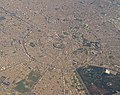 The city of Arbil in the Kurdistan Region of Iraq has a radial urban structure centred on an ancient fortress (from Urban structure)
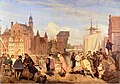 Gdańsk in the 17th century (from History of cities)
 This woodcut shows Nuremberg as a prototype of a flourishing and independent city in the 15th century. (from History of cities)
 Aerial photograph shows the remains of the Sumerian city Ur, near Nasiriyah, Iraq. (from History of cities)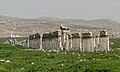
 Palmanova, Italy, constructed in 1593 according to the defensive ideal of the star fort, today retains its distinctive geometry. (from History of cities)
 A poster from the EPA entitled "Soak Up the Rain with Green Infrastructure." The poster depicts various green infrastructure that can be effective in preventing floods. (from Urban geography)
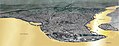 Constantinople, the largest and wealthiest city in Europe from the 9th through the 12th century (from History of cities)
 Daily life of people from the Song period at the capital, Bianjing, today's Kaifeng (from History of cities)
 New York City, one of the largest urban areas in the world (from Urban geography)
 View of the Agora of Athens with the temple of Hephaestus to the left and the Stoa of Attalos to the right (from History of cities)
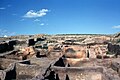 Excavated foundations of Çatalhöyük, Turkey. An Anatolian town dated to 7000 BCE. (from History of cities)
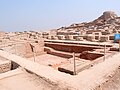 Mohenjo-daro, a World Heritage Site that was part of the Indus Valley Civilization (from History of cities)
 Extent and major sites of the Indus Valley Civilization of ancient India (from History of cities)
 The Round city of Baghdad, the capital of Iraq (from History of cities)
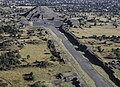 The Avenue of the Dead in Teotihuacan originates with the Pyramid of the Moon, forming the basis of the city grid. (from History of cities)
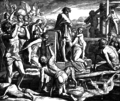 Cain founding the city of Enoch (from History of cities)
 A map showing the world energy consumption per capita based on 2013 data from the World Bank. (from Urban geography)


.jpg)
_from_the_east_corner_of_the_86th_Floor_Observatory_of_the_Empire_State_Building_in_Manhattan,_New_York_City,_New_York.jpg)


_LACMA_M.2008.40.98.8.jpg)


Topics
List articles
Subcategories

Associated Wikimedia
The following Wikimedia Foundation sister projects provide more on this subject:
-
 Commons
Free media repository -
 Wikidata
Free knowledge base -
 Wikiquote
Collection of quotations -
 Wikisource
Free-content library -
 Wikiversity
Free learning tools -
 Wiktionary
Dictionary and thesaurus


