Ports of entry of China
Legal entryways to China
From Wikipedia, the free encyclopedia
In China, ports of entry (POE) (Chinese: 口岸; pinyin: kǒu'àn; lit. 'shore mouths') are the lawful points of entry and exit from the country for freight and passengers. These include seaports, inland ports, airports, railway stations, and border crossings.[1] POEs are created by the State Council or by provincial governments. They are legally distinct from transportation facilities; for example, the Tianjin Water Transport Port of Entry (Chinese: 天津水运口岸) is distinct from Tianjin Port (Chinese: 天津港).
POE facilities perform customs and border control functions. They are generally located at transport terminals.[2]: 1
Classes of ports
According to the "Regulations of the State Council on Port of Entry Openings", ports of entry are categorized as either Class I or Class II.[1] The "China Port of Entry Yearbook" uses these categories when identifying inbound and outbound inspection stations for freight, personnel, and vehicles.[citation needed]
Class I
Class I, or national-level, entry ports are established by national authorities. The State Council authorizes them after consultations with the province where the port is located and the People's Liberation Army (PLA).[3]: 385 There are three types of Class I ports:[1]
- Sea, land, air, and passenger/cargo ports of entry that are open to foreign vessels, aircraft, vehicles, and other means of transportation. Most Class I ports belong to this category.
- Sea, land, air, passenger, and cargo ports of entry that only allow Chinese-flagged ships, aircraft, and vehicles to enter or leave the country (e.g. Luoyang Air Transportation Port of Entry in Henan Province and Zhongshan Water Transportation Port in Guangdong Province, which only allow Chinese aircraft and ships to enter or leave the country).[4]: 834–835 As of 2016, there were no Class I land Ports of Entry with that limitation.
- Sea delivery points in China's territorial waters where foreign vessels are allowed to enter and exit (e.g., the Bozhong [Bohai Oil] Water Transport Port of Entry in Tianjin, which is the offshore oil delivery point for CNOOC Bohai Corporation).[4]: 67
The "13th Five-Year Plan for the Development of National Ports of Entry" specifies that certain passenger and cargo volume indicators three years after the opening of a Port of Entry will be used to determine the suitability of its status, and this status may be withdrawn.[5]
Class II
Class II, or "local-level", entry ports are created by local governments with the consent of the PLA and the provincial government after consulting local border inspection and examination units. Construction is financed locally.[3]: 386 There are three types of Class II ports:[1]
- Loading and unloading points, points of departure, and transshipment points for foreign trade transportation by national vessels that rely on other ports of entry for border inspection and examination procedures.
- Ports for small-scale border trade and people-to-people exchanges agreed with the local governments of neighboring countries.
- Entry-exit points that are restricted to border residents only.
In the period of reform and opening, the various provincial governments of China approved the establishment of 331 Type II ports. On August 28, 1998: 46, the State Council issued the "Circular on Cleaning up and Rectifying Class II Ports" (State Circular [1998] No. 74),[6]: 46 which intended to clean-up and rectify this proliferation of Type II Ports of Entry. The circular suspended the approval of class II ports, and proceeded to review the existing ones for their suitability as Ports of Entry. A total of 177 class II ports were closed, 57 class II ports were upgraded to class I ports, and 97 class II ports were merged with neighboring class I ports.[7] This consolidation process is still ongoing.
Government Bodies
The basic structure of a Port of Entry includes 1) an integrated management system, 2) a supervision and inspection system, 3) an external transportation and external trade system; and 4) a service system. Generally, the number of units and departments working at a port of entry can reach about 40.[8]: 11
First, because of the different bureaucratic affiliations of the units at the port, it is necessary to have an integrated management organization to coordinate the relationship between the systems, which is usually a "port of entry management committee" (口岸管理委员会) or a "port of entry office" (口岸办公室) set up by the local government.[3]: 387
Second, the supervision and inspection system entails the management, supervision, and inspection of people, baggage, cargo, and means of transportation entering and leaving the country, and includes three subsystems: inspection (检查), testing (检验), and quarantine (检疫). As of 2024, the relevant agencies include
- The National Immigration Administration for migration inspection.
- The General Administration of Customs is responsible for customs, excise, and duties; for contraband and prohibited goods interdiction; and for health, animal, and plant quarantine.[a]
- The China Maritime Safety Administration is responsible for ship inspection and ship health certification.
- The China Civil Aviation Authority is responsible for airplane inspection.
- The State Administration for Market Regulation for commodity inspection, quality testing, and food testing.
- The Ministry of Agriculture for the fishing vessels registry (中华人民共和国渔业船舶检验局),[10] and many other state organizations each with their own remits.[3]: 387
Third, the external transportation system includes the actual transport institutions such as the management companies of the seaports, airports, railway stations, and other terminals and hubs; the shipping companies, airlines, transportation companies, logistics companies, and other enterprises involved in the transport of goods and people.
Finally, the service system includes banking, insurance, shipping agencies, supply, warehousing, seafarers' clubs, etc.[8]: 11 。
The China Association of Ports-of-Entry (中国口岸协会 CAOP)[11] is a national comprehensive association with independent legal personality, approved by the Ministry of Civil Affairs and supervised by the General Administration of Customs (GAC). The leading members of the association are composed of relevant personnel from the GAC, Ministry of Public Security, Ministry of Transport, China Railway, Civil Aviation Administration of China, plus other central departments and important local port of entry authorities. It serves as an organization for the exchange of port of entry information, business training, international cooperation, and the provision of consulting services, and also edits the China Port of Entry Yearbook.[12]
History
The Ming and Qing dynasties, guided by the idea of "naval defense over commerce", had a long history of closed-door policies, closing ports, removing population from coastal areas, and forcing foreign traders into specific, limited ports (the Canton factories). This changed abruptly after the Opium War in 1840, when China was forced to open five ports of entry to foreign commerce: (Guangzhou, Xiamen, Fuzhou, Ningbo, and Shanghai).[2]: 2 As Western powers forced the opening of China in a succession of wars and unequal treaties, the number of treaty ports opened to the outside world increased to 35 by 1895.[13]: 68 The idea of "commercial war", counterattacking the West commercial dominance, was put forward by thinkers such as Zheng Guanying in the 1870s, and began to be practiced in 1898, with the emergence of "self-opened commercial ports"[14]: 88 The earliest self-opened commercial port in China was the port of Sandu'ao in Ningde, Fujian, followed by Qinhuangdao and Yuezhou.[15]: 158 By the end of the Qing dynasty, there were 36 self-opened merchant ports spread throughout China, increasing to 52 in 1924, a number almost equal to the number of treaty ports:[14]: 88
The vagaries and hardships of the twentieth century meant that the number of open ports in China varied wildly as circumstances and governments changed. By 1978, there were only 51 ports of entry open to the outside world, including 18 water ports (17 on the coast and one on an inland waterway), eight air ports (seven international airports and one special airport), nine railroad ports, and 16 highway ports.[3]: 388 Due to political reasons, most land ports were opened with socialist countries, and foreign trade was mainly in the form of barter and aid.[8]: 12 In 1978, the volume of foreign trade goods entering and leaving the country through the Class I ports was 70.33 million tons, and the total value of import and export trade through the various types of ports was 20.64 billion US dollars, with 5,658,000 passengers entering and exiting the country, and a total of 325,000 ships, planes, trains, and cars.[16]: 12
After the start of the reform and opening, and especially after Deng Xiaoping's southern tour, the Chinese government started opening a new wave of ports; between 1978 and 1993, 150 new national ports were opened, 50 new ports were opened in 1992 and 1993 alone. By 1993, there were 201 Class I ports in China, including 117 water transport ports (65 coastal and 52 inland waterway ports), 46 air transport ports, 12 railroad ports and 35 highway ports, and all the province-level entities in China, except for landlocked Qinghai and Ningxia, had open ports. In 1993, the volume of foreign trade cargo in and out of the Class I ports amounted to 305 million tons, and the total amount of import and export trade through all kinds of ports was 195.72 billion U.S. dollars, 95.68 million passengers entering and leaving the country, and 8.989 million ships, planes, trains, and cars.[16]: 12
In 2006, the State Council approved the opening of Xining Caojiapu Airport in Qinghai province to international flights, which opened a port of entry into the last of the 31 provincial-level entities in China. The whole of China was now for the first time literally open to the world. By 2016, China had a total of 305 national-level ports of entry officially open to the public, including 137 water transport ports (82 coastal and 55 in inland waterways), 73 air transport ports, 20 railroad ports, and 75 highway ports. In 2016,[b] the total value of imported and exported cargo at ports nationwide was US$3,685,557 million.[4]: 770 The COVID-19 pandemic closed or restricted most of those ports, but on 8 January 2023, all mainland China ports that had been closed due to the pandemic were opened again.[17][18][19]
List of national-level ports of entry
Highways
As of 2016, the People's Republic of China had a total of 75 Class I highway PoEs, including 9 international ports of entry open to Hong Kong and Macao, and 64 international or bilateral ports[c] to land-adjacent countries, in addition to 1 temporarily open PoE.
In 2016 statistics, the road port with the highest volume of import and export freight was Xinjiang's Khorgos Port of Entry, with an annual cargo volume of 25,575,568 tons, followed by Inner Mongolia's Ganq Mod Port of Entry with a cargo volume of 15,535,196 tons, and Guangdong's Huanggang Port, with a volume of 13,522,881 tons. The port with the largest number of passenger arrivals and departures was Gongbei Port in Guangdong, with 123,576,659 arrivals and departures per year, followed by Luohu Crossing in Guangdong with 81,231,123 arrivals and departures, and Shenzhen Bay Port also in Guangdong with 42,831,754 arrivals and departures; the port with the largest number of departures and arrivals among the ports not connected with Hong Kong and Macao was Ruili Port in Yunnan with 15,756,480 arrivals and departures, which was the fifth largest land port of entry overall in terms of number of arrivals and departures. The port with the largest number of inbound and outbound vehicles was Huanggang Port, with 8,452,162 vehicles, followed by Shenzhen Bay Port with 4,388,461 vehicles and Ruili Port with 3,975,104 vehicles.[4]: 37
| Province | Name | Opening year | Connects to | Notes |
|---|---|---|---|---|
| Inner Mongolia | Manzhouli | 1989[20] | Zabaykalsk, Russia | |
| Inner Mongolia | Heishantou | 1989[21] | Tsurukaitu, Russia | |
| Inner Mongolia | Shiwei | 1989[20] | Olochi, Russia | Bilateral traffic only |
| Inner Mongolia | Ar Haxat | 1992[22] | Choibalsan, Mongolia | Bilateral traffic only |
| Inner Mongolia | Ebuduge | 2009[23] | Bayankhoshuu, Mongolia | Bilateral traffic only |
| Inner Mongolia | Arxan | 2012[24] | Khalkh River, Mongolia | |
| Inner Mongolia | Erenhot | 1990[4]: 106 | Zamyn-Üüd, Mongolia | |
| Inner Mongolia | Ganq Mod | 1992[25] | Gashuun Sukhait, Mongolia | Bilateral traffic only |
| Inner Mongolia | Ceke | 2005[26] | Shivee Khuren, Mongolia | Bilateral traffic only |
| Inner Mongolia | Zhu'engadabuqi | 1992[27] | Bichigt Zuun, Mongolia | |
| Inner Mongolia | Mandula | 2009[28] | Khangi, Mongolia | Bilateral traffic only |
| Inner Mongolia | Uliji | 2016[29] | Tsagaandel Uul, Mongolia | Bilateral traffic only |
| Liaoning | Dandong | 1955[4]: 140 | Sinuiju, North Korea | |
| Jilin | Tumen | 1941[30] | Namyang, North Korea | |
| Jilin | Nanping | 1951[30] | Musan, North Korea | Bilateral traffic only |
| Jilin | Hunchun | 1988[30] | Kraskino, Russia | |
| Jilin | Quanhe | 1998[30] | Rason, North Korea | |
| Jilin | Changbai | 1950[4]: 154 | Hyesan, North Korea | |
| Jilin | Linjiang | 1950[30] | Junggang, North Korea | Bilateral traffic only |
| Jilin | Sanhe | 1941[30] | Hoeryong, North Korea | Bilateral traffic only |
| Jilin | Kaishantun | 1933[30] | Onsong, North Korea | Bilateral traffic only |
| Jilin | Guchengli | 1953[4]: 154 | Taehongdan, North Korea | |
| Jilin | Shatuozi | 1985[4]: 154 | Kyongwon, North Korea | Bilateral traffic only |
| Jilin | Ji'an | 2014[4]: 164 | Manpo, North Korea | |
| Jilin | Shuangmufeng | 2019[4]: 166 | Samjiyon, North Korea | Bilateral traffic only |
| Heilongjiang | Dongning | 1989[31] | Poltavka, Russia | |
| Heilongjiang | Suifenhe | 2000[4]: 179 | Pogranichny, Russia | |
| Heilongjiang | Mishan | 1989[32] | Turii Rog, Russia | |
| Heilongjiang | Hulin | 1989[4]: 172 | Markovo, Russia | |
| Guangdong | Luohu Port | 1887[4]: 457 | Lo Wu Control Point, Hong Kong | |
| Guangdong | Huanggang Port | 1988[4]: 457 | Lok Ma Chau Control Point, Hong Kong | |
| Guangdong | Wenjindu Port | 1979[4]: 458 | Man Kam To Control Point, Hong Kong | |
| Guangdong | Shatoujiao | 1984[4]: 458 | Sha Tau Kok Control Point, Hong Kong | |
| Guangdong | Shenzhen Bay Port | 2006[4]: 458 | Shenzhen Bay Control Point, Hong Kong | |
| Guangdong | Futian Port | 2007[33] | Lok Ma Chau Spur Line Control Point, Hong Kong | |
| Guangdong | Liantang Checkpoint | 2019[34] | Heung Yuen Wai Control Point, Hong Kong | |
| Guangdong | Gongbei Port | 1887[4]: 459 | Portas do Cerco, Macau | |
| Guangdong | Hengqin Port | 1999 | Posto Fronteiriço Hengqin, Macau | |
| Guangdong | Zhuhai-Macau Transborder Industrial Park | 2006[4]: 460 | Posto Fronteiriço do Parque Industrial Transfronteiriço, Macau | Bilateral traffic only |
| Guangdong | Gangzhu'ao Bridge | 2017[35] | Hong Kong-Zhuhai-Macao Bridge Control Point, Hong Kong | |
| Guangdong | Gangzhu'ao Bridge | 2017[35] | Posto Fronteiriço Da Ponte Hong Kong-Zhuhai-Macau, Macau | |
| Guangdong | Qingmao Port | 2017[35] | Posto Fronteiriço Qingmao, Macau | Pedestrian only |
| Guangxi | Friendship Pass | 1992[4]: 522 | Đồng Đăng, Vietnam | |
| Guangxi | Friendship Pass | 1992[4]: 522 | Tân Thanh, Vietnam | |
| Guangxi | Friendship Pass | 1992[4]: 522 | Cốc Nam, Vietnam[36] | |
| Guangxi | Dongxing | 1992[37] | Móng Cái, Vietnam | |
| Guangxi | Shuikou | 1992[4]: 523 | Tà Lùng, Vietnam | |
| Guangxi | Longbang | 2003[4]: 523 | Trà Lĩnh, Vietnam | Bilateral traffic only |
| Guangxi | Pingmeng | 2011[38] | Sóc Giang, Vietnam | Bilateral traffic only |
| Guangxi | Aidian | 2015[39] | Chi Ma, Vietnam | Bilateral traffic only |
| Guangxi | Dongzhong | 2017[40] | Hoành Mô, Vietnam | Bilateral traffic only |
| Guangxi | Shuolong | 2017[41] | Lý Vạn, Vietnam | Bilateral traffic only |
| Yunnan | Ruili | 1978[42] | Muse, Myanmar | Bilateral traffic only |
| Yunnan | Wanding | 1952[43] | Pang Hseng, Myanmar | Bilateral traffic only |
| Yunnan | Tengchong Houqiao | 2000[44] | Kanpaikti, Myanmar | Bilateral traffic only |
| Yunnan | Mengding | 2004[45] | Chinshwehaw, Myanmar | Bilateral traffic only |
| Yunnan | Daluo | 2007[46] | Mong La, Myanmar | Bilateral traffic only |
| Yunnan | Hekou | 2011[47] | Lào Cai, Vietnam | |
| Yunnan | Jinshuihe | 1954[48] | Ma Lù Thàng, Vietnam | Bilateral traffic only |
| Yunnan | Tianbao | 1954[49] | Thanh Thủy, Vietnam | |
| Yunnan | Dulong | 2015[50] | Xín Mần, Vietnam | |
| Yunnan | Mohan | 1992[51] | Boten, Vietnam | |
| Yunnan | Mengkang | 2011[52] | Lantouy, Laos | |
| Tibet | Zhangmu | 1961[4]: 622 | Kodari, Nepal | |
| Tibet | Gyirong Port[53] | 1961[54] | Rasuwa Fort, Nepal | |
| Tibet | Burang | 1961[4]: 622 | Yari, Nepal | Bilateral traffic only |
| Tibet | Burang | 1992[55] | Gunji, India | |
| Gansu | Mazongshan | 1992[56] | Norin-Sebestei, Mongolia |
Bilateral traffic only Out of service; crossing closed by Mongolia in 1993.[citation needed] |
| Xinjiang | Laoyemiao | 1992[57] | Bugat, Mongolia | Bilateral traffic only |
| Xinjiang | Ulatay | 1992[57] | Baitag, Mongolia | Bilateral traffic only |
| Xinjiang | Takshin | 1989[58] | Bulgan, Mongolia | |
| Xinjiang | Kiziltaw | 1992[57] | Dayan, Mongolia | Bilateral traffic only |
| Xinjiang | Aqimbek | 1994[59] | Terekty, Kazakhstan | Bilateral traffic only |
| Xinjiang | Jeminay | 1994[59] | Maykapshagay, Kazakhstan | |
| Xinjiang | Baktu | 1994[59] | Bakhty, Kazakhstan | |
| Xinjiang | Alashankou | 1990[60] | Dostyk, Kazakhstan | |
| Xinjiang | Port of Khorgos | 1983[61] | Khorgos, Kazakhstan | |
| Xinjiang | Dulata | 1994[59] | Kolzhat, Kazakhstan | Bilateral traffic only |
| Xinjiang | Muzha'erte | 1994[59] | Narynkol, Kazakhstan | Bilateral traffic only |
| Xinjiang | Tu'ergate | 1983[62] | Torugart Pass, Kazakhstan | |
| Xinjiang | Yierkeshitan | 1998[4]: 685 | Erkeshtam, Kazakhstan | |
| Xinjiang | Hongqilafu | 1982[4]: 674 | Sust, Pakistan | |
| Xinjiang | Karasu | 2007[63] | Kulma Pass, Tajikistan |
Railways
As of 2016, the People's Republic of China had a total of 11 Class I border railway ports, and six Class I inland railway ports.
In 2016 statistics, the railway port with the highest import and export freight volume was the Manzhouli Railway Port in Inner Mongolia, with an annual volume of 13,957,721 tons, followed by the Erenhot Railway Port in Inner Mongolia, with 9,703,068 tons, and the Suifenhe Railway Port in Heilongjiang, with 8,875,453 tons. The largest number of passengers entering and leaving the country was at Guangzhou Railway Port in Guangdong, with 3,362,499, followed by 390,043 at Dongguan Railway Port in Guangdong and 184,700 at Suifenhe Railway Port in Heilongjiang. The railway port with the largest number of inbound and outbound trains was Manzhouli Railway Port in Inner Mongolia with 8,869 trains, followed by the Erenhot Railway Port with 8,688 trains, Alashankou Railway Port in Xinjiang with 8,379 trains, and Guangzhou Railway Port with 7,985 trains.[4]: 40
Border
All international trains passing through these border crossings are subject to border control there.
| Province | Name | Opening year | Connects to | Notes |
|---|---|---|---|---|
| Inner Mongolia | Manzhouli | 1989[4]: 106 | Zabaykalsk, Russia | |
| Inner Mongolia | Erenhot | 1956[4]: 106 | Zamiin-Uud, Mongolia | |
| Inner Mongolia | Ganq Mod | 2007[64] | Gashuun Sukhait, Mongolia | Bilateral traffic only |
| Inner Mongolia | Ceke | 2003[65] | Shivee Khuren, Mongolia | |
| Inner Mongolia | Zhu'engadabuqi | 1992[66] | Erdenetsagaan, Mongolia | |
| Liaoning | Dandong | 1954[4]: 132 | Sinŭiju Ch'ŏngnyŏn, North Korea | |
| Jilin | Ji'an | 1954[4]: 154 | Manpo, North Korea | |
| Jilin | Tumen | 1954[4]: 154 | Namyang, North Korea | |
| Jilin | Hunchun | 1998[67] | Kamyshovyy, Russia | |
| Heilongjiang | Suifenhe | 1952[4]: 172 | Pogranichny, Russia | |
| Guangxi | Pingxiang | 1992[4]: 523 | Đồng Đăng, Vietnam | |
| Yunnan | Hekou | 1953[4]: 612 | Lào Cai, Vietnam | |
| Yunnan | Mohan | 2021[68] | Boten, Laos | |
| Xinjiang | Alashankou | 1990[60] | Dostyk, Kazakhstan | |
| Xinjiang | Khorgas | 2014[69] | Altynkol, Kazakhstan |
Inland
Some inland ports do not have "direct entry and exit" required by law to be ports of entry. These ports operate with restrictions as "temporary ports".[70]
| Province | Name | Opening year | Railway station | Connects to | Notes |
|---|---|---|---|---|---|
| Jilin | Changchun | 2016[71] | Xinglongshan | European Union | Temporary. Used by Trans-Eurasia Logistics. |
| Heilongjiang | Harbin | 1996[4]: 179 | Harbin | Russia | |
| Heilongjiang | Harbin | 1996[4]: 179 | Xiangfang | European Union | Used by Trans-Eurasia Logistics |
| Shanghai | Shanghai | 2009[4]: 201 | Yangpu | European Union | Used by Trans-Eurasia Logistics |
| Shanghai | Shanghai | 2009[4]: 201 | Luchaogang | European Union | Used by Trans-Eurasia Logistics |
| Zhejiang | Yiwu | 2015[72] | Yiwu | European Union | Temporary. Used by Trans-Eurasia Logistics. |
| Jiangxi | Ganzhou | 2016[73] | Ganzhou International Port | European Union | Temporary. Used by Trans-Eurasia Logistics. |
| Henan | Zhengzhou | 1997[4]: 367 | Putian West | European Union | Temporary. Used by Trans-Eurasia Logistics. |
| Hubei | Wuhan | 2015[74] | Wuhan Railway Container Transport Center[75][76] | European Union | Temporary. Used by Trans-Eurasia Logistics. |
| Guangdong | Guangzhou | 1979[4]: 455 | Dalang | European Union | Used by Trans-Eurasia Logistics. |
| Guangdong | Dongguan | 2015[77] | Shilong | European Union | Temporary. Used by Trans-Eurasia Logistics. |
| Guangdong | Guangzhou–Shenzhen–Hong Kong Express Rail Link | 2018[78]: 440 | Hong Kong West Kowloon | HSR Kowloon West Control Point, Hong Kong | Control point located in Hong Kong and operates under mainland China laws. |
| Chongqing | Chongqing | 2013[79] | Tuanjiecun | European Union | Temporary |
| Sichuan | Chengdu | 2014[80] | Chengxiang | European Union | Temporary. Used by Trans-Eurasia Logistics. |
| Shaanxi | Xi'an | 2014[81] | Xi'an Guojigang | European Union | Temporary. Used by Trans-Eurasia Logistics. |
| Gansu | Lanzhou | 2016[82] | Zhongchuan North | European Union | Temporary. Used by Trans-Eurasia Logistics. |
| Gansu | Lanzhou | 2016[82] | Yingchuanpu | European Union | Temporary. Used by Trans-Eurasia Logistics. |
| Xinjiang | Ürümqi | 2016[83] | Ürümqi West | European Union | Temporary. Used by Trans-Eurasia Logistics. |
Seaports
As of 2016, the People's Republic of China had 82 Type I seaports. According to 2016 statistics, the port with the largest import and export cargo volume was Qingdao Water Transport Port in Shandong, with an annual transport volume of 298,370,511 tons, followed by Tangshan Water Transport Port in Hebei with 294,365,760 tons, and Shanghai Water Transport Port with 276,327,246 tons.[d]The port with the largest number of inbound and outbound passengers was the Shanghai Water Transport Port with 4,382,056 passengers, followed by the Guangdong Shekou Water Transport Port with 3,222,543 passengers and the Xiamen Water Transport Port of Entry with 2,251,615 passengers. The port with the largest number of inbound and outbound vessels is Guangdong Shekou Port of Entry with 60,023 vessels, followed by Shanghai Maritime Port with 25,551 vessels and Fujian Xiamen Water Port with 21,677 vessels.[4]: 32
| Province | Name | Opening year | Seaport | Notes |
|---|---|---|---|---|
| Tianjin | Tianjin | 1860[4]: 60 | Tianjin | |
| Tianjin | Bozhong | 1988[4]: 60 | China National Offshore Oil Corporation offshore oil delivery point | |
| Hebei | Qinhuangdao | 1898[4]: 76 | Qinhuangdao | |
| Hebei | Tangshan | 1992[84] | Tangshan | |
| Hebei | Huanghua | 2002[4]: 76 | Huanghua | |
| Liaoning | Dalian | 1960[4]: 141 | Dalian | |
| Liaoning | Lushun Xingang | 2006[85] | Dalian | |
| Liaoning | Zhuanghe | 2007[86] | Dalian | |
| Liaoning | Changxingdao | 2011[87] | Dalian | |
| Liaoning | Yingkou | 1984[4]: 132 | Yingkou | |
| Liaoning | Panjin | 2015[88] | Panjin | |
| Liaoning | Dandong | 1985[89] | Dandong | |
| Liaoning | Jinzhou | 1989[90] | Jinzhou | |
| Liaoning | Huludao | 1999[91] | Huludao | |
| Shanghai | Shanghai | 1842[4]: 190 | Shanghai | |
| Jiangsu | Lianyungang | 1956[4]: 219 | Lianyungang | |
| Jiangsu | Dafeng | 2006[4]: 220 | Yancheng | |
| Jiangsu | Yancheng | 2017[92] | Yancheng | |
| Jiangsu | Rudong | 2014[93] | Nantong | |
| Jiangsu | Qidong | 2014[93] | Nantong | |
| Zhejiang | Ningbo | 1979[4]: 255 | Ningbo-Zhoushan | Includes temporary PoE area[4]: 255 |
| Zhejiang | Zhoushan | 1986[94] | Ningbo-Zhoushan | |
| Zhejiang | Wenzhou | 1957[4]: 256 | Wenzhou | |
| Zhejiang | Taizhou | 1989[4]: 256 | Taizhou | Includes temporary PoE area[4]: 256 |
| Zhejiang | Jiaxing | 1996[4]: 257 | Jiaxing | |
| Fujian | Fuzhou | 1842[4]: 294 | Fuzhou[95] | |
| Fujian | Pingtan | 2014[96] | Fuzhou[95] | |
| Fujian | Ningde | 1993[97] | Fuzhou[95] | |
| Fujian | Putian | 1995[98] | Putian | |
| Fujian | Quanzhou | 1981[4]: 304 | Quanzhou | |
| Fujian | Zhangzhou | 1991[99] | Xiamen[100] | |
| Fujian | Xiamen | 1842[4]: 294 | Xiamen[101] | |
| Shandong | Qingdao | 1953[4]: 334 | Qingdao | |
| Shandong | Dongjiakou | 2016[102] | Qingdao | |
| Shandong | Yantai | 1953[4]: 334 | Yantai | |
| Shandong | Longkou | 1984[4]: 346 | Yantai | |
| Shandong | Penglai | 1996[4]: 349 | Yantai | |
| Shandong | Laizhou | 1996[4]: 349 | Yantai | |
| Shandong | Weihai | 1984[4]: 346 | Weihai | |
| Shandong | Shidao | 1988[103] | Weihai | |
| Shandong | Longyan | 1999[4]: 350 | Weihai | |
| Shandong | Rizhao[e][citation needed] | 1986[104][failed verification] | Rizhao | |
| Shandong | Dongying | 1995[105] | Dongying | |
| Shandong | Weifang | 2007[106]: 90 | Weifang | |
| Guangdong | Guangzhou | 1963[107] | Guangzhou | |
| Guangdong | Nansha | 1992[106]: 462 | Guangzhou | |
| Guangdong | Lianhuashan | 1985[108] | Guangzhou | |
| Guangdong | Pazhou | 2023[109] | Guangzhou | |
| Guangdong | Yantian Wharves | 1990[110] | Shenzhen | |
| Guangdong | Shenzhen Dachanwan | 2009[111] | Shenzhen | |
| Guangdong | Daya Bay Special Wharf | 1985[4]: 463 | Shenzhen | Serves the Daya Bay Nuclear Power Plant |
| Guangdong | Xichong | 1983[4]: 408 | Shenzhen | |
| Guangdong | Meisha | 1984[4]: 463 | Shenzhen | |
| Guangdong | Shekou Industrial Area | 1981[4]: 463 | Shenzhen | |
| Guangdong | Chiwan Wharf | 1984[4]: 408 | Shenzhen | |
| Guangdong | Mawan Wharf | 1990[4]: 408 | Shenzhen | |
| Guangdong | Dongjiaotou | 1987[4]: 408 | Shenzhen | |
| Guangdong | Fuyong | 1992[112] | Shenzhen Bao'an International Airport | |
| Guangdong | Huizhou | 1993[113] | Huizhou | |
| Guangdong | Humen | 1997[114] | Dongguan | |
| Guangdong | Shanwei | 1988[4]: 408 | Shanwei | |
| Guangdong | Chaozhou | 1994[115] | Chaozhou | |
| Guangdong | Jieyang | 2010[116] | Jieyang | |
| Guangdong | Shantou | 1860[4]: 408 | Shantou | |
| Guangdong | Chaoyang | 1996[117] | Shantou | |
| Guangdong | Nan'ao | 1993[118] | Shantou | |
| Guangdong | Zhuhai | 1994[4]: 465 | Zhuhai | |
| Guangdong | Jiuzhou | 1981[4]: 465 | Zhuhai | |
| Guangdong | Wanshan | 1995[4]: 465 | Zhuhai | |
| Guangdong | Wanzai Ferry | 1984[4]: 466 | Zhuhai | |
| Guangdong | Jiangmen | 1996[119] | Jiangmen | |
| Guangdong | Guangmei | 1985[120] | Jiangmen | |
| Guangdong | Yangjiang | 1993[121] | Yangjiang | |
| Guangdong | Zhanjiang | 1956[122] | Zhanjiang | |
| Guangdong | Maoming | 1988[123] | Maoming | |
| Guangxi | Beihai | 1950[4]: 514 | Beibu Gulf | |
| Guangxi | Shitoubu | 1994[115] | Beibu Gulf | |
| Guangxi | Qinzhou | 1994[124] | Beibu Gulf | |
| Guangxi | Fangchenggang | 1983[115] | Beibu Gulf | |
| Hainan | Haikou | 1957[125] | Haikou | |
| Hainan | Sanya | 1984[125] | Sanya | |
| Hainan | Qinglan | 1996[126] | Qinglan | |
| Hainan | Yangpu | 1990[125] | Yangpu | |
| Hainan | Basuo | 1988[125] | Basuo |
Rivers
As of 2016, the People's Republic of China has a total of 44 Class I river ports and 11 Class I boundary river ports on the Songhua, Heilongjiang, Ussuri, Yangtze, Pearl, and Lancang rivers. Boundary river ports between China and Russia utilize ship transportation during the clear water period, and road transportation during the ice closure period.
In 2016 statistics, the river port with the largest volume of import and export freight was Zhangjiagang Water Transport Port in Jiangsu, with an annual volume of 76,256,569 tons, followed by Taicang Waterway Port in Jiangsu with 62,180,070 tons and Nantong Waterway Port with 51,403,683 tons, also in Jiangsu. The river port with the largest number of people entering and leaving the country was Guangdong's Zhongshan Water Transportation Port with 1,339,634 person-times, followed by Heilongjiang's Heihe with 718,521 person-times and Guangdong's Shunde with 632,295 person-times. The port with the largest number of inbound and outbound vehicles was Zhongshan Port with 20,071 trips, followed by Shunde with 10,819 trips, and Heihe with 8,523 trips, in addition to having 31,959 vehicles entering and exiting the country during the ice closure period.[4]: 36
| Province | Name | Established | River port | Notes |
|---|---|---|---|---|
| Jilin | Da'an | 1990[127] | Da'an | |
| Heilongjiang | Harbin | 1989[4]: 180 | Harbin | |
| Heilongjiang | Jiamusi | 1989[4]: 180 | Jiamusi | |
| Heilongjiang | Huachuan | 1994[128] | Jiamusi | |
| Heilongjiang | Fujin | 1989[4]: 180 | Jiamusi | |
| Heilongjiang | Suibin | 1995[4]: 180 | Suibin | |
| Jiangsu | Nanjing | 1986[129] | Nanjing | |
| Jiangsu | Nantong | 1982[130] | Nantong | |
| Jiangsu | Rugao | 2008[131] | Nantong | |
| Jiangsu | Zhangjiagang | 1982[4]: 210 | Suzhou | |
| Jiangsu | Taicang | 1995[4]: 210 | Suzhou | |
| Jiangsu | Changshu | 1995[4]: 223 | Suzhou | |
| Jiangsu | Zhenjiang | 1986[132] | Zhenjiang | |
| Jiangsu | Jiangyin | 1992[133] | Jiangyin | |
| Jiangsu | Yangzhou | 1992[134] | Yangzhou | |
| Jiangsu | Taizhou | 1992[134] | Taizhou | |
| Jiangsu | Jingjiang | 2012[135] | Taizhou | |
| Jiangsu | Changzhou | 2001[136] | Changzhou | |
| Anhui | Wuhu | 1980[4]: 283 | Wuhu | |
| Anhui | Tongling | 1993[137] | Tongling | |
| Anhui | Anqing | 1986[4]: 284 | Anqing | |
| Anhui | Ma'anshan | 1990[138] | Ma'anshan | |
| Anhui | Chizhou | 2005[139] | Chizhou | |
| Jiangxi | Jiujiang | 1980[4]: 326 | Jiujiang | |
| Hubei | Wuhan | 1992[140] | Wuhan | |
| Hubei | Huangshi | 1993[141] | Huangshi | |
| Hunan | Chenglingji | 1996[142] | Yueyang | |
| Guangdong | Xintang | 1995[107] | — | Chinese-flagged ships only |
| Guangdong | Doumen | 1987[143] | Zhuhai | Chinese-flagged ships only |
| Guangdong | Zhongshan | 1984[4]: 469 | Zhongshan | |
| Guangdong | Nanhai | 1985[4]: 408 | Foshan | Chinese-flagged ships only |
| Guangdong | Rongqi | 1986[144] | Foshan | Chinese-flagged ships only |
| Guangdong | Gaoming | 1992[145] | Foshan | Chinese-flagged ships only |
| Guangdong | Zhaoqing | 1982[4]: 473 | Zhaoqing | Chinese-flagged ships only |
| Guangdong | Jiangmen | 1981[4]: 408 | Jiangmen | Chinese-flagged ships only |
| Guangdong | Xinhui | 1992[4]: 470 | Jiangmen | |
| Guangdong | Heshan | 1988[146] | Jiangmen | Chinese-flagged ships only |
| Guangdong | Sanbu | 1982[4]: 471 | Jiangmen | Chinese-flagged ships only |
| Guangxi | Wuzhou | 1982[4]: 514 | Wuzhou | Chinese-flagged ships only |
| Guangxi | Guigang | 1992[147] | Guigang | Chinese-flagged ships only |
| Guangxi | Liuzhou | 1988[148] | Liuzhou | Chinese-flagged ships only |
| Chongqing | Chongqing | 2010[4]: 562 | Chongqing | Chinese-flagged ships only |
| Sichuan | Yibin | 2018[149] | Yibin | Temporary |
| Sichuan | Luzhou | 2018[150] | Luzhou | Temporary |
| Shanghai | Pujiang | 2013[151] | Pujiang | |
| Yunnan | Jinghong | 1993[152] | Jinghong | |
| Yunnan | Simao | 1993[152] | Simao |
Border river
| Province | Name | Opening year | Port name | Connects to | Notes |
|---|---|---|---|---|---|
| Heilongjiang | Fuyuan | 1992[153] | Jiamushi | Khabarovsk, Russia | |
| Heilongjiang | Tongjiang | 1986[154] | Jiamushi | Nizhneleninskoye, Russia | |
| Heilongjiang | Luobei | 1989[155] | Luobei | Amurzet, Russia | |
| Heilongjiang | Jiayin | 1989[155] | Jiayin | Pashkovo, Russia | |
| Heilongjiang | Heihe | 1982[4]: 181 | Heihe | Blagoveshchensk, Russia | |
| Heilongjiang | Xunke | 1989[156] | Heihe | Poyarkovo, Russia | |
| Heilongjiang | Sunwu | 1993[157] | Heihe | Konstantinovka, Russia | Unopened due to construction delays on the Russian side[158] |
| Heilongjiang | Huma | 1993[159] | Huma | Ushakovo, Russia | Unopened due to construction delays on the Russian side[158] |
| Heilongjiang | Mohe | 1989[155] | Mohe | Dzhalinda, Russia | Inactive since 2007 due to Russian changes to Dzhalinda Port operations[160] |
| Heilongjiang | Raohe | 1989[155] | Raohe | Pokrovka, Russia |
Airports
Air Transportation Ports of Entry (APE), also known as Aviation Ports of Entry, are categorized into two types: Class I aviation ports, open to all airlines, and Restricted (限制类) Class I aviation ports, open only to aircraft flying the Chinese flag. According to the "Regulations of the State Council on the Opening of Ports of Entry", issued on 18 September 1985, the opening of an Air Transport Port of Entry must always be subject to State Council approval.[161]
According to the requirements of the Civil Aviation Administration of China (CAAC), to officially become an "international airport", the airport must meet the requirements of a port of entry, meet the requirements to allow the flight of foreign airplanes, and the acceptance of the joint inspection facilities by the State Port Administration Office.[162] As of January 12, 2024, the People's Republic of China has a total of 83 Class I APE (adding up to 86 actual airports),[163] including 60 official international airports, 16 international airports that have not yet been named as such, 4 airports with restricted access, and 6 airports that have not yet passed the acceptance for a port of entry. There are also 18 temporarily open aviation ports, and in emergencies, ports may be open exceptionally: Guanghan Airport, which is not a civil transportation airport, was temporarily opened to the public during the Wenchuan earthquake relief efforts.[164]
In 2016 statistics, the port with the largest number of arrivals and departures was the Shanghai Air Transport Port, with an annual volume of 37,927,468 passengers,[d] followed by the Beijing Air Transportation Port with 24,252,289 passengers, and the Guangdong Guangzhou Air Transport Port with 13,219,779 passengers. The port with the largest volume of import and export cargo was the Shanghai APE, with 4,746,330 tons, followed by the Beijing APE with 1,853,736 tons, and the Guangzhou APE in Guangdong Province with 1,631,938 tons. The largest number of inbound/outbound flights was at the Shanghai APE with 234,047, followed by 131,483 at the Beijing APE, and 93,616 at the Guangzhou APE in Guangdong Province.[4]: 29
Images
Images of various ports of entry of China


 Dandong PoE, the Sino-Korean Friendship Bridge towards North Korea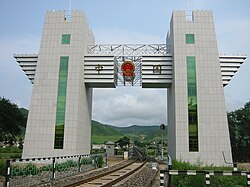
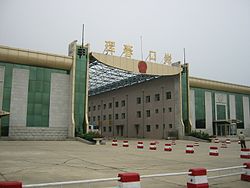

 Sino-Vietnamese border, Pingxiang, Friendship Pass
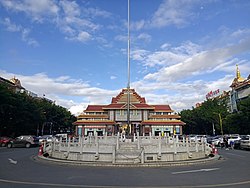
 Wanding PoE, Mangman Crossing


 Kashgar, Khunjerab Pass 's boundary marker

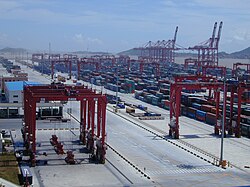


.jpg)


See also
Notes
- during the COVID-19 pandemic, the National Health Commission and the Chinese Center for Disease Control and Prevention took over organizing and running the new stringent border controls and 21-days quarantines, once the full-country lock-down was eased down.[9]
- These statistics refer to the officially opened ports of entry, and excludes the cargo and passengers that entered to temporarily opened ports
- Bilateral ports mean those ports of entry that are limited exclusively to the citizens of the two bordering countries, and cannot process third-country nationals
- As these statistics are port of entry measurements, they count only passengers and cargo entering or leaving the country in international flights or ships. Total throughput numbers for ports such as Shanghai and Beijing are much larger when including domestic cargo and passengers.
- On December 28, 2016, the State Council approved merging Shishu Port and Lanshan Port into Rizhao Port.