| Genus |
Species |
Location |
Member |
Material |
Notes |
Images |
|---|
| Acentrophryne |
A. sp. |
City of Industry, Pomona Freeway Chalk Hill |
Yorba |
Articulated skeleton |
An leftvent deep-sea anglerfish.[6] |
 |
| Acipenseridae indet. |
|
|
|
Subopercule |
A sturgeon of uncertain affinities. |
|
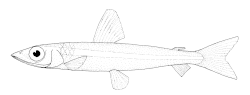
| Argentina |
A. sp. |
Pomona Freeway Chalk Hill |
|
"Remains" |
A herring smelt. |
 |
| Argyropelecus |
A. sp. |
Pomona Freeway Chalk Hill |
|
Unknown |
A marine hatchetfish. |
 |
| Atherinops |
A. sp. |
Pomona Freeway Chalk Hill |
|
Unknown |
A Neotropical silverside related to the modern topsmelt silverside. |
 |
| Atherinopsis |
A. sp. |
Pomona Freeway Chalk Hill |
|
Unknown |
A Neotropical silverside related to the modern jack silverside. |
 |
| Bathylaginae indet. |
|
Pomona Freeway Chalk Hill |
|
Unknown |
A deep-sea smelt. |
|
| Borophryne |
B. cf. apogon |
LACM Locality 6202 |
Yorba |
Complete articulated skeleton |
A leftvent deep-sea anglerfish, potentially referable to the modern netdevil.[5] |
 |
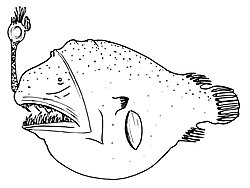
| Chaenophryne |
C. aff. melanorhabdus |
LACM Locality 6202 |
Yorba |
4 complete articulated skeletons |
An oneirodid deep-sea anglerfish, potential affinities to the modern smooth dreamer.[5] |
 |
| Chauliodus |
C. eximius |
Pomona Freeway Chalk Hill |
|
Unknown |
A viperfish. |
 |
| Cyclothone |
C. sp. |
Pomona Freeway Chalk Hill |
|
Unknown |
A bristlemouth. |
 |
| Decapterus |
D. cf. hopkinsi |
Continental Oil Company “Turnbull” well number 3 |
Lower |
One scale; lost |
A scad. |
 |
| D. sp. |
Pomona Freeway Chalk Hill |
|
Unknown |
| Etringus |
E. scintillans |
Puente Hills |
|
Two scales; lost |
A herring. |
|
| Ganoessus |
G. clepsydra |
Featherstone Quarry |
|
Unknown |
A herring. |
|
| G. meiklejohni |
Featherstone Quarry |
|
Articulated skeleton |
|
| Ganolytes |
G. cameo |
Pomona Freeway Chalk Hill |
|
Unknown |
A herring. |
|
| Genyonemus |
G. whistleri |
Pomona Freeway Chalk Hill |
|
Partial articulated specimen. |
A drumfish related to the white croaker. |
 |
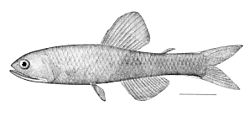
| Lampanyctus |
L. sp. |
Pomona Freeway Chalk Hill |
|
">100 otoliths and several skeletal imprints with otoliths" |
A lanternfish. |
 |
| Leptacanthichthys |
L. cf. gracilispinis |
LACM Locality 6202 |
Yorba |
Articulated skeleton |
An oneirodid deep-sea anglerfish, potentially referable to the modern plainchin dreamarm.[5] |
 |
| Linophryne |
L. cf. indica |
LACM Locality 6202 |
Yorba |
Articulated skeleton |
A leftvent deep-sea anglerfish, potentially referable to the modern headlight angler.[5] |
 |
| Lompoquia |
L. sp. |
|
Upper |
Unknown |
A drumfish. |
 |
| Molidae indet. |
|
|
|
|
An ocean sunfish of uncertain affinities. |
|
| Moridae indet. |
|
Pomona Freeway Chalk Hill |
|
Unknown |
A codling of uncertain affinities. |
|
| Oneirodes |
O. sp. |
LACM Locality 6202 |
Yorba |
Articulated incomplete skeleton |
An oneirodid deep-sea anglerfish. |
 |
| Paralabrax |
P. sp. |
Pomona Freeway Chalk Hill |
|
Unknown |
A sand bass. |
 |
| Pseudoseriola |
P. gilliandi |
|
|
|
A relative of the bluefish. |
|
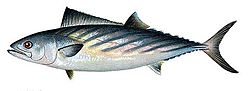
| Sarda |
S. stockii |
Union Oil Company “Chapman” well number 29 |
Lower |
2 scales |
A bonito. |
 |
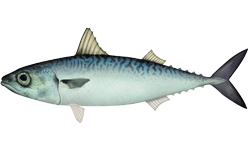
| Scomber |
S. cf. japonicus |
Continental Oil Company “Turnbull” well number 3 |
Lower |
1 scale, lost |
A mackerel, potentially referable to the modern chub mackerel. |
 |
| S. sp. |
Pomona Freeway Chalk Hill |
|
Unknown |
A mackerel. |
| Seriphus |
S. lavenbergi |
City of Industry |
Yorba |
Disarticulated skull with otolith |
A drumfish related to the queenfish. |
 |
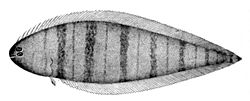
| Symphurus |
S. sp. |
Santiago Road Overcrossing |
La Vida |
6 partial skeletons |
A tonguefish. |
 |
| Syngnathus |
S. emeritus |
San Dimas |
|
Several articulated skeletons |
A pipefish. |
 |
| Thyrsocles |
T. kriegeri |
Pomona Freeway Chalk Hill |
|
Unknown |
A euzaphlegid. |
 |
| Xyne |
X. grex |
Pomona Freeway Chalk Hill |
|
Unknown |
A herring. |
|
| ?Xyrinius |
X. houshi |
"Los Angeles" |
|
Unknown |
A herring, from either the Monterey or Puente Formations. Potentially conspecific with Xyne grex. |
|
| Zanteclites |
Z. hubbsi |
Covina, El Modena |
|
6 specimens |
A Neotropical silverside. |
|


.gif)


