Quasi-sphere
From Wikipedia, the free encyclopedia
In mathematics and theoretical physics, a quasi-sphere is a generalization of the hypersphere and the hyperplane to the context of a pseudo-Euclidean space. It may be described as the set of points for which the quadratic form for the space applied to the displacement vector from a centre point is a constant value, with the inclusion of hyperplanes as a limiting case.
This article uses the following notation and terminology:
- A pseudo-Euclidean vector space, denoted Rs,t, is a real vector space with a nondegenerate quadratic form with signature (s, t). The quadratic form is permitted to be definite (where s = 0 or t = 0), making this a generalization of a Euclidean vector space.[a]
- A pseudo-Euclidean space, denoted Es,t, is a real affine space in which displacement vectors are the elements of the space Rs,t. It is distinguished from the vector space.
- The quadratic form Q acting on a vector x ∈ Rs,t, denoted Q(x), is a generalization of the squared Euclidean distance in a Euclidean space. Élie Cartan calls Q(x) the scalar square of x.[1]
- The symmetric bilinear form B acting on two vectors x, y ∈ Rs,t is denoted B(x, y) or x ⋅ y.[b] This is associated with the quadratic form Q.[c]
- Two vectors x, y ∈ Rs,t are orthogonal if x ⋅ y = 0.
- A normal vector at a point of a quasi-sphere is a nonzero vector that is orthogonal to each vector in the tangent space at that point.
Definition
A quasi-sphere is a submanifold of a pseudo-Euclidean space Es,t consisting of the points u for which the displacement vector x = u − o from a reference point o satisfies the equation
- a x ⋅ x + b ⋅ x + c = 0,
where a, c ∈ R and b, x ∈ Rs,t.[2][d]
Since a = 0 is permitted, this definition includes hyperplanes; it is thus a generalization of generalized circles and their analogues in any number of dimensions. This inclusion provides a more regular structure under conformal transformations than if they are omitted.
This definition has been generalized to affine spaces over complex numbers and quaternions by replacing the quadratic form with a Hermitian form.[3]
A quasi-sphere P = {x ∈ X : Q(x) = k} in a quadratic space (X, Q) has a counter-sphere N = {x ∈ X : Q(x) = −k}.[e] Furthermore, if k ≠ 0 and L is an isotropic line in X through x = 0, then L ∩ (P ∪ N) = ∅, puncturing the union of quasi-sphere and counter-sphere. One example is the unit hyperbola that forms a quasi-sphere of the hyperbolic plane, and its conjugate hyperbola, which is its counter-sphere.
Geometric characterizations
Centre and radial scalar square
The centre of a quasi-sphere is a point that has equal scalar square from every point of the quasi-sphere, the point at which the pencil of lines normal to the tangent hyperplanes meet. If the quasi-sphere is a hyperplane, the centre is the point at infinity defined by this pencil.
When a ≠ 0, the displacement vector p of the centre from the reference point and the radial scalar square r may be found as follows. We put Q(x − p) = r, and comparing to the defining equation above for a quasi-sphere, we get

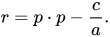
The case of a = 0 may be interpreted as the centre p being a well-defined point at infinity with either infinite or zero radial scalar square (the latter for the case of a null hyperplane). Knowing p (and r) in this case does not determine the hyperplane's position, though, only its orientation in space.
The radial scalar square may take on a positive, zero or negative value. When the quadratic form is definite, even though p and r may be determined from the above expressions, the set of vectors x satisfying the defining equation may be empty, as is the case in a Euclidean space for a negative radial scalar square.
Diameter and radius
Any pair of points, which need not be distinct, (including the option of up to one of these being a point at infinity) defines a diameter of a quasi-sphere. The quasi-sphere is the set of points for which the two displacement vectors from these two points are orthogonal.
Any point may be selected as a centre (including a point at infinity), and any other point on the quasi-sphere (other than a point at infinity) define a radius of a quasi-sphere, and thus specifies the quasi-sphere.
Partitioning
Referring to the quadratic form applied to the displacement vector of a point on the quasi-sphere from the centre (i.e. Q(x − p)) as the radial scalar square, in any pseudo-Euclidean space the quasi-spheres may be separated into three disjoint sets: those with positive radial scalar square, those with negative radial scalar square, those with zero radial scalar square.[f]
In a space with a positive-definite quadratic form (i.e. a Euclidean space), a quasi-sphere with negative radial scalar square is the empty set, one with zero radial scalar square consists of a single point, one with positive radial scalar square is a standard n-sphere, and one with zero curvature is a hyperplane that is partitioned with the n-spheres.
