Rapid Train
From Wikipedia, the free encyclopedia
.jpg)
In Japan, rapid trains (Japanese: 快速列車, Hepburn: Kaisoku Ressha) are passenger rail services that provide express services between their origin and destination, usually stopping only at major stations. They generally do not require surcharges. In the terminology used in the Passenger Operation Regulations of Japan National Railways (JNR) and JR Group, rapid trains are included in the broad sense of the term local trains (Japanese: 普通列車, Hepburn: Futsū Ressha).[1]
Unless otherwise noted, this section focuses on rapid trains in Japan. Also, "Commuter Rapid" (通勤快速, Tsūkin Kaisoku) and other derivatives of "Rapid" (快速, Kaisoku) are also treated.
Rolling stock
Under the JR Group's Passenger Operation Regulations, this is a type of local train that allows passengers to board without a surcharge, as opposed to an express train ("higher-category train" (優等列車, Yūtō ressha)).
Some rapid trains may be considered local trains in sections where they stop at all stations. For example, rapid trains on the Tōkaidō Main Line and San'yō Main Line (Biwako Line, JR Kyōto Line and JR Kōbe Line) in the Keihanshin area and local trains on the Joban Line operate as "Rapid" in the rapid operation section and "Local" in the section where the train stops at each station. These trains are not marked as "Rapid" in commercial timetables and are treated as local trains. As an unusual example, on the Shōnan–Shinjuku Line, trains on the Tōkaidō Line (-Takasaki Line) pass through Nishi-Ōi Station, Shin-Kawasaki Station, Hodogaya Station, and Higashi Totsuka Station where trains on the Yokosuka Line (-Utsunomiya Line) stop, so the latter are operated as "Rapid" trains even though they stop at the same stations as Trains stopping at every stations on the Tōkaidō Main Line.
Although many of these trains operate over relatively long distances, they often stop at all stations in the terminal section.
However, there are cases where the existence of a direct or express train itself is useful. For example, Aioi City and Ako City in Hyogo Prefecture have been promoting the fact that they can reach Keihanshin by "one Shin-Kaisoku" train to promote tourism and settlement activities, but the March 26, 2016 timetable revision eliminated daytime Shin-Kaisoku service, replacing it with local trains. Although the new rapid trains are not reduced in service since they stop at each station along these lines, the situation has become a cause for concern from the municipalities along the lines.[2] Even if the rapid trains operate only during the daytime, their presence has the advantage that the travel time can be posted on real estate advertisements [3] (if the travel time during commuting hours increases or if the rapid trains do not operate, it is necessary to add a note to that effect, but that note is small).
Unlike Limited Express trains and Express trains, the type of rolling stock used is not basically defined, but usually a regular train car (general, suburban, or commuter type) is used. From July 1992 to March 2016, some of JR Hokkaido's Airport trains were Limited Express trains (781 series, 785 series, and 789-1000 series) between Sapporo and Asahikawa Stations. JR East used Limited Express trains (185 series, E257 series, etc.) for some of the temporary rapid trains in the Tokyo metropolitan area, such as the Holiday Rapid (most of these trains are now upgraded to Limited Express).
Some trains were downgraded and used limited express cars as they are. For example, JR East used 485 series sets for rapid trains between Niigata Station and Itoigawa Station, which were newly established after the abolition of the Hokuetsu limited express and operated until the March 4, 2017 timetable revision. However, the use of 485 series trains was terminated due to the discontinuation of these trains and their upgrading to Limited Express trains by replacing them with new train types. In the past, some trains used Express type cars, and as a form of downgrading, 153 series were used on the "Shin-Kaisoku" in the Keihanshin area and the Rapid in the Chukyo area, KiHa 58 and KiHa 65 series trains were used on the Rapid Mie, and 165 series trains were used on the "Moonlight Echigo".
On some intercity routes and sightseeing routes, some or all cars are reserved-seat cars, requiring a reserved-seat ticket in addition to the train ticket, and some trains are coupled with green cars.
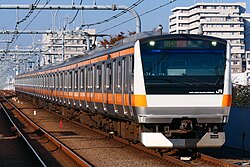 Rapid trains on the Chūō Main Line using the general commuter type (E233 series)
 Rapid Trains of JR Kobe Line using suburban type (223 series)
 Rapid Trains on the Senseki-Tōhoku Line using the general type (HB-E210 series)

.jpg)

 Rapid "Airport" at that time using Limited Express type (789-1000 series)
 Rapid "Mie" that used an Express Train type.
 165 series used for "Moonlight Echigo"


Nickname

Most of JR Hokkaido's rapid trains are given train nicknames, but most of the other regions do not have train nicknames. However, there are (or were) some cases where rapid trains with nicknames were operated, such as "Tottori Liner" (San'in Main Line), "Acty" (Tōkaidō Line), "Seaside Liner" (Ōmura Line), and "Moonlight XX" Night Trains.
For trains that have reserved seats, such as Airport, Marine Liner, Hamayuri, Mie, and Home Liner, the train is identified by its nickname, not by its train number, when managing the reserved seat ticketing system. For this reason, when two or more trains with the same name are operated, the train number (e.g., "Marine Liner No. XX") is assigned.
A train that operates as an electric multiple unit (電車, Densha) around a specified sections of trains with passing stations is called a "rapid electric multiple unit"(快速電車, Kaisoku Densha). Although this is mainly meant as an express train for local trains, it may cause discrepancies when running parallel to a medium-distance train (Local Train).
The reason why ordinary trains on the Joban Line, JR Kyoto Line, and JR Kobe Line are referred to as "rapid" in specified sections of trains, as mentioned above, is to distinguish them from the local trains that run separately, and to unify their stops with those of ordinary trains (by train), which are medium-distance trains connecting areas that are not already served by Local Trains.
In the Joban Line, although rapid trains used to stop at Mikawashima and Minami-Senju stations, which were out of the double-double track plan due to the five-way commuter plan, and at Tennodai station, which was greatly delayed, ordinary trains used to pass through (in the past, there were other stations that ordinary trains passed through). The information was unified to "Rapid" in the revision of March 13, 2004 and October 16, 2004, respectively.
Originally, "Express Trains" started to be operated on the Chūō Main Line as an express service, but when Express Trains started to be operated for a fee, the name was changed to "rapid trains" due to confusion. Even on the Chūō Main Line, ordinary trains used to stop at fewer stations than rapid trains (although some rapid trains, such as View Yamanashi, follow the "ordinary" stopping system on the Chūō Rapid Line).
Other
Some trains are labeled as "Local" while still having a passing station or in the form of a special passing train. In the days of the former JNR, there were trains that passed through stations with few passengers or short platforms in the morning and evening hours on regional lines, but they were treated simply as local trains, not as "rapid" trains. On the Takayama Line, as of 2017, the first and last trains operating between Takayama Station and Gifu Station are still "Local," but they stop at every station between Gero Station and Gifu Station, and only at Kuguno Station, Hida-Hagiwara Station, and Hida-Osaka Station between Takayama Station and Gero Station.
Conversely, there are cases where a train calls itself a "rapid" train even though it only passes through one station in its entire route. For example, as of the March 16, 2013 revision, this is the case for some rapid trains operating in the Kita-Kinki region, such as San'in Line, Maizuru Line, and Bantan Line. Also, the Chuo Line rapid trains that operate only between Musashi-Koganei Station, Tachikawa Station, between Toyoda Station and Takao Station, and Otsuki Station do not pass through any station (although the train is a local train).
Similarly, the "Shin-Kaisoku" trains bound for Banshu-Ako stop at every station on the Ako Line, but the type curtain remains "Shin-Kaisoku".
