Hokuetsu
From Wikipedia, the free encyclopedia
 A 485-3000 series EMU on a Hokuetsu service, September 2014 | |
| Overview | |
|---|---|
| Service type | Limited express |
| Status | Discontinued |
| Locale | Japan |
| First service | 1 March 1970 |
| Last service | 13 March 2015 |
| Former operator(s) | |
| Route | |
| Termini | Kanazawa Niigata |
| Service frequency | 5 return services daily |
| Line(s) used | Hokuriku Main Line, Shinetsu Main Line |
| On-board services | |
| Class(es) | Standard + Green |
| Seating arrangements | 2+2 unidirectional |
| Technical | |
| Rolling stock | 485 series EMU |
| Track gauge | 1,067 mm (3 ft 6 in) |
| Electrification | 20 kV AC |
| Operating speed | 120 km/h (75 mph)[1] |
The Hokuetsu (北越) was a limited express train service in Japan formerly operated by Japanese National Railways (JNR) and later by East Japan Railway Company (JR East) between Kanazawa and Niigata from 1970 until March 2015.[1]
Hokuetsu services were normally formed of 6-car 485 series (sets T12–16) or refurbished 485-3000 series electric multiple unit EMU trainsets (sets R21–28), based at Niigata Depot.[2]
 Original "bonnet-style" 485 series EMU, 1982
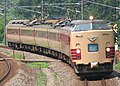 JNR-liveried 485 series EMU, August 2010
 485 series in revised livery, September 2010
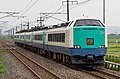 485-3000 series set R-26, July 2013


Formations
The six-car 485 series sets were formed with car 1 at the Kanazawa end and car 6 at the Niigata end.[2] All cars are no smoking.[3]
| Car No. | 1 | 2 | 3 | 4 | 5 | 6 | |
|---|---|---|---|---|---|---|---|
| Numbering | KuRoHa 481 | MoHa 484 | MoHa 485 | MoHa 484 | MoHa 485 | KuHa 481 | |
| Accommodation | Green | Reserved | Reserved | Reserved | Non-reserved | Non-reserved | Non-reserved |
The 485 series sets had toilets in each car, while 485-3000 series sets had toilets in 1, 2, 4, and 6 only.[2]


.svg)