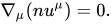
In the case of flat space, that is  and using a metric signature of
  , the equations of motion are,[6]

Where  is the energy density of the system, with
  being the pressure, and
  being the four-velocity of the system.
Expanding out the sums and equations, we have, (using  as the material derivative)

Then, picking 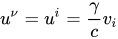 to observe the behavior of the velocity itself, we see that the equations of motion become

Note that taking the non-relativistic limit, we have  . This says that the energy of the fluid is dominated by its rest energy.
In this limit, we have  and
and  , and can see that we return the Euler Equation of
 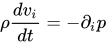 .
.
In order to determine the equations of motion, we take advantage of the following spatial projection tensor condition:

We prove this by looking at  and then multiplying each side by
  . Upon doing this, and noting that
  , we have
  . Relabeling the indices
  as
as  shows that the two completely cancel. This cancellation is the expected result of contracting a temporal tensor with a spatial tensor.
Now, when we note that

where we have implicitly defined that  , we can calculate that
![{\displaystyle {\begin{aligned}\partial _{\mu }T^{\mu \nu }&=\left(\partial _{\mu }w\right)u^{\mu }u^{\nu }+w\left(\partial _{\mu }u^{\mu }\right)u^{\nu }+wu^{\mu }\partial _{\mu }u^{\nu }+\partial ^{\nu }p\\[1ex]\partial _{\mu }T^{\mu \alpha }&=\left(\partial _{\mu }w\right)u^{\mu }u^{\alpha }+w\left(\partial _{\mu }u^{\mu }\right)u^{\alpha }+wu^{\mu }\partial _{\mu }u^{\alpha }+\partial ^{\alpha }p\end{aligned}}}](https://wikimedia.org/api/rest_v1/media/math/render/svg/b4af79fa89f1e26d7646049a4f6ae9e6270fd932)
and thus

Then, let's note the fact that  and
and  . Note that the second identity follows from the first. Under these simplifications, we find that

and thus by , we have

We have two cancellations, and are thus left with