
Romania in the Eurovision Song Contest
From Wikipedia, the free encyclopedia
Romania has been represented at the Eurovision Song Contest 24 times since its debut in 1994, and has placed in the top ten six times. Its best results were achieved with "Let Me Try" by Luminița Anghel and Sistem in 2005, "Playing with Fire" by Paula Seling and Ovi in 2010, and "Choke Me" by Alexandra Căpitănescu in 2026, who all finished in third place. The Romanian participating broadcaster in the contest is Televiziunea Română (TVR), which selects its entrant with Selecția Națională,[a] a song contest organised every year since 1993,[b] except for 2021.

| Romania in the Eurovision Song Contest | |
|---|---|
| Eurovision Song Contest | |

| |
| Participating broadcaster | Televiziunea Română (TVR) |
| Participation summary | |
| Appearances | 24 (20 finals) |
| First appearance | 1994 |
| Highest placement | 3rd: 2005, 2010, 2026 |
| External links | |
| TVR's official website | |
Romania's page at Eurovision.com  | |
| For the most recent participation see Romania in the Eurovision Song Contest 2026 | |
In 1993, the year before its first appearance, Romania attempted to debut in the contest, but came last in the qualifying round. After joining the following year, poor placements followed until 2002, resulting in several relegations. This changed with the introduction of semi-finals to the contest in 2004, after which Romania reached the final 14 times, failing to qualify from the semi-finals in 2018, 2019, 2021, and 2023, the latter finishing with no points. After missing the 2024 and 2025 contests, the country returned in 2026.
Contest history
Televiziunea Română (TVR) has been a full member of the European Broadcasting Union (EBU) since 1st January 1993, thus eligible to participate in the Eurovision Song Contest since then. It has participated in the contest representing Romania since the 39th edition in 1994. Before becoming a member of the EBU, TVR had broadcast the contest several times during the 1960s, 1970s, 1980s, and early 1990s.[2][3][4][5]
TVR unsuccessfully attempted to debut in the 1993 contest, selecting "Nu pleca" by Dida Drăgan for the qualifying round Kvalifikacija za Millstreet (English: Preselection for Millstreet); Drăgan came in last place.[6] A non-qualification was also achieved in 1996 when there was a qualifying round for all countries excluding hosts Norway.[7][8] The Eurovision site does not count either year in Romania's list of appearances.[9] The country's first official participation occurred in 1994 with "Dincolo de nori" by Dan Bittman placing 21st in the contest's final. The following years saw similar low placements and non-participations in 1995, 1997, 1999, and 2001.[9]

Romania's first top ten result was achieved in 2002, when "Tell Me Why" by Monica Anghel and Marcel Pavel finished ninth. The country placed within the top 20 every year from 2004 to 2015, claiming its best position to date, third place, in 2005 with "Let Me Try" by Luminița Anghel and Sistem and in 2010 with "Playing with Fire" by Paula Seling and Ovi. In the 2010s, the country's only other top ten placement was in 2017, with "Yodel It!" by Ilinca and Alex Florea, which reached seventh place.[9] 2019 was TVR's first year to significantly invest in a performance; the costs for the use of graphics and special effects during the show for "On a Sunday" by Ester Peony amounted to 100,000 euros.[10][11] Romania had previously introduced the first-ever use of overlays at Eurovision in 2014.[12]
Romania has participated in the contest 23 times, having qualified for the final 14 times since the introduction of the semi-finals in 2004, failing to qualify in 2018, 2019, 2021, and 2023.[9] In 2016, the EBU suspended TVR from all its member services due to the repeated non-payment of debts and the threat of insolvency. This in turn disqualified their 2016 entry, "Moment of Silence" by Ovidiu Anton, from participating in the contest.[13][14][15][16] Although TVR had selected "Alcohol You" by Roxen to be performed in 2020,[17] the contest was cancelled due to the COVID-19 pandemic.[18] Roxen was internally selected for 2021 nonetheless, performing "Amnesia".[19][20] After failing to qualify for the final in four out of its latest five participations, Romania opted not to take part in 2024 and 2025,[21][22] and returned to the contest in 2026.[23] Alexandra Căpitănescu represented Romania that year with the song "Choke Me", managing to qualify for the final and place third overall, thus equalling the best-ever results from 2005 and 2010.[9]
Selection process and accolades
Since 1993, TVR organises Selecția Națională,[a] a song contest which has been taking place every year except for 2021, to select its entry for Eurovision. The winner of the first edition was chosen by 1100 households in the country.[6] Since then, several voting procedures have been used, often combining televoting with the votes of a jury panel.[26][27][28] The selection of the winner either occurred during one show,[29] or through a varying amount of semi-finals.[27][30] For the first time, a part of Romania's entry was determined internally in 2020. Roxen was selected by TVR out of exclusive partner Global Records's roster, and was appointed five songs for a jury and the public to choose from.[31][32][33][1] The broadcaster and the label also collaborated the following year for the internal selection of Roxen and her entry.[34][35]
In 2008, "Pe-o margine de lume" by Nico and Vlad won Romania's first and only Marcel Bezençon Award, in the Composer Award category,[36] and Sanda received the infamous Barbara Dex Award in 2004.[37] A number of Romania's Eurovision entries have experienced commercial success over the years. While "Let Me Try" reached number nine on the Romanian Top 100,[38] 2006's "Tornerò" by Mihai Trăistariu peaked within the top ten in Finland and Greece.[39][40] "The Balkan Girls" by Elena topped the Romanian chart in 2009, and similar success was attained by "Zaleilah" by Mandinga in 2012, obtaining number two in the country's Airplay 100 ranking and a Gold certification for digital downloads exceeding 10,000 copies in Romania.[41][42] "Llámame" by Wrs also peaked atop the charts in Romania in 2022.[43]
Participation overview
| 1 | First place |
| 2 | Second place |
| 3 | Third place |
| ◁ | Last place |
| X | Entry selected but did not compete |
| † | Upcoming event |
| Year | Artist | Song | Language | Final | Points | Semi | Points |
|---|---|---|---|---|---|---|---|
| 1993 | Dida Drăgan | "Nu pleca" | Romanian | Failed to qualify[c] X | 7 ◁ | 38 | |
| 1994 | Dan Bittman | "Dincolo de nori" | Romanian | 21 | 14 | No semi-finals | |
| 1996 | Monica Anghel and Sincron | "Rugă pentru pacea lumii" | Romanian | Failed to qualify[d] X | 29 ◁ | 11 | |
| 1998 | Mălina Olinescu | "Eu cred" | Romanian | 22 | 6 | No semi-finals | |
| 2000 | Taxi | "The Moon" | English | 17 | 25 | ||
| 2002 | Monica Anghel and Marcel Pavel | "Tell Me Why" | English | 9 | 71 | ||
| 2003 | Nicola | "Don't Break My Heart" | English | 10 | 73 | ||
| 2004 | Sanda | "I Admit" | English | 18 | 18 | Top 11 in 2003 contest[e] | |
| 2005 | Luminița Anghel and Sistem | "Let Me Try" | English | 3 | 158 | 1 | 235 |
| 2006 | Mihai Trăistariu | "Tornerò" | English, Italian | 4 | 172 | Top 11 in 2005 final[e] | |
| 2007 | Todomondo | "Liubi, Liubi, I Love You" | English, Italian, Spanish, Russian, French, Romanian |
13 | 84 | Top 10 in 2006 final[e] | |
| 2008 | Nico and Vlad | "Pe-o margine de lume" | Romanian, Italian | 20 | 45 | 7 | 94 |
| 2009 | Elena | "The Balkan Girls" | English | 19 | 40 | 9 | 67 |
| 2010 | Paula Seling and Ovi | "Playing with Fire" | English | 3 | 162 | 4 | 104 |
| 2011 | Hotel FM | "Change" | English | 17 | 77 | 4 | 111 |
| 2012 | Mandinga | "Zaleilah" | Spanish, English | 12 | 71 | 3 | 120 |
| 2013 | Cezar | "It's My Life" | English | 13 | 65 | 5 | 83 |
| 2014 | Paula Seling and Ovi | "Miracle" | English | 12 | 72 | 2 | 125 |
| 2015 | Voltaj | "De la capăt" | Romanian, English | 15 | 35 | 5 | 89 |
| 2016 | Ovidiu Anton | "Moment of Silence" | English | Disqualified X | |||
| 2017 | Ilinca feat. Alex Florea | "Yodel It!" | English | 7 | 282 | 6 | 174 |
| 2018 | The Humans | "Goodbye" | English | Failed to qualify | 11 | 107 | |
| 2019 | Ester Peony | "On a Sunday" | English | 13 | 71 | ||
| 2020 | Roxen | "Alcohol You" | English | Contest cancelled[f] X | |||
| 2021 | Roxen | "Amnesia" | English | Failed to qualify | 12 | 85 | |
| 2022 | Wrs | "Llámame" | English, Spanish | 18 | 65 | 9 | 118 |
| 2023 | Theodor Andrei | "D.G.T. (Off and On)" | Romanian, English | Failed to qualify | 15 | 0 | |
| 2026 | Alexandra Căpitănescu | "Choke Me" | English | 3 | 296 | 2 | 234 |
Songs by language
- English (69.9%)
- Romanian (21.8%)
- Spanish (3.72%)
- Italian (3.40%)
| Songs | Language | Years |
|---|---|---|
| 23 | English | 2000, 2002, 2003, 2004, 2005, 2006, 2007, 2009, 2010, 2011, 2012, 2013, 2014, 2015, |
| 8 | Romanian | |
| 3 | Italian | 2006, 2007, 2008 |
| 3 | Spanish | 2007, 2012, 2022 |
| 1 | Russian | 2007 |
| 1 | French | 2007 |
Related involvement
Heads of delegation
Each participating broadcaster in the Eurovision Song Contest assigns a head of delegation as the EBU's contact person and the leader of their delegation at the event. The delegation, whose size can greatly vary, includes a head of press, the performers, songwriters, composers, and backing vocalists, among others.[46]
| Year | Head of delegation | Ref. |
|---|---|---|
| 2000 | Dan Manoliu | [47] |
| 2002 | ||
| 2003 | [48] | |
| 2004 | [49] | |
| 2005 | [50] | |
| 2006 | [51] | |
| 2007 | [52] | |
| 2008 | Ioan Duma | [53] |
| 2009 | Dan Manoliu | [54] |
| 2010 | Marina Almăşan | [55] |
| 2011 | [56] | |
| 2012 | Dan Manoliu | [57] |
| 2013 | [58] | |
| 2014 | Liana Stanciu | [59] |
| 2015 | [60] | |
| 2016 | Iuliana Marciuc | [61] |
| 2017 | [62] | |
| 2018 | [62] | |
| 2019 | Smaranda Vornicu-Shalit | [62] |
| 2020 | Liana Stanciu | [32] |
| 2021 | [34] | |
| 2022 | Iuliana Marciuc | [63] |
| 2023 | Mihai Predescu | [64] |
| 2026 | Smaranda Vornicu-Shalit | [citation needed] |
Stage directors
The participating broadcaster usually appoints a stage director responsible for directing the live performance of the song at the contest, its camerawork for the television broadcast, and the visuals and props used on stage.[65]
Jury members
Each participating broadcaster assembles a five-member jury panel consisting of music industry professionals for the semi-finals and final of the Eurovision Song Contest, ranking all entries except their own. The juries' votes constitute 50% of the overall result alongside televoting.[73]
| Year | 1st member | 2nd member | 3rd member | 4th member | 5th member | Ref. |
|---|---|---|---|---|---|---|
| 2014 | Mădălin Voicu | Mirela Fugaru | Mihai Stoica | Alexandru Călin Geambasu | Nico | [74] |
| 2015 | Viorel Gavrilă | Mihai Pocorschi | Ovi | Anca Lupeș | Alexandra Cepraga | [75] |
| 2017 | Luminița Anghel | Mihai Trăistariu | Tavi Colen | Paula Seling | Cezar | [76] |
| 2018 | Nicu Patoi | Anca Lupeș | Sanda Cepraga | Gabriel Cotabiță | Mihai Alexandru | [77] |
| 2019 | Ozana Barabancea | Liana Stanciu | Monica Anghel | Andrei Kerestely | Bogdan Pavlică | [78] |
| 2021 | DJ Andy | Ilinca | Liviu Teodorescu | Luminița Anghel | Răzvan Popescu | [79] |
| 2022[g] | Sanda Ladoși | Luminiţa Anghel | Ovi | Liviu Elekeş | Mihai Pocorschi | [82] |
| 2023 | Bogdan Strătulă | Răzvan Petre | Alexandra Cepraga | Christina Săvulescu | Monica Anghel | [83] |
Commentators and spokespersons
For the show's broadcast on TVR,[9] various commentators and dual commentators have been hired throughout the years, with Leonard Miron notably having done the job on seven occasions.[84] At the contest, after all points are calculated, the presenters of the show call upon each voting broadcaster to invite their respective spokesperson to announce the results of their vote.[85]
| Year | Commentator(s) | Spokesperson | Refs. |
|---|---|---|---|
| 1991 | Unknown | Did not participate | [86] |
| 1992 | [87] | ||
| 1994 | Gabriela Cristea | Cristina Țopescu | [88][89] |
| 1995 | Unknown | Did not participate | [90] |
| 1996 | Doina Caramzulescu and Costin Grigore | [91] | |
| 1997 | [92] | ||
| 1998 | Leonard Miron | Anca Țurcașiu | [84][93] |
| 1999 | Doina Caramzulescu and Costin Grigore | Did not participate | [94] |
| 2000 | Leonard Miron | Andreea Marin | [84][95] |
| 2001 | Did not participate | [84] | |
| 2002 | Unknown | Leonard Miron | [96] |
| 2003 | [97] | ||
| 2004 | Andreea Marin | [98] | |
| 2005 | Berti Barbera | [99] | |
| 2006 | Andreea Marin Bănică | [100] | |
| 2007 | [101] | ||
| 2008 | Leonard Miron | Alina Sorescu | [84][102] |
| 2009 | Unknown | [103] | |
| 2010 | Leonard Miron and Gianina Corondan | Malvina Cservenschi | [84][104][105] |
| 2011 | Liana Stanciu and Bogdan Pavlică | [106][107] | |
| 2012 | Leonard Miron and Gianina Corondan | Paula Seling | [84][108][109] |
| 2013 | Liana Stanciu | Sonia Argint-Ionescu | [110][111][112] |
| 2014 | Bogdan Stănescu | [113][112][114] | |
| 2015 | [85][112][114] | ||
| 2017 | Liana Stanciu and Radu Andrei Tudor | [115][116][112] | |
| 2018 | Liliana Ștefan and Radu Andrei Tudor | [117][118][112] | |
| 2019 | Liana Stanciu and Bogdan Stănescu | Ilinca | [119][120] |
| 2021 | Bogdan Stănescu | Cătălina Ponor | [121][122] |
| 2022 | Bogdan Stănescu and Kyrie Mendél | None[h] | [114] |
| 2023 | Eda Marcus | [64] | |
| 2026 | Bogdan Stănescu and Ilinca Băcilă (semi-finals) Bogdan Stănescu and Kyrie Mendél (final) |
[125][126] |
Conductors
In contests where an orchestra was provided, a conductor was required to lead the musicians during each country's performance. Broadcasters were able to provide their own conductors, or could call upon the services of the conductor appointed by the host broadcaster.[127] For 1993's Kvalifikacija za Millstreet pre-selection round, George Natsis conducted the Romanian entry.[128] In 1994 and 1998, Irish host conductor Noel Kelehan and Romanian conductor Adrian Romcescu – also the composer of "Eu cred" – were hired, respectively.[129][130]
Photo gallery



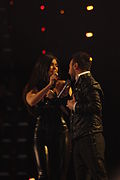


 Paula Seling and Ovi in Copenhagen (2014)

 The Humans in Lisbon (2018)

 Theodor Andrei in Liverpool (2023)
 Alexandra Căpitănescu in Vienna (2026)

.jpg)
.jpg)


.jpg)
.jpg)

See also
Notes
- Pronounced [seˈlektsi.a natsi.oˈnalə], meaning "The National Selection". The contest is sometimes referred to by local media and TVR as Eurovision România.[24][25]
- A qualifying round was held for new countries looking to make their debut at the 1993 contest. Romania failed to progress from this round; entries which failed to progress have subsequently been discounted by the EBU and do not feature as part of the countries' list of appearances.
- In order to reduce the number of participating countries at the 1996 event a qualifying round was held among all countries except the hosts. Romania failed to progress from this round; entries which failed to progress have subsequently been discounted by the EBU and do not feature as part of the countries' list of appearances.
- According to the then-Eurovision rules, the top ten non-Big Four countries from the previous year along with the Big Four automatically qualified for the final without having to compete in semi-finals. For example, if two Big Four countries were placed inside the top ten, the 11th and 12th spots would be advanced to next year's final, along with all countries ranked in the top ten.[45]
- The 2020 contest was cancelled due to the COVID-19 pandemic.
- The results of the Romanian jury were not taken into consideration for the contest's second semi-final and final since the EBU detected alleged "irregular voting patterns" in them. As a result, Romania was given a "substitute aggregated result" based on countries with similar voting patterns.[80][81]
- Eda Marcus was supposed to announce Romania's results during the final, however she was replaced by the EBU with the contest's executive supervisor Martin Österdahl due to alleged technical difficulties. Contradictory to the EBU, TVR claimed that no technical difficulties had occurred during the jury voting segment of the final.[123][124]