Rosenbauer Panther
From Wikipedia, the free encyclopedia
| Rosenbauer Panther | |
|---|---|
 | |
| Overview | |
| Type | Airport Crash Tender |
| Manufacturer | Rosenbauer |
| Production | 1991 |
| Assembly | Europe, North America and Asia |
| Designer | Kristian Fenzl |
| Body and chassis | |
| Platform | Rosenbauer Simba |
| Powertrain | |
| Engine | Volvo D16 |
| Power output | 700hp, 1400hp |
| Transmission | 6-speed, 7-speed |
| Hybrid drivetrain | 4×4, 6×6, 8×8 |
| Dimensions | |
| Length |
|
| Width |
|
| Height |
|
| Curb weight |
|
| Chronology | |
| Predecessor | Rosenbauer Simba |
Rosenbauer Panther is a model of airport crash tender produced by Austrian manufacturer Rosenbauer.
It exists in 4×4, 6×6 and 8×8 versions, with a 6×6 electric version in development. The 8×8 version accommodates 14,500 litres (3,830 gallons) of fire extinguishing agents and a maximum speed of 140 km/h (87 mph), with an operating weight of 40 tons.[1]
Generations
The Panther was released in 1991 and was the second airport crash tender vehicle from the manufacturer as a successor of the Rosenbauer Simba, which was discontinued in 1996. Panther was showcased at the Hanover show. The new vehicle was designed by Kristian Fenzl based on a MAN 36.1000 VFAEG chassis, powered by a MAN 22 litre V12 charge-cooled diesel engine producing 735 kW (990 hp) at 2,300rpm. Weighing at 36 tons, the vehicle was capable of accelerating from 0–80 km/h in 25 seconds with a top speed of 140 km/h, also having an automatic gearbox and a gradability of 60%.
First generation (1994–2004)
The first-generation Rosenbauer Panther was introduced in 1994. It featured a box-shaped cab design with a flat two-piece windshield, angular bodywork, and a mechanically simpler electrical system. Early models used halogen lighting and conventional mirror assemblies. This generation established the basic layout that would define later Panther models.
Second generation (2005–2014)
The second-generation Panther entered production in 2005. It introduced a redesigned curved windshield, a more rounded cab profile, and improved aerodynamics. The vehicle incorporated upgraded pump systems and electronics while retaining the overall proportions of the first generation. This version remained in production for nearly a decade and was widely adopted by international airports and military air bases.
Third generation (2015–2020)
Rosenbauer launched the third-generation Panther in 2015. This version featured an updated cab with more angular styling, fully integrated LED lighting, revised mirror housings, and a more modern dashboard layout. Mechanical improvements included upgraded engines, enhanced pump performance, and improved suspension options. The third generation is visually identified by its aggressive front fascia and more streamlined body panels.
Fourth generation (2021–present)
The fourth-generation Panther was unveiled in 2021. It introduced a complete redesign of the cab with expanded visibility, thin LED light bars, and a modular electronics platform. This generation supports hybrid and alternative-powertrain configurations and includes improved safety systems such as advanced driver-assistance features. It is currently the newest iteration of the Panther family.
The Panther can carry 10,000-14,000 litres of water, 1,000-2,000 litres of foaming agent and up to 500 kg of powder. The vehicle usually has an 8×8 drivetrain, but smaller vehicles with 4×4 and 6×6 drivetrain were also manufactured. These became available in May 1992.[2]
Models
- Panther 4×4
- Panther 6×6s
- Panther 6×6
- Panther 6×6 electric
- Panther 8×8
Capacity
| Models | Water (ltr) | Foam (ltr) | Powder (kg) | Output (l/min) |
|---|---|---|---|---|
| Panther 4×4 | 6,200 | 750 | 250 | 7,000 |
| Panther 6×6s | 9,100 | 1,200 | 250 | 6,500 |
| Panther 6×6 | 11,400 | 1,400 | 250 | 9,000 |
| Panther 6×6 electric | 12,000 | 1438.5 | 250 | 7949.4 |
| Panther 8×8 | 12,500 | 750×2 | 500 | 9,000[3] |
Operators
 Australia: Royal Australian Air Force
 Austria: Vienna International Airport,[4] Innsbruck Airport, Linz Airport
 Bangladesh: Civil Aviation Authority of Bangladesh
 Belarus: Minsk National Airport[5]
 Belgium: Belgian Air Force, Brussels Airport, Liège Airport
 Bolivia: Navegación Aérea y Aeropuertos Bolivianos[6]
 Brazil: São Paulo/Guarulhos International Airport
 Bosnia and Herzegovina: Sarajevo International Airport[7]
 Botswana: Civil Aviation Authority of Botswana
 Bulgaria: Vasil Levski Sofia Airport
 Cabo Verde: Aeroportos e Segurança Aérea
 Cambodia: Phnom Penh International Airport,[8]Siem Reap International Airport, Sihanouk International Airport[9]
 Canada: Toronto Pearson International Airport[10]
 China: Beijing Capital International Airport,[11] Tianjin Binhai International Airport
 Colombia: Gabriel Vargas Santos Airport, El Edén International Airport, Alfredo Vásquez Cobo International Airport[13]
 Croatia: Zagreb Airport,[14] Split Airport
 Cyprus: Larnaca International Airport[15]
 Czechia: Václav Havel Airport Prague
 Denmark: Royal Danish Air Force, Copenhagen Airport
 Ecuador: Quito International Airport
 Egypt: Cairo International Airport
 Fiji: Nadi International Airport[16]
 Finland: Helsinki Airport [17]
 France: Charles de Gaulle Airport, Lyon–Saint-Exupéry Airport
 Germany: Dortmund Airport, Frankfurt Airport, Munich Airport, Nuremberg Airport, Stuttgart Airport
 Hungary: Budapest Ferenc Liszt International Airport
 India: Indira Gandhi International Airport, Kempegowda International Airport, Cochin International Airport
 Iran: Ahwaz Airport[18]
 Iraq: Baghdad International Airport
 Ireland: Dublin Airport, Ireland West Airport, Shannon Airport, Donegal Airport
 Israel: Israeli Air Force, Ramon Airport
 Japan: Japan Air Self-Defense Force, Kansai International Airport,[19]Hanamaki Airport, Sendai Airport
 Jordan: King Hussein International Airport[20]
 Kazakhstan: Astana International Airport[21]
 Latvia: Riga International Airport
 Lithuania: Kaunas International Airport,[22] Palanga International Airport
 Luxembourg: Luxembourg Airport
 Malta: Malta International Airport[23]
 Mauritius: Sir Seewoosagur Ramgoolam International Airport
 Montenegro: Podgorica Airport,[24]Tivat Airport
 Morocco: Mohammed V International Airport
 Myanmar: Mandalay International Airport[25]
 Nepal: Civil Aviation Authority of Nepal
 The Netherlands: Amsterdam Airport Schiphol, Rotterdam The Hague Airport
 New Zealand: Wellington Airport, Auckland Airport, Christchurch Airport[28]
 Papua New Guinea: Lae Nadzab Airport[29]
 Peru: Peruvian Air Force, Jorge Chávez International Airport
 Philippines: Ninoy Aquino International Airport
 Poland: Warsaw Chopin Airport, Kraków John Paul II International Airport
 Portugal: Lisbon Airport
 Russia: Vnukovo International Airport[30]
 Saint Kitts and Nevis: Robert L. Bradshaw International Airport[31]
 Saint Lucia: George F. L. Charles Airport[32]
 Saudi Arabia: King Khalid International Airport
 Singapore: Changi Airport
 Serbia: Belgrade Nikola Tesla Airport, Niš Constantine the Great Airport
 Slovakia: Bratislava Airport
 Slovenia: Fraport Aviation Academy
 South Africa: Lanseria International Airport
 South Korea: Gyeongnam Fire Department, Wolseong Nuclear Power Plant,[33] Incheon International Airport
 Taiwan: Taoyuan Fire Department,[34] Kaohsiung International Airport, Tainan Airport
 Thailand: Suvarnabhumi Airport, Chiang Mai International Airport, U-Tapao International Airport
 Timor-Leste: Oecusse Airport
 Tunisia: Tunis–Carthage International Airport[35]
 Türkiye: Istanbul Airport
 Ukraine: Boryspil International Airport[36]
 United Arab Emirates: Dubai International Airport, Zayed International Airport
 United Kingdom: Heathrow Airport, Edinburgh Airport, Belfast International Airport, Glasgow Airport
 United States: United States Air Force,[39] Fort Lauderdale–Hollywood International Airport, Dallas Fort Worth International Airport, Port of Seattle, Los Angeles International Airport.
 Uruguay: Rivera International Airport, Nueva Hespérides International Airport
 Vietnam: Noi Bai International Airport, Tan Son Nhat International Airport,[40] Da Nang International Airport[41]


Gallery
 Budapest Airport’s Panther 6x6.
 Israeli Air Force’s Panther 4x4.
 Stuttgart Airport’s Panther 6x6.
 Hong Kong International Airport’s Panther 6x6.
 Taoyuan Fire Department’s Panther 6x6 in disaster relief exercise.
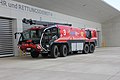 Vienna Airport’s Panther 8x8.
 A USAF Panther 6x6.
 Lima Airport’s Panther 6x6 in exhibition.
 JASDF Panther 6x6 in exhibition.


演習」_(52167025316).jpg)

.jpg)
.jpg)
_left_front_view_at_Hamamatsu_Air_Base_October_23,_2022_03.jpg)
In popular culture
The Rosenbauer Panther appears in the 2011 film Transformers: Dark of the Moon, where the character Sentinel Prime transforms into a 2001 Panther 6×6 airport crash tender. The truck used for filming had a unique red-and-black color scheme not typically used for U.S. airport ARFF vehicles.[42]
