Saraiki shalwar suits
From Wikipedia, the free encyclopedia
There are two types of Saraiki shalwar suits which originate in the southern area of Punjab, Pakistan. These are the Bahawalpuri shalwar suit and the Multani shalwar suit. The two main suits from that area.[citation needed]
The Bahawalpuri shalwar originates from the Bahawalpur region of Punjab, Pakistan.[1] The Bahawalpuri shalwar is wide and baggy with voluminous folds.[2][3]
The Bahawalpuri shalwar was worn by the men of the royal family of Bahawalpur. The royal men wore shalwar with coats, made of silk,[4] embroidered in golden patterns. The material traditionally used for the Bahawalpuri shalwar and suthan is known as sufi which is a mixture of cotton warp mixed with silk weft and gold threads running down the material.[5] The other name for these types of mixed cloth is shuja khani.[6]
The Bahawalpuri shalwar is worn with the Bahawalpur style kameez, the Punjabi kurta or chola.[7] The Bahawalpur kameez has local prints and embroidery patterns. Bandhani tye-dyeing is popular in the Cholistan desert.[8] In the early 20th century A.D. it was traditional for men to wear the angarkha on its own leaving the chest and abdomen exposed, which was locally known as the chola.[9]
The headgear includes the turban for men and headscarf for women. In the past, large turbans were worn such as the type in Bahawalpur which could be up to 40 feet long.[10] Now the turbans are shorter of various designs. Under the turban, it is traditional to wear a cap called a kolah. Men also traditionally throw a scarf over their shoulders which is embroidered on the borders.[11]
 Nawab Muhammad Of Bahawalpur (1868-1900) wearing a loose Bahawalpuri shalwar
 Prince Suba Sadiq Abbasi, Bahawalpur
 Bahawalpur kameez
 Rohi (Cholistan) woman's bandhani dress (Punjab, Pakistan)
 Nawab Sadiq Khan Fifth (died 1966)[12] in the Bahawalpuri shalwar
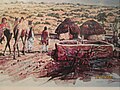 Saraiki Tradition Rohi
 Sadeq Mohammad Khan in Bahawalpuri suit


.jpg)


