Schur test
From Wikipedia, the free encyclopedia
In mathematical analysis, the Schur test, named after German mathematician Issai Schur, is a bound on the operator norm of an integral operator in terms of its Schwartz kernel (see Schwartz kernel theorem).

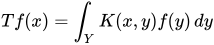
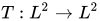
Here is one version.[1] Let be two measurable spaces (such as ). Let be an integral operator with the non-negative Schwartz kernel , , :


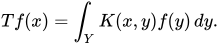
If there exist real functions and and numbers such that



for almost all and


for almost all , then extends to a continuous operator with the operator norm


Such functions , are called the Schur test functions.


In the original version, is a matrix and .[2]

A common usage of the Schur test is to take Then we get:


This inequality is valid no matter whether the Schwartz kernel is non-negative or not.
A similar statement about operator norms is known as Young's inequality for integral operators:[3]

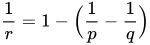
if

where satisfies , for some , then the operator extends to a continuous operator , with