Sei uns willkommen, Herre Christ
From Wikipedia, the free encyclopedia
| "Sei uns willkommen, Herre Christ" | |
|---|---|
| Christmas hymn | |
| Language | German |
| Published | 1394 |
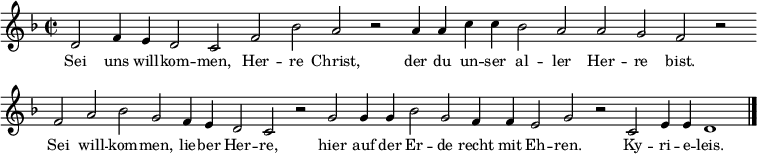
"Sei uns willkommen, Herre Christ" is the earliest surviving Christmas hymn in the German language.[1] It originated as a leise and its melody is first recorded as a fragment in the Liuthar Gospels at Aachen Cathedral Treasury, probably dating to the 14th century. The earliest complete surviving version is in a manuscript from Erfurt dating to 1394. August Heinrich Hoffmann von Fallersleben saw the hymn as originating in the 11th century and in 1861 reconstructed a translation from the Erfurt version back into Old High German.[2]
The song welcomes the Lord Christ ("Herre Christ") on earth ("auf Erden") as the Lord of "us all" ("unser aller"). The hymn is also known as the Aachener Weihnachtslied (Aachen Christmas carol) or Aachener Schöffenlied (Aachen juror carol) – according to old Aachen chronicles it was sung from the choir stalls of Aachen Cathedral by the schöffen, appointed honourable citizens involved in general government and jurisdiction, at Midnight Mass on Christmas Eve.[3][4]
Ancient melody
Sei uns willkommen, Herre Christ appeared in the 1975 Gotteslob, a German Catholic hymnal, as GL 131 with a 14th or 15th century melody from Aachen in modern notation and with the addition of a new second verse from 1970. It is no longer included in the main section of the new Gotteslob, introduced on the first Sunday of Advent in 2013, but the regional section of the Diocese of Limburg includes it as GL 757. The current Protestant hymnal Evangelisches Gesangbuch (EG 22) includes it as a round under the title Nun sei uns willkommen, Herre Christ, with a 1934 canon melody by Walter Rein.[5]

Source:[6]
Modern melody
Source: Gotteslob (1975) nr. 131


