September 10 (Eastern Orthodox liturgics)
Day in the Eastern Orthodox liturgical calendar
From Wikipedia, the free encyclopedia
Sep. 9 - Eastern Orthodox liturgical calendar - Sep. 11

All fixed commemorations below celebrated on September 23 by Orthodox Churches on the Old Calendar.[note 1]
For September 10th, Orthodox Churches on the Old Calendar commemorate the Saints listed on August 28.
Feasts
Saints
- Holy Apostles Apelles,[2] Lucius (of Laodicea in Syria, not the Evangelist),[3] and Clement,[4] of the Seventy (1st century)[5][6][7]
- Martyr Barypsabas in Dalmatia (2nd century)[5][7][8][note 2]
- Martyrs Menodora, Metrodora, and Nymphodora at Nicomedia (305-311)[5][7][10][11][note 3]
- Martyr Ia and 9,000 with her in Persia (363)[7][13] (see also: August 4, August 11, and September 11)
- Saint Eudokia the Child.[7][14][note 4]
- Saint Pulcheria the Empress (453)[5][7][15][16] (see also: February 17)[note 5]
- Venerable Peter[7][17] and Paul, Bishops of Nicaea (9th century)[5][18][19]
Pre-Schism Western saints
- Martyrs Nemesian, Felix, Lucius, another Felix, Litteus, Polyanus, Victor, Jader, Dativus and Companions (257)[9][note 6][note 7]
- Saint Agapius (Agapitus), Bishop of Novara (447)[9][12]
- Saint Veranus of Vence, son of St Eucherius of Lyons, he became a monk at Lérins, then later Bishop of Vence in the south of France (c. 480)[9]
- Saint Finnian of Movilla (Findbarr, Winnin), Abbot, in Ulster (579)[5][9][20][note 8][note 9]
- Saint Salvius, Bishop of Albi in Gaul, Confessor (584)[5][9][12][20][note 10]
- Saint Candida the Younger, a married woman in Naples who hallowed herself as a wife and as a mother (586)[9]
- Saint Theodard of Maastricht (c. 670)[5][9][20][note 11][note 12]
- Saint Autbert, Bishop of Avranches, founder of the Monastery of Mont-St-Michel on the Normandy coast (c. 709)[9]
- Saint Frithestan, a disciple of St Grimbald, he was consecrated Bishop of Winchester in England by St Plegmund (933)[9][note 13][note 14]
- Saint Peter Martinez (Peter of Mozonzo), a monk at the monastery of St Mary of Mozonzo, later Abbot of St Martin in Compostella, and finally (c 986) Archbishop (c. 1000)[9][note 15][note 16]
Post-Schism Orthodox saints
- Venerable Esaias, founder of the Kykkos Monastery in Cyprus (12th century)[22]
- Venerable Paul the Obedient, of the Kiev Caves (13th-14th century)[5][18][20][23]
- Saint Iosaph, monk, of Kubensk in Vologda (1453)[5][20][24]
- Saint Cassian, Abbot of Spaso-Kamenny and White Lake Monasteries (1469)[5][20]
- Saint Theodoritus, Archbishop of Ryazan and Murom (1617)[5][note 17]
- Venerable Saint Tikhon (Golenkov) of Kapsala, Mount Athos, the spiritual father of St. Paisios the Athonite (1968)[25][26][27][28][note 18][note 19]
New martyrs and confessors
- New Hieromartyr Meletius (Fedyunev), Hieromonk, of Kuzhba (Komi) (1937)[5][20][30]
- New Hieromartyr Gabriel (Yatsik), Archimandrite, of Donskoy Monastery, Moscow (1937)[5][20][30][31]
- New Hieromartyrs Ismael Kudryavtsev,[32] Eugene Popov,[33] John Popov,[34] Constantine Kolpetsky, Peter Grigoriev, Basil Maximov,[35] Gleb Apukhtin,[36] Basil Malinin,[37] John Sofronov,[38] Peter Yurkov, Nicholas Pavlinov, Palladius Popov, Priests (1937)[20][30]
- Martyr Symeon Turkin (1937)[20][30]
- Virgin-Martyr Tatiana Grimblit (1937)[20][30][note 20]
- New Hieromartyr Warus (Shmarin), Bishop of Lipetsk (1938)[5][20][30][note 21]
- New Martyrs of Rmanj.[39][40][note 22]
Other commemorations
- Translation of the relics of St. Egvin, Bishop of Worcester.[20]
- Translation of the relics of St. Ethelwold, Bishop of Winchester.[20]
- Synaxis of the Icon of the Theotokos "Trikeriotissas" (1825)[42][43]
- Synaxis of the Theotokos "Orchomeniotissa" ("Panagia Skripou") (1943)[44]
- Synaxis of the Saints of Lipetsk.[30][note 23]
Icon gallery
 Martyr Barypsabas in Dalmatia.
 Martyrs Menodora, Metrodora, and Nymphodora at Nicomedia.
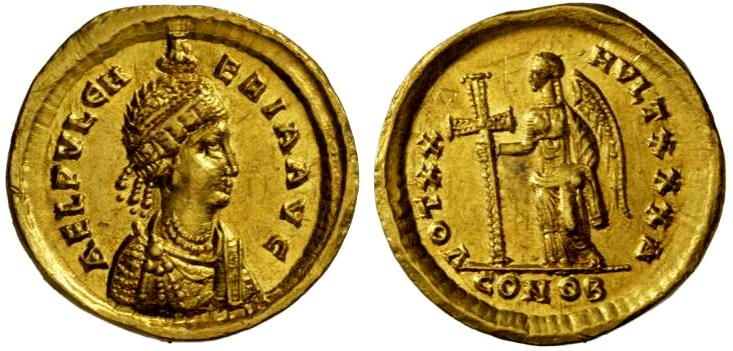 Coin of Aelia Pulcheria.
 St. Finnian of Movilla.
 Virgin-Martyr Tatiana Grimblit.
 New Hieromartyr Warus (Shmarin), Bishop of Lipetsk.
.jpg)
.jpg)


.jpg)
Notes
- The notation Old Style or (OS) is sometimes used to indicate a date in the Julian Calendar (which is used by churches on the "Old Calendar").
The notation New Style or (NS), indicates a date in the Revised Julian calendar (which is used by churches on the "New Calendar"). - The memory of this young girl is recorded in the Jerusalemitic Canonarion, page 107, and is absent from the Synaxaria. Note also, there is an entry on August 4 for "Martyr Eudokia of Anatolia, in Persia, by beheading", which notes that there is some confusion in the Synaxaria between this Eudokia (Eudok-ia) and the martyr Ia.
- Nine bishops of Numidia in North Africa who with numerous other clergy and laypeople were condemned to slavery in the marble quarries of Sigum where they ended their lives. A letter of St Cyprian addressed to them still exists.
- "In Africa, the birthday of the holy bishops Nemesian, Felix, Lucius, another Felix, Litteus, Polyan, Victor, Jader, Dativus, and others. As a violent persecution was breaking out under Valerian and Gallienus, they were at their first courageous confession of Christ beaten with rods, then put in irons, and being sent to dig in the metal mines, they terminated their combat and glorious confession."[12]
- "ST. FlNIAN, or FlNDBAR, who is also called FlNAN, and by the Britons WlNNlN, was a native of Ireland, and of noble birth. He received his first education from Colman, a holy Bishop, and afterwards went over to Britain. Like St. Tigernake, he is called a disciple of Monennius, which probably means that he became a scholar of St. Ninian's great monastery at Whithern, in Strathclyde. On his return to Ireland he became Abbot of Maghbile, and is also called a Bishop. He was greatly famed for his sanctity and extraordinary miraculous gifts. Among other prodigies, he is said to have raised four persons to life. He was anciently honoured as the Patron of the Province of Ulster."[21]
- A lawyer who became a monk and abbot, then a hermit and finally Bishop of Albi in France (574-584). He died while tending the sick during an epidemic.
- A disciple of St Remaclus at Malmédy-Stavelot in Belgium and his successor as Abbot (653) and Bishop of Maastricht (663). He was murdered by robbers in the forest of Bienwald near Speyer in Germany on a journey undertaken in defence of his church.
- He was bishop for twenty-three years, loved the poor and prayed much for the departed.
- "ST. FRITHESTANE is said to have been a disciple f St. Grimbald. His eminent virtues led to his appointment as Bishop of Winchester, and he was one of seven who were consecrated on the same day in the year 909, by Archbishop St. Plegmund, to fill the Sees which were then vacant. He ruled his diocese for the long period of twenty-three years, and is reported to have been a man of great sanctity of life, though no record of his acts has come down to our time. A year before his blessed death he consecrated St. Bristan as his successor, and retired to pass his last days in solitude and prayer."[21]
- See: (in Spanish) Pedro de Mezonzo. Wikipedia. (Spanish Wikipedia).
- See: (in Russian) ФеодоÑÐ¸Ñ (аÑÑ Ð¸ÐµÐ¿Ð¸Ñкоп Ð ÑзанÑкий). Ðикипедии. (Russian Wikipedia).
- He was glorified by the Ecumenical Patriarchate on February 11, 2026. The official communiqué of the Ecumenical Patriarchate was as follows:
(in Greek)"Î¤Ï á¼¹ÎµÏÏν Σῶμα á¼ÏεÏάÏιÏεν á½Î¼Î¿ÏÏνÏÏ Ïήν καÏάÏαξιν Îµá¼°Ï ÏÏ á¼Î³Î¹Î¿Î»Ïγιον Ïá¿Ï á¼ÎºÎºÎ»Î·ÏÎ¯Î±Ï Ïῶν á½Ïιακá¿Ï βιοÏá¿Ï á¼Î³Î¹Î¿ÏειÏῶν ἹεÏομονάÏÎ¿Ï Î¤ÏÏÏνοÏ, Ïοῦ á¼Î½ Ïá¿· á¼Î½ ÏῠΣκήÏá¿ ÎαÏÎ¬Î»Î±Ï á¼¹ÎµÏá¿· ΣÏÎ±Ï ÏονικηÏιανῷ Îελλίῳ Ïοῦ Î¤Î¹Î¼Î¯Î¿Ï Î£ÏÎ±Ï Ïοῦ á¼ÏκήÏανÏοÏ, καί μοναÏοῦ ÎεÏÏÎ³Î¯Î¿Ï , Ïοá½Ïίκλην ΧαÏζη-ÎεÏÏγη, Ïοῦ á¼Îº ÎαÏÏÎ±Î´Î¿ÎºÎ¯Î±Ï ÎºÎ±ÏαγομÎÎ½Î¿Ï ÎºÎ±Î¯ á¼Î½ ÎÏνÏÏανÏÎ¹Î½Î¿Ï ÏÏλει κοιμηθÎνÏοÏ."[26]
- The question of the glorification of the Russian Athonite elder Tikhon (Golenkov) was also discussed in 2017 at the Moscow Theological Academy at the Trinity-St. Sergius Lavra. The discussion occurred as part of the academyâs "Day of the Memory of Two Elders: St. Paisios the Athonite and Archimandrite Kirill (Pavlov)", in which the new book Athonite Elder Tikhon (Golenkov) (in Russian) was presented. The hope was expressed that the Church would support the glorification of this great twentieth-century elder, reports a correspondent of the site 'Russian Athos'.
Elder Tikhon was born in 1884 in the Russian Empire, in the village of Novaya Mikhaylovka (in present-day Volgograd). At the age of 24 he arrived to Mount Athos where he spent the remaining sixty years of his life in unceasing prayer and repentance. He is an example to all of a true Christian and monk who already in his lifetime acquired the Holy Spirit, and his relics have been shown to be incorrupt.[29]
(in Russian): СÑаÑÐµÑ Ð¢Ð¸Ñ Ð¾Ð½ (Ðоленков) СвÑÑогоÑÐµÑ (1884â1968). - See: (in Russian) ÐÑимблиÑ, ТаÑÑÑна Ðиколаевна. Ðикипедии. (Russian Wikipedia).
- See: (in Russian) Ð£Ð°Ñ (ШмаÑин). Ðикипедии. (Russian Wikipedia).
- The Martyrs of Rmanj were monks and clergy from St. Nicholas Monastery in Rmanj whose remains were discovered during renovation work around the monastery church in 2022, having been buried near the church foundations and entrance as witnesses to the monasteryâs difficult history, and are now preserved in a reliquary in the monastery.[41]
- See: (in Russian) Ð¡Ð¾Ð±Ð¾Ñ ÐипеÑÐºÐ¸Ñ ÑвÑÑÑÑ . Ðикипедии. (Russian Wikipedia).