Spinor condensate
From Wikipedia, the free encyclopedia
Spinor condensates are degenerate Bose gases that have degrees of freedom arising from the internal spin of the constituent particles.[1][2] They are described by a multi-component (spinor) order parameter. Since their initial experimental realisation, a wealth of studies have appeared, both experimental and theoretical, focusing on the physical properties of spinor condensates, including their ground states, non-equilibrium dynamics, and vortices.
The study of spinor condensates was initiated in 1998 by experimental groups at JILA[3] and MIT.[4] These experiments utilised 23Na and 87Rb atoms, respectively. In contrast to most prior experiments on ultracold gases, these experiments utilised a purely optical trap, which is spin-insensitive. Shortly thereafter, theoretical work appeared[5][6] which described the possible mean-field phases of spin-one spinor condensates.
Underlying Hamiltonian
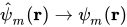
The Hamiltonian describing a spinor condensate is most frequently written using the language of second quantization. Here the field operator creates a boson in Zeeman level at position . These operators satisfy bosonic commutation relations:


![{\displaystyle [{\hat {\psi }}_{m}({\bf {r}}),{\hat {\psi }}_{m'}^{\dagger }({\bf {r}}')]=\delta ({\bf {r}}-{\bf {r}}')\delta _{mm'}.}](https://wikimedia.org/api/rest_v1/media/math/render/svg/49dd034f01c623a03ec748d225dcaabfefd9b60e)
The free (non-interacting) part of the Hamiltonian is

where denotes the mass of the constituent particles and is an external potential. For a spin-one spinor condensate, the interaction Hamiltonian is[5][6]


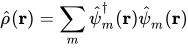
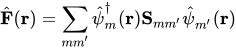
In this expression, is the operator corresponding to the density, is the local spin operator ( is a vector composed of the spin-one matrices), and :: denotes normal ordering. The parameters can be expressed in terms of the s-wave scattering lengths of the constituent particles. Higher spin versions of the interaction Hamiltonian are slightly more involved, but can generally be expressed by using Clebsch–Gordan coefficients.


The full Hamiltonian then is .