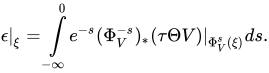
Spray (mathematics)
From Wikipedia, the free encyclopedia
In differential geometry, a spray is a vector field H on the tangent bundle TM that encodes a quasilinear second order system of ordinary differential equations on the base manifold M. Usually a spray is required to be homogeneous in the sense that its integral curves t→ΦHt(ξ)∈TM obey the rule ΦHt(λξ)=ΦHλt(ξ) in positive re-parameterizations. If this requirement is dropped, H is called a semi-spray.
Sprays arise naturally in Riemannian and Finsler geometry as the geodesic sprays whose integral curves are precisely the tangent curves of locally length minimizing curves. Semisprays arise naturally as the extremal curves of action integrals in Lagrangian mechanics. Generalizing all these examples, any (possibly nonlinear) connection on M induces a semispray H, and conversely, any semispray H induces a torsion-free nonlinear connection on M. If the original connection is torsion-free it coincides with the connection induced by H, and homogeneous torsion-free connections are in one-to-one correspondence with full sprays.[1]
Let M be a differentiable manifold and (TM,πTM,M) its tangent bundle. Then a vector field H on TM (that is, a section of the double tangent bundle TTM) is a semi-spray on M, if any of the three following equivalent conditions holds:
- (πTM)*Hξ = ξ.
- JH=V, where J is the tangent structure on TM and V is the canonical vector field on TM\0.
- j∘H=H, where j:TTM→TTM is the canonical flip and H is seen as a mapping TM→TTM.
A semispray H on M is a (full) spray if any of the following equivalent conditions hold:
- Hλξ = λ*(λHξ), where λ*:TTM→TTM is the push-forward of the multiplication λ:TM→TM by a positive scalar λ>0.
- The Lie-derivative of H along the canonical vector field V satisfies [V,H]=H.
- The integral curves t→ΦHt(ξ)∈TM\0 of H satisfy ΦHt(λξ)=λΦHλt(ξ) for any λ>0.
Let be the local coordinates on associated with the local coordinates ) on using the coordinate basis on each tangent space. Then is a semi-spray on if it has a local representation of the form



on each associated coordinate system on TM. The semispray H is a (full) spray, if and only if the spray coefficients Gi satisfy

Semi-sprays in Lagrangian mechanics
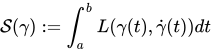
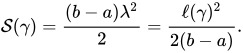
A physical system is modeled in Lagrangian mechanics by a Lagrangian function L:TM→R on the tangent bundle of some configuration space M. The dynamical law is obtained from the Hamiltonian principle, which states that the time evolution γ:[a,b]→M of the state of the system is stationary for the action integral
- .
In the associated coordinates on TM the first variation of the action integral reads as

where X:[a,b]→R is the variation vector field associated with the variation γs:[a,b]→M around γ(t) = γ0(t). This first variation formula can be recast in a more informative form by introducing the following concepts:
- The covector with is the conjugate momentum of .
- The corresponding one-form with is the Hilbert-form associated with the Lagrangian.
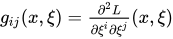
- The bilinear form with is the fundamental tensor of the Lagrangian at .
- The Lagrangian satisfies the Legendre condition if the fundamental tensor is non-degenerate at every . Then the inverse matrix of is denoted by .
- The Energy associated with the Lagrangian is .

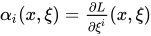

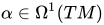





If the Legendre condition is satisfied, then dα∈Ω2(TM) is a symplectic form, and there exists a unique Hamiltonian vector field H on TM corresponding to the Hamiltonian function E such that
- .

Let (Xi,Yi) be the components of the Hamiltonian vector field H in the associated coordinates on TM. Then

and

so we see that the Hamiltonian vector field H is a semi-spray on the configuration space M with the spray coefficients

Now the first variational formula can be rewritten as

and we see γ[a,b]→M is stationary for the action integral with fixed end points if and only if its tangent curve γ':[a,b]→TM is an integral curve for the Hamiltonian vector field H. Hence the dynamics of mechanical systems are described by semisprays arising from action integrals.





![{\displaystyle \gamma :[a,b]\to M}](https://wikimedia.org/api/rest_v1/media/math/render/svg/b5c2d8d0dd04be91ac24d40469cc8b8ad0c7057d)



![{\displaystyle \displaystyle T(X,Y)=J[hX,hY]-v[JX,hY]-v[hX,JY].}](https://wikimedia.org/api/rest_v1/media/math/render/svg/a9178556606b1f11ce438b111f558599b7a5be31)

![{\displaystyle \tau ={\mathcal {L}}_{V}v={\tfrac {1}{2}}{\mathcal {L}}_{[V,H]-H}J}](https://wikimedia.org/api/rest_v1/media/math/render/svg/8f06a7d1e36c15f43f227c93eaa3c54fc466df1b)