Talk:Muslims
From Wikipedia, the free encyclopedia
| This is the talk page for discussing improvements to the Muslims article. This is not a forum for general discussion of the subject of the article. |
Article policies
|
| Find sources: Google (books · news · scholar · free images · WP refs) · FENS · JSTOR · TWL |
Archives (index): 1, 2, 3, 4, 5, 6, 7, 8, 9Auto-archiving period: 12 months  |
 | This  level-5 vital article is rated C-class on Wikipedia's content assessment scale. level-5 vital article is rated C-class on Wikipedia's content assessment scale.It is of interest to the following WikiProjects: | ||||||||||||||||||||
| |||||||||||||||||||||


 | This article was reviewed by The Independent on February 12, 2006. For more information about external reviews of Wikipedia articles and about this review in particular, see this page. |
 Archives |
| Index 1, 2, 3, 4, 5, 6, 7, 8, 9 |
|
This page has archives. Topics inactive for 365 days are automatically archived by ClueBot III if there are more than 4. |
Infobox image
Recently, I changed the image in the infobox for this article, which was later reverted by @StasiaNote. I did this because the image shown in the infobox is the following painting:

The reason I decided to remove this painting as the depiction for Muslims is primarily because of the artist himself, Jean-Léon Gérôme. Gérôme is infamously known for his participation in Orientalism, even the lead image on that article shows a painting by Gérôme. His article also discusses his Orientalist legacy. By using this image (and only this depiction of Muslims is used in the entire article), Wikipedia risks associating itself with Orientalism, which would violate NPOV.
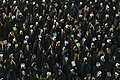
I certainly recommend replacing the Gérôme painting with a less controversial image. When I removed the painting, I replaced it with the following photograph. I thought it would be the most helpful as:
- Every person depicted in the image is certainly a Muslim.
- The location is an area important to the religion of Islam.
- A diverse group of people are represented in the photo.
- The people are participating an Islamic ritual.

If, for whatever reason, this image is also controversial, then I suggest the usage of one of the images in the below gallery.
 Muslim men praying in Indonesia
 Muslim women in Iran during Qadr night.
 Muslim prayer in Damascus
 Eid al-fitr prayer in Zahedan
 Jiangwan Mosque, Yangpu District, Shanghai, China


―Howard • 🌽33 19:14, 11 March 2024 (UTC)
- Not only this but even within Islam illustrations of living beings is very controversial. I agree with the reasons you have listed which favour these selected photographs. The first image capturing pilgrims in Mecca is a great image suitable to be used. I also like the one capturing Muslims praying in Zahedan, as it shows a great amount of Muslims. 58.106.179.154 (talk) 12:28, 22 October 2024 (UTC)
- I cannot follow you. What do you mean by "risks associating tiself with Orientalism"? Here, the cited definition of the article:
"In art history, literature and cultural studies, Orientalism is the imitation or depiction of aspects of the Eastern world (or "Orient") by writers, designers, and artists from the Western world. Orientalist painting, particularly of the Middle East"
- How is the image cultural appropriation by drawing Muslims? VenusFeuerFalle (talk) 16:07, 10 December 2024 (UTC)
- The painting has been described as Orientalist by various sources.[1][2][3] It is also important to note that the painting itself features a topographical inaccuracy which would have the subjects praying in a direction other than Mecca.[4] Gerome was probably not aiming to depict a faithful Muslim prayer here, and we have better images anyway. ―Howard • 🌽33 16:56, 10 December 2024 (UTC)
- How is topographical inaccuracy indicating that Gerome was praying something else than faithful Muslims? Would you mind elaborating your point?
- Also kindly remind you to respond to my questions. I posed them because I consider them relevant to the discussion. VenusFeuerFalle (talk) 22:59, 11 December 2024 (UTC)
- I did answer your questions, I gave three citations which state that the painting is an Orientalist work. On the question of topographical accuracy, in Islam, directing oneself towards the Kaaba is an important aspect of prayer. By misdirecting the Muslims to pray to a different direction, it would be an inaccuracy in portraying Muslim prayer. In any case, can I ask why you insistently want this particular painting to be the lead image, despite there being hundreds of other options? ―Howard • 🌽33 23:12, 11 December 2024 (UTC)
- This leads to nothing... Please read the questions again, and then answer them. I do not intent to repeat them neither do I intent to work them out for you. Until then, I ignore the rest of your points, since I need my questions to be answered before I can adress the rest. Although I think I clarified the rest of your inquiries in my initial reverting. VenusFeuerFalle (talk) 02:19, 12 December 2024 (UTC)
- I gave you my answer for why I believe the artwork is Orientalist. The majority of reliable sources describe it as such, and that is enough. If you cannot provide any sources to back up your claim that the work is somehow not Orientalist, then your argument is meritless. Until then, I ignore the rest of your points, which shouldn't matter since you have so far cited no reliable sources to back up your claim that the painting has "symbol value," (outside of the value being that it is an inaccurate Orientalist depiction.) ―Howard • 🌽33 02:36, 12 December 2024 (UTC)
- I never asked you "why" you believe it is Orientalist, but okay. With your tone getting more and more passive aggressive, I will conclude our discussion now: You failed to reach consensus and everything remains as it was. good day Sir VenusFeuerFalle (talk) 03:07, 12 December 2024 (UTC)
- Question:
What do you mean by "risks associating tiself with Orientalism"?
- Answer: The artwork is Orientalist, per the cited sources. By presenting an Orientalist artwork as the lead image, the article is thereby presenting a view of Muslims from an Orientalist perspective. This is what I mean by "risks associating itself with Orientalism," because the article is using an Orientalist depiction as its primary depiction of Muslims.
- Question:
How is the image cultural appropriation by drawing Muslims?
- Answer: The artwork was painted by a French non-Muslim artist who has repeatedly made Orientalist works throughout his career.[5][6][7][8] In the case of this painting, it is known that he took artistic license with how he depicted the prayer. Most importantly, the Muslims in the painting are not praying towards Mecca,[9] which goes against normative prayer practice. The image is therefore cultural appropriation since:
- 1. Gerome was neither Muslim, nor a member of the culture he is depicting.
- 2. He prioritizes artistic license above depicting the prayer accurately.
- Question:
How is topographical inaccuracy indicating that Gerome was praying something else than faithful Muslims? Would you mind elaborating your point?
- Answer: See Qibla. Muslims traditionally pray towards the Kaaba. In his depiction of Muslims, Gerome did not acknowledge this, or worse, he actively ignored it, thereby showing his callousness towards depicting Muslims faithfully.
- Additional statement:
Although I think I clarified the rest of your inquiries in my initial reverting
- Response: You have so far appealed only to prior consensus and have not addressed any of my arguments or provided any citations which back up your claim that the artwork is somehow not Orientalist. ―Howard • 🌽33 15:17, 12 December 2024 (UTC)
- I agree with your Howardcorn33. This image is extremely problematic and borderline racist and colonialist and should be removed. Clearly a lot of people are against it as there have been many people who’ve tried to change or remove it recently but Venus thinks they’re some authority and can revert everyone’s edits without any consensus even though concencus should now be established that dozens of people find this extremely problematic compared to just one who doesn’t and think they’re the authority Rafnator9 (talk) 17:04, 22 December 2024 (UTC)
- Crazy that this is even a topic - of course this painting should have been removed a long time ago. An analogous example would be if the Wiki page for Christians featured an Ottoman miniature from the 15th century showing Christians praying (incorrectly) in Constantinople. Teodorfon (talk) 02:24, 29 December 2024 (UTC)
- Can't we just use a miniature or something if showing artwork is that important? Something like this maybe:

- Yes I know it shows a court scene instead of people praying but I couldn't find any like that. Maybe if we look hard enough that could be the best solution? BlackHole360 (talk) 12:27, 18 December 2025 (UTC)
- Crazy that this is even a topic - of course this painting should have been removed a long time ago. An analogous example would be if the Wiki page for Christians featured an Ottoman miniature from the 15th century showing Christians praying (incorrectly) in Constantinople. Teodorfon (talk) 02:24, 29 December 2024 (UTC)
- I agree with your Howardcorn33. This image is extremely problematic and borderline racist and colonialist and should be removed. Clearly a lot of people are against it as there have been many people who’ve tried to change or remove it recently but Venus thinks they’re some authority and can revert everyone’s edits without any consensus even though concencus should now be established that dozens of people find this extremely problematic compared to just one who doesn’t and think they’re the authority Rafnator9 (talk) 17:04, 22 December 2024 (UTC)
- Question:
- I never asked you "why" you believe it is Orientalist, but okay. With your tone getting more and more passive aggressive, I will conclude our discussion now: You failed to reach consensus and everything remains as it was. good day Sir VenusFeuerFalle (talk) 03:07, 12 December 2024 (UTC)
- I gave you my answer for why I believe the artwork is Orientalist. The majority of reliable sources describe it as such, and that is enough. If you cannot provide any sources to back up your claim that the work is somehow not Orientalist, then your argument is meritless. Until then, I ignore the rest of your points, which shouldn't matter since you have so far cited no reliable sources to back up your claim that the painting has "symbol value," (outside of the value being that it is an inaccurate Orientalist depiction.) ―Howard • 🌽33 02:36, 12 December 2024 (UTC)
- This leads to nothing... Please read the questions again, and then answer them. I do not intent to repeat them neither do I intent to work them out for you. Until then, I ignore the rest of your points, since I need my questions to be answered before I can adress the rest. Although I think I clarified the rest of your inquiries in my initial reverting. VenusFeuerFalle (talk) 02:19, 12 December 2024 (UTC)
- I did answer your questions, I gave three citations which state that the painting is an Orientalist work. On the question of topographical accuracy, in Islam, directing oneself towards the Kaaba is an important aspect of prayer. By misdirecting the Muslims to pray to a different direction, it would be an inaccuracy in portraying Muslim prayer. In any case, can I ask why you insistently want this particular painting to be the lead image, despite there being hundreds of other options? ―Howard • 🌽33 23:12, 11 December 2024 (UTC)
- The painting has been described as Orientalist by various sources.[1][2][3] It is also important to note that the painting itself features a topographical inaccuracy which would have the subjects praying in a direction other than Mecca.[4] Gerome was probably not aiming to depict a faithful Muslim prayer here, and we have better images anyway. ―Howard • 🌽33 16:56, 10 December 2024 (UTC)
- I agree with your Howardcorn33. This image is extremely problematic and borderline racist and colonialist and should be removed. Clearly a lot of people are against it as there have been many people who’ve tried to change or remove it recently but Venus thinks they’re some authority and can revert everyone’s edits without any consensus even though concencus should now be established that dozens of people find this extremely problematic compared to just one who doesn’t and think they’re the authority. It would be most appropriate and appreciated to change the image to a neutral one like the ones that you’ve suggested above Rafnator9 (talk) 17:05, 22 December 2024 (UTC)

References
- O’Regan, Maebh (2008-01-01). "Painting, Politics and Propaganda". Journal of Irish and Scottish Studies. 2 (1): 142. doi:10.57132/jiss.163. ISSN 2753-328X.
- Gill, Hélène (2002). "French orientalist painting as a transcultural exercise: an ambiguous gaze". ASCALF Bulletin. 25: 13.
- Martin, Meredith (2017-01-02). "History Repeats Itself in Jean-Léon Gérôme's Reception of the Siamese Ambassadors". The Art Bulletin. 99 (1): 19. doi:10.1080/00043079.2017.1265287. ISSN 0004-3079.
- Fantasy or ethnography : irony and collusion in subaltern representation. Columbus, Ohio : Division of Comparative Studies in the Humanities, Ohio State University. 1996. pp. 120–121.
- https://www.theguardian.com/artanddesign/jonathanjonesblog/2012/jul/03/jean-leon-gerome-orientalism-impressionists (can't be bothered to make a full citation)
July 2025

@Howardcorn33: How about this image? It is a commons FP, shows a wide range of ages, racial/ethnic backgrounds, gender, clothing etc, engaged in an Islamic ritual at the holiest Muslim shrine. It depicts Muslims in the diversity that they exist in. I also believe the painting should be replaced. UnpetitproleX (talk) 23:12, 24 July 2025 (UTC)
- I also like the image you originally posted above (it is from the same author, apparently). But in this one more people have their face towards the camera, I think that way it is better. And is FP. UnpetitproleX (talk) 23:17, 24 July 2025 (UTC)
- OK, I just realized that Christians, Hindus and Sikhs also have paintings in infobox. If it is a deliberate choice, I understand. But the image at right still makes more sense to me. (Jews only has the star of David; Buddhists, Jains, Bahais and Zoroastrians are redirects to their respective religion articles). UnpetitproleX (talk) 23:26, 24 July 2025 (UTC)
Semi-protected edit request on 23 October 2024
 | This edit request has been answered. Set the |answered= parameter to no to reactivate your request. |
The Muslim Population has officially passed 2 Billion. According to the very source 3 linked on the population 1.9 number. All stats used are from 2020 or prior. The projections in all the linked sources show that it’d be 2 billion by now. Again the 3rd source for the 1.9 billion number already updated itself to 2 billion and Wikipedia should update the number as well. Thank you. 2601:447:CB80:C1D0:8DD8:6149:7E06:5C5 (talk) 05:13, 23 October 2024 (UTC)
 Not done: please provide reliable sources that support the change you want to be made. Are there any sources that state the population has passed 2 billion not as a prediction? FifthFive (talk) 06:06, 23 October 2024 (UTC)
- Does this work?
- https://timesprayer.com/en/muslim-population/
- 2,045,109,643 75.142.254.3 (talk) 04:17, 6 May 2025 (UTC)

Breakdown by ethnic groups
This article makes reference to nationalities represented within the group of Muslim-identifying people worldwide, but I would like to see a breakdown by ethnic groupings. For example, the article notes that Indonesia is home to the most Muslims, but Indonesia is also home to various ethnic groups such as Javanese, Sudanese and Malay. I would like to see this article describe the ethnic groups who identify as Muslim, globally. 69.132.247.149 (talk) 15:32, 29 April 2025 (UTC)
Copy Edit of the whole article
| This edit request by an editor with a partial block from editing this page has now been answered. |
Outside of the Muslim -> Outside the Muslim
its pronunciation was opposed -> its pronunciation were opposed
on Muslim population -> on the Muslim population The Other Karma (talk) 09:05, 21 October 2025 (UTC)
 Done Side note, the first one seems like a British vs. American thing, but since the article does ask for British English, then the change is appropriate. TimSmit (talk) 20:39, 22 October 2025 (UTC)

Semi-protected edit request on 28 October 2025
| This edit request has been answered. Set the |answered= parameter to no to reactivate your request. |
Hello, in the demographic section, Arabs do not the largest ethnic group that is muslim and the source included is wrong. Indo-aryans, Turkic and persians are a larger. Arab muslims only account for 20% of the muslim population. links: https://www.learnreligions.com/worlds-muslim-population-2004480.com https://www.dailyprincetonian.com/article/2023/04/princeton-opinion-arabic-religion-islam-ramadan.com 82.32.241.192 (talk) 10:00, 28 October 2025 (UTC)
 Not done: it's not clear what changes you want to be made. Please mention the specific changes in a "change X to Y" format and provide a reliable source if appropriate.
 Please use the "x to y" format, because otherwise I or another volunteer will need to come up with the new text for your edit request. Thank you and happy editing, Slomo666 (talk) 18:12, 28 October 2025 (UTC)

Sunni Islam and Shia Islam and other sects are not “denominations”.
Denominations are defined as groups that follow the same religion with slightly different beliefs.
However, when a creed is fundamentally different, it is defined as a “sect”, and not a denomination.
Denomination is semantically a faulty description for the different sects because these sects fundamentally believe in different things, to the point they are no longer always the same religion, nor do they have slightly different beliefs. ~2026-11104-65 (talk) 13:16, 19 February 2026 (UTC)
Infobox image (2026)
I changed the infobox image as had been discussed previously and it has been reverted, once again, to the Gérôme painting. It certainly appeared to me that a consensus had been reached, and users were discussing this issue as reverently as December 2025, but I figured I'd bring this back up in the talk page.
My thoughts as to why the image should be changed:
1. Prayer in Cairo is an artifact of Orientalism. Gérôme is basically THE Orientalist painter. How can this be in line with NPOV?
2. Illustrations of living beings are not entirely uncontroversial. Aniconism is very much still a part of Islam, even if it is not necessarily mainstream. (Admittedly, I'm not sure that photograph entirely circumvents that).
3. NPOV is a pillar of Wikipedia. Why should the first depiction of Muslims on their Wikipedia page an image created by someone from outside of that faith and cultural sphere?
I don't know that I have seen any convincing arguments in favor of the Gérôme painting on this talk page. I'm open to having my mind changed, but from where I stand it sort of just seems that some users who are closely watching this page are just partial to the painting. Bcbroughton (talk) 19:02, 25 February 2026 (UTC)
- I don't see anything inherently wrong with the painting. Gérôme may have been Orientalist painter but this specific work merely depicts Muslims praying in a mosque and there's nothing that makes it problematic. Moreover, Wikipedia does require depictions to come from insiders of the faith for neutrality. A random contemporary photograph isn't necessarily an improvement. Skitash (talk) 19:19, 25 February 2026 (UTC)
- I have changed the caption from "Prayer in Cairo (1865) by Jean-Léon Gérôme" to "Mid-19th-century painting by Jean-Léon Gérôme, the muslim performs of Salah 5 times a day with imam as a leader of salah". Baqotun0023 (talk) 06:35, 3 March 2026 (UTC)