Tokyo Metro 05 series
Japanese train type
From Wikipedia, the free encyclopedia
The TRTA/Tokyo Metro 05 series (å¶å£ã»æ±äº¬ã¡ãã05ç³», Eidan/TÅkyÅ Metoro 05-kei) is an electric multiple unit (EMU) train type operated on the Tokyo Metro Tozai Line and Tokyo Metro Chiyoda Line Ayase Branch in Japan by the subway operator Tokyo Metro. Some sets have also been shipped to Indonesia, where they operated on the KRL Commuterline system in Jakarta between 2011 and 2025.

2010â2025 (Indonesia)
- Tokyo Metro 5000 series
- Tokyo Metro 6000 series (Chiyoda Branch Line)
| TRTA/Tokyo Metro 05 series | |
|---|---|
Set 05-122 in July 2022 | |
| In service | 1988âpresent (Japan) 2010â2025 (Indonesia) |
| Manufacturers | Kinki Sharyo, Hitachi, Nippon Sharyo, Kawasaki Heavy Industries, Tokyu Car Corporation |
| Family name | Hitachi A-train (Batch 13) |
| Replaced |
|
| Constructed | 1988â2004 |
| Entered service | 16 November 1988 |
| Refurbished | Tokyo Metro (2012â) INKA (2023â) |
| Scrapped | 2010â |
| Number built | 430 vehicles (43 sets) |
| Number in service |
|
| Successor | Tokyo Metro 15000 series (Batch 1, Japan) |
| Formation |
|
| Fleet numbers | 01-43 |
| Operators |
|
| Depots |
|
| Lines served |
|
| Specifications | |
| Car body construction | Aluminium |
| Car length | 20 m (65 ft 7 in) |
| Width | 2.850 m (9 ft 4+3â16 in)(05) 2.800 m (9 ft 2+1â4 in)(05N) |
| Height | 4.022â4.135 m (13 ft 2 in â 13 ft 7 in) (4.08â4.145 m (13 ft 5 in â 13 ft 7 in) with pantograph) |
| Doors | 4 per car |
| Maximum speed | 110 km/h (68.4 mph) (design, sets 05101-05133) 120 km/h (74.6 mph) (design, 05134-05143) 100 km/h (62.1 mph) (Tokyo Metro Tozai Line) |
| Traction system |
|
| Transmission | Westinghouse Natal (WN) drive |
| Acceleration | 3.3 km/(hâ s) (2.1 mph/s) |
| Deceleration | 3.5 km/(hâ s) (2.2 mph/s) |
| Electric systems | 1,500 V DC overhead catenary |
| Current collection | Pantograph |
| Bogies | Bolsterless air spring bogie |
| Braking system | Electronically controlled pneumatic brakes with regenerative braking |
| Safety systems | CS-ATC (Tokyo Metro Tozai Line), ATS-P (ChÅ«Å-SÅbu Line), WS-ATC (TÅyÅ Rapid Railway) |
| Coupling system | Shibata |
| Track gauge | 1,067 mm (3 ft 6 in) |


A total of 43 ten-car trainsets were built from 1988 to 2004, with a number of variants. Sets 05-125 onward have a redesigned front end, and are called "05N series". Sets 05-114 to 05-118 have wide doors. A further four sets were due to be built, but the plan was changed to use 07 series trains transferred from the Yurakucho Line, so no further 05 series trains were built.
Operations
As of 1 April 2017[update], a total of 34 sets (30 x ten-car sets and 4 x three-car sets) were in operation in Japan.[1]
Tozai Line 10-car sets
30 x ten-car sets based at Fukagawa Depot and used on the following lines.[1]
- Tokyo Metro Tozai Line
- TÅyÅ Rapid Line between Nishi-Funabashi Station, TÅyÅ-Katsutadai Station and Nakano Station.
- JR ChÅ«Å-SÅbu Line between Nakano Station and Mitaka Station.
- JR ChÅ«Å-SÅbu Line between Nishi-Funabashi Station and Tsudanuma Station (only weekday mornings and evenings).
Chiyoda Line 3-car sets
Four three-car sets based at Ayase Depot for use on Chiyoda Line Kita-Ayase Branch Line services since 2014.[1]
Specifications
| 05-101 to 113 | 05-114 | 05-115 to 118 | 05-119 to 124 | 05-125 to 133 | 05-134 to 139 | 05-140 to 143 | |
|---|---|---|---|---|---|---|---|
| Max speed (km/h) | 110 | 120 | |||||
| Acceleration (km/h/s) | 3.3 | 3.0 | 3.3 | ||||
| Deceleration (km/h/s) | 3.5 (emergency 5.0) | ||||||
| Front end style | Rectangular lights, no skirt | Round lights, skirt | |||||
| Headlights | Sealed beam | HID | |||||
| Destination indicators | Roller blind (converted Chiyoda branch line use LED display) | 3-colour LED | |||||
| Interior LED displays | 8 per car | 4 per car | |||||
| Control system | Chopper | GTO-VVVF | Chopper | IGBT-VVVF | |||
| Motor/trailer ratio | 5M5T | 4M6T | 5M5T | 4M6T | 5M5T | ||
| Motor output (kW per motor) | 160 | 200 | 160 | 205 | 165 | ||
| Train power output (kW) | 3,200 | 3,280 | 3,300 | ||||
| Gear ratio | 5.73 (86:15) | 7.79 (109:14) | 5.73 (86:15) | 7.79 (109:14) | 6.21 (87:14) | ||
| Pantographs | lozenge x5 | lozenge x4 | lozenge x5 | lozenge x4 | single arm x5 | single arm x3 | |
| Door width (m) | 1.3 | 1.8 | 1.3 | ||||
| Driving controls | Dual handle | single handle | |||||
| Seat configuration | 3-7-7-7-3 | 2-6-6-6-2 | 4-6-7-6-4 | 3-7-7-7-3 | |||
- Note: Sets 05-135 to 139 use 3 pantographs (other pantographs are not used).
Batch differences
- 05-101 to 05-113
- Built 1988 to 1991.
- From05-104 front end glass is slightly extended.
- 05-114
- Built 1991.
- Wide-door cars.
- VVVF prototype cars.
- 05-115 to 05-118
- Built 1992.
- Wide-door cars.
- Control system same as sets 05-101 to 05-113.
- 05-119 to 05-124
- Built 1993 to 1994.
- Control system is similar to 06 series and 07 series.
- Window sizes are not uniform.
- Set 05-124 contains recycled aluminium components.
- 05-125 to 05-133
- Built 1999 to 2001.
- Design is completely changed.(05N)
- Performance is similar to sets 119 to 124.
- 05â134 to 05-139
- Built 2002 to 2003.
- Control system is similar to 08 series (used on HanzÅmon Line), with increased performance.
- Uniform window size
- 05-140 to 05-143 (13th batch)[2]
- Built 2004.
- Control system is similar to sets 134 to 139, but uses pure electric braking.
- Body fabrication changed to adopt Hitachi A-Train concept.
 05-114 with wide doors and GTO-VVVF system in July 2022
 Set 05-124 in July 2022
 Set 05-143 in May 2022


Formations
Refurbished sets
The refurbished sets are formed as shown below, with four motored "M" cars, and with car 1 at the Nishi-Funabashi end.[3]
| Car No. | 1 | 2 | 3 | 4 | 5 | 6 | 7 | 8 | 9 | 10 |
|---|---|---|---|---|---|---|---|---|---|---|
| Designation | CT1 | M1 | T | M2 | Tc1 | Tc2 | M3 | T' | M4 | CT2 |
| Numbering | 05-100 | 05-200 | 05-400 | 05-800 | 05-500 | 05-600 | 05-300 | 05-700 | 05-900 | 05-000 |
| Weight (t) | 24.9 | 33.5 | 22.8 | 32.0 | 25.9 | 25.6 | 32.3 | 23.3 | 32.2 | 25.0 |
| Capacity (total/seated) | 143/40 | 155/42 | 154/44 | 154/42 | 154/44 | 143/40 | ||||
Each motored car (cars 2, 4, 7, and 9) is fitted with one single-arm pantograph.[3]
Chiyoda Line Kita-Ayase Branch 3-car sets

The four sets refurbished and reformed as three-car units for use on the Chiyoda Line Kita-Ayase Branch from April 2014 are formed as shown below, with two motored ("M") cars and one non-powered trailer ("T") car, and with car 1 at the Ayase end.[4] Sets 05-101, 05-103, 05-106 and 05-113 have been moved to the Chiyoda line.
| Car No. | 1 | 2 | 3 |
|---|---|---|---|
| Designation | CM | M1 | CT |
| Numbering | 05-100 | 05-200 | 05-000 |
| Capacity (total/seated) | 142/48 | 154/51 | 142/48 |
Interior
 Interior of a Tokyo Metro 05 series (1st batch)
 Interior of a Tokyo Metro 05 series (7th batch)
 Interior of a Tokyo Metro 05N series (9th batch)
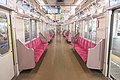 Interior of a Tokyo Metro 05N series (12th batch)
 Interior of a Tokyo Metro 05N series (13th batch)


Refurbishment
In December 2012, set 05-114 underwent "type B" refurbishment, with a number of improvements utilizing features on the newer 15000 series sets.[5] The traction motors were replaced with new PMSM (permanent magnet synchronous motors), as used on the Chiyoda Line 16000 series sets, and internally, 17-inch (432 mm) LCD passenger information screens were added above the doorways.[5] The same was done to fifth-batch sets 05-115 to 05-118 over the next few years, and eventually all sixth-batch sets 05-119 to 05-121 by the end of May 2020.[6]
All Tokyo Metro trains, including the Tokyo Metro 05 series in Indonesia, are planned to be retrofitted or refurbished by INKA soon.[7][8][9] The refurbishment or retrofit process including conversion from 4-Quadrant Chopper to IGBT-VVVF and changing the number of cars per trainset (8 cars to 12 cars per trainset).
Retirement
The 05 series begun to be replaced by new 15000 series trains from May 2010. The first batch was replaced by the 15000 series, and has since been scrapped.
Eight former 05 series sets have been shipped to KAI Commuter (formerly known as KA Commuter Jabodetabek / KRL Jabodetabek) in Jakarta, Indonesia. They are sets 05-102, 05-104, 05-105, 05-107, 05-108, 05â109, 05-110 and 05â112. These sets have been reduced to eight cars.[10]
Set 05-107 was withdrawn following derailment accident damage sustained in October 2012.[10] Set 05-110F is bearing the latest KAI Commuter's gray-red-white color scheme before being retired in December 2025.
In December 2025, the 05-110 set had its final run from Bogor railway station to Depok Train Depot after being withdrawn, following the decision that the set would not receive a retrofitting or refurbishing by INKA[11]. The set was then scrapped in January 2026.[12]
 Withdrawn 05 series units at Kawasaki wharf awaiting shipping to Indonesia in November 2010
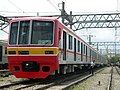 Former 05 series set 109 operated by Kereta Commuter Indonesia in Jakarta, Indonesia, in February 2011
 Former 05 series set 110 in Indonesia in March 2016
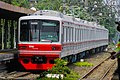 Repainted set 110 in Ancol railway station. The only 05 set that bears the KAI Commuter's gray-red-white color scheme.
 05-104F parked at Depok KRL Depot emplacement.
 The last run of 05-110F at Bogor Station to Depok Train Depot on 17 December 2025. This set was then scrapped in January 2026.


Gallery
 SS161 bogie of a 05 series
 Chopper control device as used on the 05 series
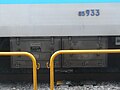 VVVF inverter as used on the 05 series
 Some 05 series trains bear this sticker to indicate that they were made using recycled aluminium
 Control cab of the 05 series
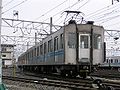 Gangway connection of a 05 series


See also
- TÅyÅ Rapid 2000 series, trains built to the same design (05N Version)
