Vauxhall Velox
From Wikipedia, the free encyclopedia
| Vauxhall Velox | |
|---|---|
.jpg) PA S Saloon 1962 | |
| Overview | |
| Manufacturer | Vauxhall (General Motors) |
| Production | 1948–1965 |
| Body and chassis | |
| Class | Executive car |
| Layout | FR layout |
| Related | Vauxhall Wyvern 1948–1957 Vauxhall Cresta 1954–1972 |
| Chronology | |
| Predecessor | Vauxhall Fourteen (J) |
| Successor | Vauxhall Cresta PC |
The Vauxhall Velox is a six-cylinder executive car which was produced by Vauxhall from 1948 to 1965. The Velox was a large family car, directly competing in the UK with the contemporary six-cylinder Ford Zephyr, and to a slightly lesser extent, with the A90, A95, and A110 Austin Westminster models.
It was introduced by Vauxhall shortly before the London Motor Show in October 1948,[1] as a successor to the Vauxhall Fourteen. Between 1948 and 1957 the Velox shared its body with the less-powerful four-cylinder Vauxhall Wyvern. From August 1954 through to October 1965, it shared its body with the more luxuriously equipped Vauxhall Cresta, a tradition that ended with the introduction of the new PC Vauxhalls. The Velox name was discontinued at that time in favour of the more upmarket Vauxhall Cresta name, while a new flagship model, the Vauxhall Viscount, was launched.
The Velox and its Opel contemporaries are remembered for having mirrored North American styling trends (e.g. the Ponton style of body) much more closely than other European models of the time. That was particularly apparent following the 1957 introduction of the PA version of the Velox.
Foreign production
| Vauxhall Velox LIP | |
|---|---|
 | |
| Overview | |
| Production | 1948–51 |
| Assembly | Luton, Bedfordshire, England Biel, Switzerland Australia,[2] Petone, New Zealand [3] South Africa [3] |
| Body and chassis | |
| Body style | 4-door saloon 2-door tourer (Australia) [4] |
| Related | Vauxhall Wyvern |
| Powertrain | |
| Engine | 2,275 cc (138.8 cu in) I6 ohv 54 bhp (40 kW) |
| Dimensions | |
| Wheelbase | 97.75 in (2,483 mm) [5] |
| Length | 164.5 in (4,178 mm) |
| Width | 62 in (1,575 mm)[6] |
| Height | 63 in (1,600 mm)[6] |
| Kerb weight | 2,268 lb (1,029 kg) |
The classic four-door saloon boasted a newly developed straight-six-cylinder engine of 2,275 cc (138.8 cu in), with overhead valves. The 54 bhp (40 kW) power output[6] provided for a claimed top speed of 74 mph (119 km/h). Power was delivered to the rear wheels via a three-speed manual gear box with synchromesh on the top two ratios.
Optional extras included a heater from which warm air was evenly distributed between the front and back areas of the passenger cabin and which could be set to de-ice the windscreen in winter or to provide cool air ventilation in summer. Also available at extra charge was an AM radio integrated into the fascia.
The body was shared with the four-cylinder Vauxhall Wyvern, a pattern that continued with subsequent versions of the Velox until the introduction of the more compact Vauxhall Victor at the beginning of 1957. While the Velox exterior differed only in badging, additional brightwork and different coloured wheels, the interior boasted superior seating materials over the Wyvern including a central arm rest in the rear.
A car tested by The Motor magazine in 1949 had a top speed of 74.1 mph (119.3 km/h) and could accelerate from 0–60 mph (97 km/h) in 22.8 seconds. A fuel consumption of 22.3 miles per imperial gallon (12.7 L/100 km; 18.6 mpg‑US) was recorded. The test car cost £550 including taxes.[6]
As well as being built at Vauxhall's Luton plant in England, early Velox and Wyvern models were assembled in Australia (by Holden in Melbourne) and in New Zealand at the GM plant in Petone, near Wellington. The LBP model ID was applied to "chassis only" exports to Australia,[3][7] where local production included a two-door Caleche tourer[4] and, in early four-door saloons, a unique "six-light" body featuring an additional rear window behind the back doors.[2] This gave the car more resemblance from the rear to the pre-war designed J-series Vauxhall Fourteen it replaced (see accompanying illustration below).
 Brochure image of Australian produced 1949 Vauxhall Velox Saloon (LBP)
 Australian Vauxhall Velox Caleche (LBP)
.jpg)
.jpg)
Velox LIP production also took place in Switzerland, where a 400 kg van version (built by Geser of Lucerne) was a common sight in the 1950s serving as Swiss Post Office vehicles. Despite the lack of bumper over-riders suggesting the four-cylinder Wyvern powerplant, all vans were Veloxes.[8] Conventional Velox and Wyvern four-door saloons were assembled at the General Motors plant at Biel.[9]
Also built in Switzerland was a unique prototype two seater roadster known as the Vauxhall Zimmerli-Velox 18–6. This used a coach built aluminium body on a tubular ladder chassis, with standard Velox running gear. It was built in 1949 for the Zimmerli brothers, who had a Vauxhall dealership in Reiden. The car survives today in near original condition.[10]
Velox EIP/EIPV & EBP (1951–57)
| Vauxhall Velox | |
|---|---|
 1955 Vauxhall Velox EIP Saloon | |
| Overview | |
| Model code |
|
| Production | 1951–57 235,296 made[11] |
| Assembly |
|
| Body and chassis | |
| Body style |
|
| Related | |
| Powertrain | |
| Engine | |
| Transmission | 3-speed manual |
| Dimensions | |
| Wheelbase | 103 in (2,616 mm) [5] |
| Length | 172 in (4,369 mm) [13] |
| Width | 67 in (1,702 mm) [13] |
| Height | 63.5 in (1,613 mm) [13] |
| Kerb weight | 2,352 lb (1,067 kg) - 2,436 lb (1,105 kg) |
In August 1951[14] a longer, wider Velox was launched, designated as the EIP series,[11] and featuring a modern 'three box' shape and integral construction. The body was again shared with the 4-cylinder-engined Wyvern. The car was launched with the previous model's engine but with power output increased to 58 bhp (43 kW).[13]
A car with the original 2275 cc engine tested by The Motor magazine in 1951 had a top speed of 77.4 mph (124.6 km/h) and could accelerate from 0-60 mph (97 km/h) in 23.7 seconds. A fuel consumption of 23.5 miles per imperial gallon (12.0 L/100 km; 19.6 mpg‑US) was recorded. The test car cost £802 including taxes.[13] In the same year, the magazine tested the similarly sized Ford Zephyr Six. Ford's test car was fitted with options including a radio, a heater and leather seating: thus equipped the Zephyr came with a recommended retail price of £842.[15]
In April 1952 the Velox was redesignated as the EIPV series,[11] and received a new over-square 2262 cc engine which had been in the development pipeline for several years.[9] This provided either 64 bhp (48 kW) [16] or, with a compression ratio improved to 7.6:1, 68 bhp (51 kW) of power.
A further test in 1952 by The Motor magazine of the EIPV with the short-stroke 2262 cc engine, found the top speed had increased to 80.4 mph (129.4 km/h) and acceleration from 0–60 mph (97 km/h) to 21.4 seconds. A similar fuel consumption of 23.6 miles per imperial gallon (12.0 L/100 km; 19.7 mpg‑US) was recorded. The test car cost had risen to £833 including taxes.[16]
In December 1952 General Motors Holden launched a tourer and coupe utility version of the EIPV Velox and EIX Wyvern models on the Australian market, these cars' chassis were prefixed EBP for the Velox and EBX for the Wyvern. Both these cars used modified Vauxhall bodies affixed to the Bedford CA chassis. The tourer was originally to be called the Caleche but by the time of launch the model name was changed to Vagabond. The Vagabond was a two-door five seater with folding top and side curtains. It did not survive the 1955 face lift. The coupe utility continued on (Velox only from 1955) until officially withdrawn at the end of the 1957 model year.
In August 1954 a significant facelift[11] was applied. Most obvious of the many cosmetic changes was a new front grille and trafficators were replaced by flashing lights (red at the rear, US-style). More important was the introduction at this time of a sister model, branded as the Vauxhall Cresta. In addition to superior equipment levels, the Cresta was distinguished by a two tone paint finish. The 1954 VELOX also differed from the 1953 which had a side opening bonnet, by having a front opening bonnet
Detroit was by now favouring annual facelifts, and Vauxhall reflected that trend, announcing further facelifts for 1956 (wind-up windows, larger rear window, wider grille slats, separate amber rear flashing indicator lights replacing US-style red units incorporated into the brake/tail light lens, new instrument graphics) and again for 1957 (electric wipers, larger tail lights, new grille, new 'magic ribbon' AC speedo) in line with the Wyvern model.[11] Technically, however, there were no further changes until the arrival of a completely new Velox in October 1957.
In Australia, Holden built a quantity of utilities (pickup trucks) as well as the 2-door Vagabond Convertible based on the EIP Velox. These had a separate chassis - prefixed EBP - with the Australian bodies fitted to them. The Velox was also assembled at the General Motors New Zealand plant in Petone, north of Wellington, through to and including the PC Cresta of the late 1960s, by which time buyer favour had turned to the similarly sized GM-dealer stablemate from Australia, the Holden Belmont/Kingswood.
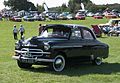 Vauxhall Velox EIP or EIPV Saloon, pre 1954 facelift
 Australian Vauxhall Velox (EBP) Coupe Utility 1954
 Australian Vauxhall Velox Vagabond (EBP) Tourer


 Vauxhall Velox EIPV Saloon 1956
 Vauxhall Velox EIPV 1956 front view
 Vauxhall Velox EIPV Saloon 1957
 Velox EIPV Grosvenor estate by Grosvenor Carriage Co 1957
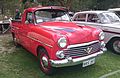 Australian Vauxhall Velox (EBP) Coupe Utility 1957


.jpg)

.JPG)


.jpg)
.jpg)

.jpg)
.jpg)

