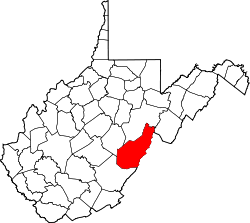
In 1921, nine African Americans from Bluefield, West Virginia became the first share holders of the Watoga Land Association. Their names were Mr. Edwin Mann, Mr. James S. Kahle, Mr. L. A. Hooper, Mr. C.A. Bradshaw, Mr. W.C. Pollock, Mrs. B.A. Alexander, Mr. E.M. McCulloch, Mr. G.W. McCulloch and Mr. J.E. Woodson and they along with the support of T. Edward Hill and The Bureau for Negro Welfare and Statistics set out to create a community where African Americans could own their own land and govern themselves.[5] The idea for this enterprise came from Dr. Tyler Edward Hill, the then director of the Bureau for Negro Welfare and Statistics, a state agency that was set up to assist African Americans economically, such as providing help in purchasing farms.[6] While Hill was politically conservative, he was a very active member of the African American political community, and he believed that employment was the key to African Americans becoming prosperous and gaining equality. He traveled the country petitioning other African Americans to join the Watoga Community saying that West Virginia made "more rapid strides in the development of business enterprises in the past two years than they have made in the previous decade."[7]
The Watoga Land Association acquired 10,000 acres of land in Pocahontas county, including the old company town of Watoga. Members of the association repurposed the buildings that had been abandoned and took up residence there. Little is known about the community, or what their lives were like. After its creation T. Edward Hill had little to do with Watoga, and the community members were left to fend for themselves. They printed a newspaper with the help of a local reverend, A.B. Farmer, called The Associated Voice however only a few issues were printed before the paper was shut down.[8] The community members also wanted to start their own school for African Americans called the Watoga People's School, however the school never came to be.[9] While the community had interests in academic and recreational pursuits, the main goal of the community was to farm the land that they purchased and become self sustainable, however the land that they had was not good farm land and it was a struggle for them to survive. By the 1930s the Watoga Land Association ran out of money, and the majority of its residents had moved away in order to find work, although members of the community still maintained ownership of the land. This did not last long, and in 1967 the majority of the land owned by the Watoga Land Association was sold to the Monongahela National Forest. State of West Virginia, West Virginia Division of Culture and History, Historic Preservation. There are still a few plots of land that are privately owned, but the vast majority of what was once the Watoga Land Association is now owned by Monongahela National Forest, including the remains of the company town.