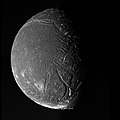
Yangoor (crater)
From Wikipedia, the free encyclopedia
Feature typeCentral-peak impact crater
LocationAriel
Coordinates68°42′S 80°18′W / 68.7°S 80.3°W[1]
Diameter78 kilometres (48 mi)
 Annotated Voyager 2 image of Ariel, with Yangoor left of center | |
| Feature type | Central-peak impact crater |
|---|---|
| Location | Ariel |
| Coordinates | 68°42′S 80°18′W / 68.7°S 80.3°W[1] |
| Diameter | 78 kilometres (48 mi) |
| Depth | ~1 kilometre (0.62 mi)[2] |
| Peak | >1 kilometre (0.62 mi) (central peak)[2] |
| Discoverer | Voyager 2 |
| Eponym | Spirit, Australian Aboriginal mythology |
Yangoor is the largest known impact crater on the surface of the Uranian moon Ariel. A central-peak impact crater, it is about 78 kilometres (48 mi) in diameter and is located approximately 450 kilometres (280 mi) from Ariel's south pole. The northwestern edge of the crater was erased by formation of ridged terrain.[3] The crater lacks bright ejecta deposits.[4]
Yangoor was imaged for the first time by the Voyager 2 spacecraft in January 1986.[4] The crater is named after a spirit that brings day in Australian Aboriginal mythology. The name Yangoor was officially approved by the International Astronomical Union in 1988.[1]