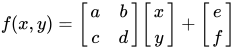
Puede usarse el código siguiente para dibujar el helecho con un ordenador:
import turtle
import random

pen = turtle.Turtle()
pen.speed(0)
pen.color("green")
pen.penup()

x = 0
y = 0
for n in range(11000):
    pen.goto(65 * x, 37 * y - 252)  # scale the fern to fit nicely inside the window
    pen.pendown()
    pen.dot(3)
    pen.penup()
    r = random.random()
    if r < 0.01:
        x, y =  0.00 * x + 0.00 * y,  0.00 * x + 0.16 * y + 0.00
    elif r < 0.86:
        x, y =  0.85 * x + 0.04 * y, -0.04 * x + 0.85 * y + 1.60
    elif r < 0.93:
        x, y =  0.20 * x - 0.26 * y,  0.23 * x + 0.22 * y + 1.60
    else:
        x, y = -0.15 * x + 0.28 * y,  0.26 * x + 0.24 * y + 0.44
# Barnsley's Fern

# create function of the probability and the current point
fractal_fern2 <- function(x, p){
  if (p <= 0.01) {
    m <- matrix(c(0, 0, 0, .16), 2, 2)
    f <- c(0, 0)
  } else if (p <= 0.86) {
    m <- matrix(c(.85, -.04, .04, .85), 2, 2)
    f <- c(0, 1.6)
  } else if (p <= 0.93) {
    m <- matrix(c(.2, .23, -.26, .22), 2, 2)
    f <- c(0, 1.6)
  } else {
    m <- matrix(c(-.15, .26, .28, .24), 2, 2)
    f <- c(0, .44)
  }
  m %*% x + f
}

# how many reps determines how detailed the fern will be
reps <- 10000

# create a vector with probability values, and a matrix to store coordinates
p <- runif(reps)

# initialise a point at the origin
coords <- c(0, 0)

# compute Fractal Coordinates
m <- Reduce(fractal_fern2, p, accumulate = T, init = coords)
m <- t(do.call(cbind, m))

# Create plot
plot(m, type = "p", cex = 0.1, col = "darkgreen",
     xlim = c(-3, 3), ylim = c(0, 10),
     xlab = NA, ylab = NA, axes = FALSE)
/*
    Barnsley Fern for Processing 3.4
*/

// declaring variables x and y
float x, y;

// creating canvas
void setup() {
  size(600, 600);
  background(255);
}

/* setting stroke,  mapping canvas and then
   plotting the points */
void drawPoint() {
  stroke(34, 139, 34);
  strokeWeight(1);
  float px = map(x, -2.1820, 2.6558, 0, width);
  float py = map(y, 0, 9.9983, height, 0);
  point(px, py);
}

/* algorithm for calculating value of (n+1)th
   term of x and y based on the transformation
   matrices */
void nextPoint() {
  float nextX, nextY;
  float r = random(1);
  if (r < 0.01) {
    nextX =  0;
    nextY =  0.16 * y;
  } else if (r < 0.86) {
    nextX =  0.85 * x + 0.04 * y;
    nextY = -0.04 * x + 0.85 * y + 1.6;
  } else if (r < 0.93) {
    nextX =  0.20 * x - 0.26 * y;
    nextY =  0.23 * x + 0.22 * y + 1.6;
  } else {
    nextX = -0.15 * x + 0.28 * y;
    nextY =  0.26 * x + 0.24 * y + 0.44;
  }
  x = nextX;
  y = nextY;
}

/* iterate the plotting and calculation
   functions over a loop */
void draw() {
  for (int i = 0; i < 100; i++) {
    drawPoint();
    nextPoint();
  }
}
let x = 0;
let y = 0;

function setup() {
  createCanvas(600, 600);
  background(0);
}

//range −2.1820 < x < 2.6558 and 0 ≤ y < 9.9983.
function drawPoint() {
  stroke(255);
  strokeWeight(1);
  let px = map(x, -2.1820, 2.6558, 0, width);
  let py = map(y, 0, 9.9983, height, 0);
  point(px, py);
}

function nextPoint() {
  let nextX;
  let nextY;

  let r = random(1);

  if (r < 0.01) {
    //1
    nextX = 0;
    nextY = 0.16 * y;
  } else if (r < 0.86) {
    //2
    nextX = 0.85 * x + 0.04 * y;
    nextY = -0.04 * x + 0.85 * y + 1.60;
  } else if (r < 0.93) {
    //3
    nextX = 0.20 * x + -0.26 * y;
    nextY = 0.23 * x + 0.22 * y + 1.60;
  } else {
    //4
    nextX = -0.15 * x + 0.28 * y;
    nextY = 0.26 * x + 0.24 * y + 0.44;
  }

  x = nextX;
  y = nextY;
}

function draw() {
  for (let i = 0; i < 1000; i++) {
    drawPoint();
    nextPoint();
  }
}
<canvas id="canvas" height="700" width="700">
</canvas>

<script>
    let canvas;
    let canvasContext;

    let x = 0, y = 0;

    window.onload = function () {
        canvas = document.getElementById("canvas");
        canvasContext = canvas.getContext('2d');

        canvasContext.fillStyle = "black";
        canvasContext.fillRect(0, 0, canvas.width, canvas.height);

        setInterval(() => {
            // Update 20 times every frame
            for (let i = 0; i < 20; i++)
                update();

        }, 1000/250); // 250 frames per second
    };

    function update() {

        let nextX, nextY;
        let r = Math.random();
        if (r < 0.01) {
            nextX =  0;
            nextY =  0.16 * y;
        } else if (r < 0.86) {
            nextX =  0.85 * x + 0.04 * y;
            nextY = -0.04 * x + 0.85 * y + 1.6;
        } else if (r < 0.93) {
            nextX =  0.20 * x - 0.26 * y;
            nextY =  0.23 * x + 0.22 * y + 1.6;
        } else {
            nextX = -0.15 * x + 0.28 * y;
            nextY =  0.26 * x + 0.24 * y + 0.44;
        }

        // Scaling and positioning
        let plotX = canvas.width * (x + 3) / 6;
        let plotY = canvas.height - canvas.height * ((y + 2) / 14);

        drawFilledCircle(plotX, plotY, 1, "green");

        x = nextX;
        y = nextY;

    }
    const drawFilledCircle = (centerX, centerY, radius, color) => {
        canvasContext.beginPath();
        canvasContext.fillStyle = color;
        canvasContext.arc(centerX, centerY, radius, 0, 2 * Math.PI, true);
        canvasContext.fill();
    };
</script>
SCREEN 12
WINDOW (-5, 0)-(5, 10)
RANDOMIZE TIMER
COLOR 10
DO
    SELECT CASE RND
        CASE IS < .01
            nextX = 0
            nextY = .16 * y
        CASE .01 TO .08
            nextX = .2 * x - .26 * y
            nextY = .23 * x + .22 * y + 1.6
        CASE .08 TO .15
            nextX = -.15 * x + .28 * y
            nextY = .26 * x + .24 * y + .44
        CASE ELSE
            nextX = .85 * x + .04 * y
            nextY = -.04 * x + .85 * y + 1.6
    END SELECT
    x = nextX
    y = nextY
    PSET (x, y)
LOOP UNTIL INKEY$ = CHR$(27)
addpackage("Forms.dll")

set("x", 0)
set("y", 0)
set("width", 600)
set("height", 600)

method setup()
	createCanvas(width, height)
	rect(0, 0, 600, 600, color(0, 0, 0))
end

method drawPoint()
    set("curX", div(mult(width, add(x, 3)), 6))
    set("curY", sub(height, mult(height, div(add(y, 2), 14))))
    set("size", 1)
	//log(curX)
	//log(curY)
	rect(round(curX - size / 2), round(curY - size / 2), round(curX + size / 2), round(curY + size / 2), color(34, 139, 34))
end

method nextPoint()
	set("nextX", 0)
	set("nextY", 0)
	set("random", random(0, 100))
	if(random < 1)
		set("nextX", 0)
		set("nextY", 0.16 * y)
	end
	else
		if(random < 86)
			set("nextX", 0.85 * x + 0.04 * y)
			set("nextY", -0.04 * x + 0.85 * y + 1.6)
		end
		else
			if(random < 93)
				set("nextX", 0.2 * x - 0.26 * y)
				set("nextY", 0.23 * x + 0.22 * y + 1.6)
			end
			else
				set("nextX", -0.15 * x + 0.28 * y)
				set("nextY", 0.26 * x + 0.24 * y + 0.44)
			end
		end
	end

	set("x", nextX)
	set("y", nextY)
end

setup()
while(true)
	drawPoint()
	nextPoint()
end
/* results table */
declare @fern table (Fun int, X float, Y float, Seq int identity(1,1) primary key, DateAdded datetime default getdate())

declare @i int = 1	/* iterations */
declare @fun int	/* random function */

declare @x float = 0	/* initialise X = 0 */
declare @y float = 0	/* initialise Y = 0 */
declare @rand float
insert into @fern (Fun, X, Y) values (0,0,0)	/* set starting point */

while @i < 5000 /* how many points? */
begin

	set @rand = rand()

	select @Fun = case	/* get random function to use -- @fun = f1 = 1%, f2 = 85%, f3 = 7%, f4 = 7% */
		when @rand <= 0.01 then 1
		when @rand <= 0.86 then 2
		when @rand <= 0.93 then 3
		when @rand <= 1 then 4
	end

	select top 1 @X = X, @Y = Y from @fern order by Seq desc /* get previous point */

	insert into @fern(Fun, X, Y)	/* transform using four different function expressions  */
	select @fun,
		case @fun
			when 1 then 0
			when 2 then 0.85*@x+0.04*@y
			when 3 then 0.2*@x-0.26*@y
			when 4 then -0.15*@x + 0.28*@y
		end X,
		case @fun
			when 1 then 0.16*@y
			when 2 then -0.04*@x + 0.85*@y + 1.6
			when 3 then 0.23*@x + 0.22*@y + 1.6
			when 4 then 0.26*@x + 0.24*@y + 0.44
		end Y

	set @i=@i+1
end

select top 5000 *,geography::Point(Y, X, 4326) from @fern
order by newid()
N = 1000000;

xy = [0; 0];
fern = zeros(N, 2);

f_1 = [0 0; 0 0.16];
f_2 = [0.85 0.04; -0.04 0.85];
f_3 = [0.2 -0.26; 0.23 0.22];
f_4 = [-0.15 0.28; 0.26 0.24];

P = randsample(1:4, N, true, [0.01 0.85 0.07 0.07]);
for i = 2:N
    p = P(i - 1);
    if p == 1 % Stem
        xy = f_1 * xy;
    elseif p == 2 % Sub-leaflets
        xy = f_2 * xy + [0; 1.6];
    elseif p == 3 % Left leaflet
        xy = f_3 * xy + [0; 1.6];
    else % Right leaflet
        xy = f_4 * xy + [0; 0.44];
    end

    fern(i, 1) = xy(1);
    fern(i, 2) = xy(2);
end
clearvars -except N fern % R2008a+

% Plotting the fern

%{
% Better detail, slower performance
c = linspace(0, 0.35, N - 1); c(end + 1) = 1;
colormap(summer(N));
set(gcf, 'Color', 'k', 'position', [10, 50, 800, 600]);
scatter(fern(:, 1), fern(:, 2), 0.1, c, 'o');
set(gca, 'Color', 'k');
%}

%
% Less detail, better performance
c = linspace(1, 0.2, N - 1); c(end + 1) = 0;
colormap(summer(N));
set(gcf, 'Color', 'k', 'position', [10, 50, 800, 600]);
scatter(fern(:, 1), fern(:, 2), 0.1, c, '.');
set(gca, 'Color', 'k');
%}
BarnsleyFern[iterations_] := (
  it = iterations;
  noElement = 1;
  BarnsleyfernTransformation(*obtained from the affine transformation matrix for simpler
coding*)= {
    {0, +0.16 y},
    {0.85 x + 0.04 y, 1.6 - 0.04 x + 0.85 y},
    {0.2 x - 0.26 y, 1.6 + 0.23 x + 0.22 y},
    {-0.15 x + 0.28 y, 0.44 + 0.26 x + 0.24 y}};
   (*list of coordinates*)
  point = {{0, 0}};
  While[it > 0 && noElement <= iterations,
   AppendTo[point,
    BarnsleyfernTransformation[[(*determines which transformation \
applies to the previous point*)
       RandomInteger[{1, 4}]]] /. {x -> Part[point, noElement, 1],
      y -> Part[point, noElement, 2] }];
   (*update var for the while loop*)
   it -= 1; noElement += 1];
  ListPlot[point, AspectRatio -> Automatic, PlotRange -> Full])