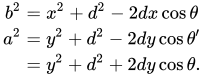
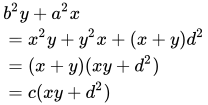
スチュワートの定理 From Wikipedia, the free encyclopedia スチュワートの定理は、図における線分たちの長さの間の関係式を与える。 スチュワートの定理(-ていり)は、平面幾何学において三角形の頂点から辺に引かれた線分の長さに関する定理である。 1746年にスコットランドの数学者マシュー・スチュワートによって発表された[1]。 三角形の辺 BC, CA, AB の長さを a, b, c とする。辺 AB 上に点 M を取り、C との距離を d とする。AM, BM の長さを x, y とすると、以下の式が成り立つ。 a 2 x + b 2 y = c ( d 2 + x y ) {\displaystyle a^{2}x+b^{2}y=c(d^{2}+xy)} M が辺の中点のとき、この式は中線定理の式に一致する。 証明 ∠AMC=θ, ∠BMC=θ′ とおくと cos θ′ = cos(π-θ) = −cos θ である。 余弦定理より以下の式が成り立つ。 b 2 = x 2 + d 2 − 2 d x cos θ a 2 = y 2 + d 2 − 2 d y cos θ ′ = y 2 + d 2 + 2 d y cos θ . {\displaystyle {\begin{aligned}b^{2}&=x^{2}+d^{2}-2dx\cos \theta \\a^{2}&=y^{2}+d^{2}-2dy\cos \theta '\\&=y^{2}+d^{2}+2dy\cos \theta .\,\end{aligned}}} 上の式に y をかけ、下の式に x をかけて和をとり、cos θ の項を消去する。 b 2 y + a 2 x = x 2 y + y 2 x + ( x + y ) d 2 = ( x + y ) ( x y + d 2 ) = c ( x y + d 2 ) {\displaystyle {\begin{aligned}&b^{2}y+a^{2}x\\&=x^{2}y+y^{2}x+(x+y)d^{2}\\&=(x+y)(xy+d^{2})\\&=c(xy+d^{2})\\\end{aligned}}} 脚注 ↑ Some General Theorems of Considerable Use in the Higher Parts of Mathematics "Proposition II" 外部リンク 『スチュワートの定理の証明とその仲間』 - 高校数学の美しい物語 Hutton, C.; Gregory, O. (1843), A Course of Mathematics, II, Longman, Orme & co., p. 219, https://books.google.co.jp/books?id=9-4GAAAAYAAJ&pg=PA219&redir_esc=y&hl=ja#v=onepage Weisstein, Eric W. "Stewart's Theorem". mathworld.wolfram.com (英語). Stewart's Theorem - PlanetMath.(英語) Proof of Stewart's Theorem - PlanetMath.(英語) Related Articles~TimelinesTop QsFact Checks