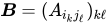
全正値行列 From Wikipedia, the free encyclopedia 数学において、全正値行列(ぜんせいちぎょうれつ、英: totally positive matrix)とは、そのすべての小行列式の値が正となる正方行列をいう[1]。全正値行列のすべての成分は正であり、正行列でもある。また、すべての主小行列式が正(および、そのすべての固有値が正)であり、対称全正値行列は正定値行列でもある。全非負行列も同様に、すべての小行列式の値が非負(正もしくは0)である正方行列のことと定義される。"全正値"を"全非負"の意味で用いる場合もある。 n × n 行列 A = ( A i j ) i j {\displaystyle {\boldsymbol {A}}=(A_{ij})_{ij}} とする。任意の p ∈ { 1 , 2 , … , n } {\displaystyle p\in \{1,2,\dotsc ,n\}} につき、任意のp × p部分行列 B = ( A i k j ℓ ) k ℓ {\displaystyle {\boldsymbol {B}}=(A_{i_{k}j_{\ell }})_{k\ell }} を以下の条件の下で取ることとする: 1 ≤ i 1 < … < i p ≤ n , 1 ≤ j 1 < … < j p ≤ n . {\displaystyle 1\leq i_{1}<\ldots <i_{p}\leq n,\qquad 1\leq j_{1}<\ldots <j_{p}\leq n.} 以下が成り立つとき、Aは全正値行列である[2]。 det ( B ) > 0 {\displaystyle \det({\boldsymbol {B}})>0} 歴史 全正値性の理論の発展につながった歴史的なトピックには、以下の研究が含まれる: [2] 全正値カーネルと全正値行列のスペクトル特性に関する研究 グリーン関数が全正値であるような常微分方程式(MGケリンと何人かの同僚による1930年代半ばの研究) variation diminishing propertiesI. J. Schoenbergによって1930年に開始された)に関する研究 (Iriation diminishing propertiesJシェーンベルグによって1930年に開始された)研究 ポリア周波数関数(1940年代後半から1950年代初頭のIJシェーンベルグによる)。 例 たとえば、ノードが正で、かつ増加しているヴァンデルモンドの行列式は全正値行列である。 脚注 [脚注の使い方] ↑ George M. Phillips (2003), “Total Positivity”, Interpolation and Approximation by Polynomials, Springer, p. 274, ISBN 9780387002156 1 2 Spectral Properties of Totally Positive Kernels and Matrices, Allan Pinkus 参照 Compound matrix 参考文献 Allan Pinkus (2009), Totally Positive Matrices, Cambridge University Press, ISBN 9780521194082 Spectral Properties of Totally Positive Kernels and Matrices, Allan Pinkus Parametrizations of Canonical Bases and Totally Positive Matrices, Arkady Berenstein Tensor Product Multiplicities, Canonical Bases And Totally Positive Varieties (2001), A. Berenstein , A. Zelevinsky Related Articles