Armenian Monastic Ensembles of Iran
From Wikipedia, the free encyclopedia
| UNESCO World Heritage Site | |
|---|---|
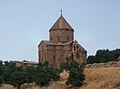
 St. Thaddeus Monastery | |
| Location | Iran |
| Includes | |
| Criteria | Cultural: ii, iii, vi |
| Reference | 1262 |
| Inscription | 2008 (32nd Session) |
| Area | 129.2819 ha |
| Buffer zone | 655.0122 ha |
  St. Thaddeus St. Stepanos Dzordzor Locations of three primary ensembles within Iranian Azerbaijan | |
The Armenian Monastic Ensembles of Iran is a UNESCO World Heritage Site located in the West Azerbaijan and East Azerbaijan provinces in Iran. The site comprises three groups of Armenian churches that were established between the 7th and 16th centuries A.D.
The edifices—the St. Thaddeus Monastery, the Saint Stepanos Monastery, and the Chapel of Dzordzor—have undergone many renovations. These sites were inscribed on the World Heritage List in the 32nd session of the World Heritage Committee on 8 July 2008. The three ensembles lie in a total area of 129 hectares (320 acres) and were inscribed under UNESCO criteria (ii), (iii), and (vi) for their outstanding value in showcasing Armenian architectural and decorative traditions, for being a major centre for diffusion of Armenian culture in the region, and for being places of pilgrimage of the Apostle Thaddeus and Saint Stepanos, key figures in Armenian religious traditions. They represent the last vestiges of old Armenian culture in its southeastern periphery. The ensembles are in a good state of preservation.
The Armenian Monastic Ensembles of Iran are located in the West Azerbaijan and East Azerbaijan provinces in Iran. The three churches lie in a total area of 129 hectares (320 acres).[1][2] The St. Thaddeus Monastery also known as "Kara Kelisa" or "Black Church" in West Azerbaijan province is about 18 kilometres (11 mi) from Maku.[3] The Saint Stepanos Monastery is 17 kilometres (11 mi) to the west of Jolfa city, East Azarbaijan Province in northwest Iran.[4]
History
The Armenian people are native to the Armenian highlands, which stretch into Iranian Azerbaijan. Armenia converted to Christianity in the early 4th century A.D.[5] A portion of the region forms part of historical Armenia.[6][7][8] Some of the oldest Armenian chapels, monasteries and churches in the world are located within this region of Iran,[9] and the Iranian Azerbaijan region in general is home to the oldest churches in Iran.[10]
According to unverified reports it is believed that the Apostle Thaddeus was buried at the site of the St. Thaddeus Monastery in the 1st century A.D., and that Gregory the Illuminator was responsible for establishing a monastery here in the 4th century.[11] However, there is recorded proof that St. Thaddeus Monastery dates to the 7th century.[1][11] It was the second Armenian church to be built, following the Etchmiadzin Cathedral[12][1] and was the seat of the diocese in the 10th century. It was destroyed in an earthquake in 1319 and was rebuilt due to the efforts of Bishop Zachariah in the 1320s.[11]
During the reign of the Safavid dynasty in the 15th century, the monasteries were preserved. The monasteries were then deserted during the 16th and 17th centuries following a period of attacks by the Ottomans that prompted many Armenians to emigrate to central Iran. Once the Safavids reestablished themselves in the area, the monasteries were reoccupied and renovated. However, during the 18th century the area became a cauldron of conflicts for domination among the Russian, Ottoman, and Persian empires. When the Persians finally gained control, the monasteries were damaged. During the Qajar era, Armenians regained control over the monasteries and they were rebuilt. The existing St. Thaddeus Monastery was rebuilt in 1814[11] and refurbished in the 1970s.[13]
Similarly, it is recorded that Saint Stepanos Monastery was first established in 649 A.D. and a new building constructed at the same location in the 10th century. It was a major Christian church during the history of Armenian independence and development.[11] After it suffered damages due to earthquake, it was rebuilt by Bishop Zachariah in the 1320s. During the entire 14th century, it was the centre of influence in the region for Christian missionary work. This period marked the creation of literary manuscripts and paintings on religious themes.[11] The monastery was rebuilt during the period from 1819 to 1825 and again became a center of religious activity.[14] It was refurbished in the 1970s, and again during the period from 1983 to 2001.[15]
The Dzordzor Chapel was built on the bank of the Makuchay River at Dzordzor by Bishop Zachariah in 1314 on very modest lines, making use of the vestiges of an earlier religious monument dated between the 10th and 12th centuries. During the period of Ottoman rule, some parts of the building were destroyed.[11] Later, the chapel came under threat of submergence from a proposed dam and had to be shifted to a new location upstream.[13]
World heritage status
The three monasteries of the ensemble were inscribed on 2008 under UNESCO criteria (ii), (iii), and (vi) for their outstanding value in showcasing Armenian architectural and decorative traditions, for being a major centre for diffusion of Armenian culture in the region, and for being a place of pilgrimage of the apostle St. Thaddeus, a key figure in Armenian religious traditions. They represent the last vestiges of old Armenian culture in its southeastern periphery. The ensemble is in a good state of preservation.[1]