BVG Class G
From Wikipedia, the free encyclopedia
| BVG Class G | |
|---|---|
-_auf_Bahnsteig_zu_Gleis_1-_Richtung_Bahnhof_Berlin_Warschauer_Straße_(BVG-Baureihe_G,_1087-1)_19.2.2017_(cropped_and_rotated).jpg) Class G train at Kurfürstendamm station in February 2017 | |
| In service | 1974–present |
| Manufacturer | LEW Hennigsdorf |
| Replaced | BVG Class A |
| Constructed | 1974–1989 |
| Refurbished | 2005–2007 |
| Scrapped | 1997 (prototype cars) |
| Formation | 2 cars per set |
| Fleet numbers | 1070–1095 |
| Operators | Berliner Verkehrsbetriebe |
| Lines served | U1, U2 & U3 |
| Specifications | |
| Car body construction | Aluminium |
| Train length | 25,660 mm (84 ft 2+1⁄4 in) |
| Width | 2,360 mm (7 ft 8+7⁄8 in) |
| Height | 3,190 mm (10 ft 5+5⁄8 in) |
| Doors | 2 pairs per side (per car) |
| Maximum speed | 70 km/h (43 mph) |
| Weight | 37 t (36 long tons; 41 short tons) |
| Power output | 120 kW per motor |
| Acceleration | 1.15 m/s2 (3.8 ft/s2)[1] |
| Deceleration | 1.2 m/s2 (3.9 ft/s2) (emergency)[1] |
| Electric system(s) | 750 V DC third rail |
| Current collection | Contact shoe |
| Braking system(s) | Electric brake, pneumatic brake |
| Track gauge | 1,435 mm (4 ft 8+1⁄2 in) |
The Class G is an electric multiple unit train type used on the Berlin U-Bahn. The trains were originally developed for the Berliner Verkehrsbetriebe of East Berlin.
Formation
Each set consists of two cars, only one of which has a driving cab. Thus, the smallest operable formation is a four-car train.[2] Up to four two-car sets can be operated together.[1]
 Driver's cab of a GI/1E train, April 2016
 Rear without driver's cab, March 1980


Electric systems
The trains are powered by one self-ventilated motor per bogie. Both axles are powered by two hollow-shaft gears.[2]
Interior
The interior features longitudinal seats.
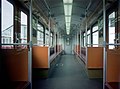 Interior, March 1980
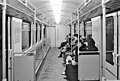 Interior, 1984
 Refurbished interior, September 2016


History
Twelve sets were lent to the Athens Metro between 1983 and 1985.[2] Class GI trains replaced all Class A1 and A2 trains by 5 November 1989.[1] In 1997, 60 sets were sold to the Pyongyang Metro in North Korea.[2]The train received new features over the years. The automatic next station announcements that first appeared on the BVG Class H trains were implemented in the BVG Class G trains in the early 2000s. A twin LCD advisement displays were also added and since the 2010s, the left screen shows next station information. The GI/1 trains were refurbished into GI/1E trains between 2005 and 2007 giving the outside unibody a full paint livery of yellow. The refurbished interior received yellow poles, new seats and the door handles to open the doors were removed and replaced with a button. The interior of the doors was also repainted gray replacing the oak brown color.
 New GI train at the Leipziger Frühjahrsmesse in March 1982
 Different livery variations, BVB (left) and BVG (right), in December 1991


Replacement
The Class G trains are to be replaced by the Class JK trains starting in 2025.


