Bazenville
From Wikipedia, the free encyclopedia
Bazenville | |
|---|---|
 An old barn in Bazenville | |
.svg) Coat of arms | |
 Location of Bazenville | |
  Bazenville  Bazenville | |
| Coordinates: 49°18′13″N 0°35′06″W / 49.3036°N 0.585°W | |
| Country | France |
| Region | Normandy |
| Department | Calvados |
| Arrondissement | Bayeux |
| Canton | Courseulles-sur-Mer |
| Intercommunality | CC Seulles Terre Mer |
| Government | |
| • Mayor (2020–2026) | Marcel Dubois[1] |
Area 1 | 4.07 km2 (1.57 sq mi) |
| Population (2023)[2] | 142 |
| • Density | 34.9/km2 (90.4/sq mi) |
| Time zone | UTC+01:00 (CET) |
| • Summer (DST) | UTC+02:00 (CEST) |
| INSEE/Postal code | 14049 /14480 |
| Elevation | 53–67 m (174–220 ft) (avg. 30 m or 98 ft) |
| 1 French Land Register data, which excludes lakes, ponds, glaciers > 1 km2 (0.386 sq mi or 247 acres) and river estuaries. | |
Bazenville (French pronunciation: [bazɑ̃vil] ⓘ) is a commune in the Calvados department in the Normandy region of north-western France.[3]
Bazenville Airfield was a former World War II Advanced Landing Ground, mostly located outside the commune of Bazenville 1.8 km to the north-east.
The inhabitants of the commune are known as Bazenvillais or Bazenvillaises.[4]
Bazenville is located some 6 km east by north-east of Bayeux and 4 km south by south-east of Arromanches-les-Bains. Access to the commune is by the D87 road from Ryes in the north-west which passes through the commune south of the village and continues south-east to Villiers-le-Sec. The D112 from Sommervieu to Crépon forms the north-western border of the commune. Apart from the village there is the hamlet of Les Noyaux. There is a British Military Cemetery in the west of the commune on the D87. The commune is entirely farmland.[5][6]
Neighbouring communes and villages[5] | ||||||||||||||||
|---|---|---|---|---|---|---|---|---|---|---|---|---|---|---|---|---|
| ||||||||||||||||


Toponymy
Bazonille is mentioned as Basonni villa in 875.
Bazenville appears as Bazanville on the 1750 Cassini Map[7] and as Bazan ville on the 1790 version.[8]
History

Bazenville was liberated on the same day as the Normandy landings on 6 June 1944. An interim Canadian aerodrome (referred to as Bazenville Airfield, Advanced Landing Ground B-2 Bazenville, or B-2 Crépon) was built commencing the following night near the commune in a large part of the triangle formed by the Bazenville, Crépon, and Villiers-le-Sec villages.[9]
It was on this aerodrome that the French ace Pierre Clostermann flew, on 11 June 1944, for the first time in France after his entry into the war in 1942: "All my life I will remember the people of Bazenville the first French to whom I spoke".[10]
Administration
Demography
Historical population | |||||||||||||||||||||||||||||||||||||||||||||||||||||||||||||
|
| ||||||||||||||||||||||||||||||||||||||||||||||||||||||||||||
| Source: EHESS[12] and INSEE[13] | |||||||||||||||||||||||||||||||||||||||||||||||||||||||||||||
Culture and heritage
Civil heritage
- A Commemorative plaque remembering the site of the airfield where Pierre Clostermann arrived on 11 June 1944.
The commune has many buildings and sites that are registered as historical monuments:
- A Farmhouse at Rue des Alliés (1759)
 [14]
[14] - A Tradesman's house at Rue des Cordiers (19th century)[15]
- The Bazenville Farmhouse at Rue de l'Eglise (17th century)[16]
- A House at Rue de l'Eglise (18th century)[17]
- A Notable's House at Rue de l'Eglise (18th century)[18]
- The Chateau of Bazenville at Rue de la Grotte (17th century)[19]
- The Manor of Tournebu at Rue des Noyaux (17th century)[20]
- A Worker's House at Route de Villiers-le-Sec (19th century)[21]
- The Chateau de la Croix at Route de Villiers-le-Sec (1727)[22]
- The British Cemetery of Ryes (20th century).[23] The cemetery contains 979 graves: 630 British, 21 Canadians, one Australian, one Pole, and 326 Germans.
- The War Memorial (1929)[24]
- The Grotto of Lourdes (1947)[25]
- Bazenville Village (Ancient times)[26]
- Houses (17th-19th century)[27]

Religious heritage
The commune has several religious buildings and sites that are registered as historical monuments:
- A Presbytery at Rue de l'Eglise (19th century)[28]
- The Parish Church of Saint-Martin at le Bourg (13th century)[29][30] The Church contains a large number of objects which are registered as historical objects.[29][30]
Heritage Picture Gallery
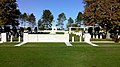 The British Military Cemetery in Bazenville
 The Chateau of Bazenville
 The Grotto of Lourdes
 The Church of Saint Martin
 The Chateau de la Croix


.jpg)


