Better Farming Train (Victoria)

From Wikipedia, the free encyclopedia

K class locomotive on the inaugural Better Farming Train in Gippsland in October 1924.

The Better Farming Train was an agricultural demonstration train which toured Victoria, Australia in the 1920s and 1930s to promote better farming practices. It was the first of two agricultural demonstration trains to run in Australia.[1]

The idea of special trains to promote better agricultural practices was developed in Canada in the early years of the 20th century. In 1904, special trains brought farmers to the Dominion Experimental Farm in Indian Head, Saskatchewan, Canada to demonstrate farming techniques.[2] From 1914 to 1922, a Better Farming Train ran throughout Saskatchewan.[2]

The Victorian train was devised by Harold Clapp, Chairman of Commissioners of the Victorian Railways, and Dr Samuel Cameron, the Victorian Director of Agriculture.[3] It was operated jointly by the Victorian Departments of Agriculture, Railways, Education and Public Health. The agricultural content of the train was devised by Hubert Mullett, an agricultural scientist with the Department of Agriculture and later Director of Agriculture.[4]

The train

Diagram showing arrangement of the Better Farming Train.
The full train on its inaugural run in Gippsland in October 1924.

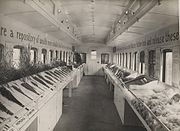
The Department of Agriculture described the train as an "agricultural college on wheels".[5] Fifteen carriages were fitted out with displays covering livestock, dairy, crop production, pasture, farm machinery, cooking and infant welfare. The train was painted bright yellow to attract attention[6] and included sleeping accommodation for the 80 staff.[7]

A typical composition, taken from the May 1925 tour, was:[8]

  • Car 1: Special car Victoria[9] for staff accommodation
  • Car 2: Louvre van with electric generator and live stock fodder
  • Cars 3-5: Cattle trucks, each with three padded compartments.
  • Car 6: An open truck with six compartments for pigs.
  • Car 7: A flat car used as a lecture platform.
  • Car 8: A corridor carriage fitted with display tables of agricultural utensils.
  • Car 9: A carriage with a display of veterinary exhibits.
  • Car 10: A carriage of potato exhibits.
  • Car 11: A carriage displaying wool production techniques, various types of weeds and grasses and soil analysis techniques.
  • Car 12: A carriage of fruit production techniques.

Tours

The full train made 38 tours of regional Victoria and into southern New South Wales and eastern South Australia.[10] The displays were varied depending on the area visited, for example dairy in Gippsland and grain in the Wimmera. In addition, the "Domestic" and "Women's" sections of the train, featuring baby health, needlework and cookery, made independent tours to some locations and a Wool Demonstration Train ran in 1934.

The first tour departed Melbourne on 13 October 1924 and toured Gippsland with the first stop at Bunyip.[11] The response from the public was beyond expectations, with some people travelling 60 to 80 miles (97 to 129 km) to see the train, and lecture cars proved to be too small.[12] There were also criticisms of some of the arrangements for the visiting public.[13] Between 500 and 2,000 people visited the train at each location[10] and the tour was so successful that a second tour was planned before the first one had returned to Melbourne.[7]

At the end of the 6th tour, Dr Cameron wrote "I have no hesitation whatever in saying that the Better Farming Train ... has made a greater appeal to the practical farmer and the younger generation of agriculturalists than anything that has hitherto been attained in Australia".[14]

Tours became less frequent during the Great Depression and a temporary suspension was considered in 1930, however the Minister for Agriculture William Slater said it had been of inestimable value.[15] With state finances becoming tight, in May 1932 the Commonwealth Bank made a grant of £600 to finance the next tour.[16] The final tour was in 1935 when funding was withdrawn.

Reviving the train was considered in July 1939 if assistance was available from the Commonwealth, however this was prevented by the outbreak of World War II.[17]

Interest from other states

In December 1924, the Government of South Australia made enquiries about borrowing the train for a tour of that state.[18] Experts from South Australia visited Victoria in 1926 to examine the train, and there was interest from New South Wales and Queensland.[19] The train eventually toured South Australia in 1929.[20]

New South Wales operated its own Better Farming Train between 1927 and 1929.[21]

Tour locations

TourRegionDatesPlaces visitedNotes
1Gippsland13–23 October 1924Bunyip, Neerim South, Warragul, Yarragon, Mirboo North, Morwell, Maffra, Bairnsdale, Kilmany, Traralgon, Moe, Drouin.[22]
2South Gippsland10–15 November 1924Lang Lang, Meeniyan, Yarram, Toora, Korumburra, Cranbourne.[7]
3Western District1–12 December 1924Colac, Terang, Allansford, Warrnambool, Penshurst, Branxholme, Heywood, Portland, Hamilton, Koroit, Camperdown, Birregurra, Moriac.[23]
4North Central/Goulburn Valley9–21 March 1925Elmore, Cohuna, Gunbower, Rochester, Echuca, Tongala/Kyabram,[24] Tatura, Shepparton, Cobram, Numurkah, Stanhope, Murchison.[25]
-Gippsland16–25 April 1925Warragul, Thorpdale, Moe, Morwell, Mirboo North, Trafalgar.[26][27]Domestic section only.
5Goldfields/Mallee11–22 May 1925Castlemaine, Raywood, Mitiamo, Kerang, Nyah, Kooloonong, Piangil, Swan Hill, Tresco, Pyramid, Dingee, Bendigo.[27]
6North East17–28 August 1925Devenish, Yarrawonga, Benalla, Springhurst, Wangaratta, Wodonga, Myrtleford, Violet Town, Seymour.[28]
7Central Victoria12–17 October 1925Broadford, Alexandra, Yea, Mansfield, Merton, Wallan.[29]
8Midlands/Goldfields9–20 November 1925Sunbury, Kyneton, Redesdale, Newstead, Maryborough, Clunes, Creswick, Newlyn, Daylesford, Trentham.[30]
9Central West30 November - 11 December 1925Ballan, Bungaree, Ballarat, Waubra, Linton, Skipton, Meredith, Geelong, Little River.[31]
-South Gippsland8–13 February 1926Koo Wee Rup, Korumburra, Meeniyan, Toora, Fish Creek, Leongatha.[32]Domestic section only.
-Central Victoria15 February 1926Alexandra.[33]Domestic Arts and Mothercraft cars only.
10Wimmera/Mallee8–20 March 1926Minyip, Beulah, Patchewollock, Hopetoun, Warracknabeal, Horsham, Jeparit, Rainbow, Dimboola, Kaniva, Nhill, Murtoa.[34]
-South Gippsland8–11 June 1926Nyora, Glen Forbes, Anderson, Wonthaggi.[35]Women's Section only.
11Mallee/Sunraysia26 July - 7 August 1926Donald, Woomelang, Underbool, Murrayville, Walpeup, Carwarp, Mildura, Ouyen, Speed, Birchip, Watchem, St Arnaud.[36]
-North East30 August - 4 September 1926Goorambat, St James, Yarrawonga, Benalla.[37]Women's Section only.
12Mallee4–15 October 1926Boort, Ultima, Manangatang, Annuello, Chillingollah, Quambatook, Charlton, Wycheproof, Sea Lake, Kulwin, Culgoa.[38]
13Midlands/Goldfields8–13 November 1926Kilmore, Inglewood, Wedderburn, Marong, Axedale, Heathcote.[39]
14Yarra Valley/Mornington Peninsula6–10 December 1926Whittlesea, Lilydale, Healesville, Somerville, Red Hill.[40]
15Western District/Wimmera21–31 March 1927Inverleigh, Cressy, Lismore, Westmere, Willaura, Glenthompson, Stawell, Ararat, Beaufort, Burrumbeet.[41]
-Western District30 May-9 June 1927Winchelsea, Colac, Cobden, Mortlake, Panmure, Port Fairy, Koroit.[42]Domestic Section only.
16Mallee/Riverina (New South Wales)11–23 July 1927Goornong, Lockington, Cohuna, Gunbower, Rochester, Deniliquin, Mathoura, Bunnaloo, Moulamein, Balranald, Wakool, Echuca.[43]
17Midlands/Goldfields/Mallee15–27 August 1927Malmsbury, Prairie, Swan Hill, Piangil, Kooloonong, Nyah West, Mystic Park, Murrabit, Kerang, Mincha, Harcourt, Maldon.[44]
18Gippsland10–21 October 1927Warragul, Trafalgar, Mirboo North, Yinnar, Maffra, Bairnsdale, Orbost, Bruthen, Sale, Rosedale, Pakenham.[45]
19South Gippsland14–19 November 1927Koo Wee Rup, Dalyston, Leongatha, Yarram, Foster, Loch.[46]
20Western District6–16 March 1928Koroit, Hamilton, Cavendish, Balmoral, Portland, Condah, Casterton, Merino, Coleraine, Penshurst.[47]
21Western District7–12 May 1928Winchelsea, Camperdown, Panmure, Mortlake, Colac, Drysdale.[48]Originally scheduled for one week earlier. Postponed to prevent clashing with the Warrnambool Racing Carnival.[48]
22Mallee30 July-9 August 1928Carwarp, Merrinee, Meringur, Werrimull, Red Cliffs, Ouyen, Underbool, Murrayville, Cowangie, Walpeup.[49]
23Goulburn Valley27 August-6 September 1928Nagambie, Colbinabbin, Girgarre, Tatura, Tongala, Shepparton, Dookie, Numurkah, Cobram, Nathalia.[50]
24North East22 October-1 November 1928Euroa, St James, Yarrawonga, Tatong, Wangaratta, Myrtleford, Rutherglen, Tallangatta, Wodonga, Chiltern, Benalla.[51][52]
25Wimmera12–22 March 1929Horsham, Natimuk, Goroke, Toolondo, Dimboola, Kaniva, Nhill, Jeparit, Rainbow, Lorquon.[53]
26Wimmera/Mallee19–24 April 1929Warracknabeal, Beulah, Hopetoun, Patchewollock, Murtoa.[54]
27Central Victoria16–26 June 1929Werribee, Longwood, Seymour, Alexandra, Yea, Mansfield, Merton, Kilmore, Axedale, Heathcote.[55]
28Central Victoria/Goldfields30 July-8 August 1929Trentham, Newlyn, Clunes, Navarre, Elmhurst, Avoca, Carisbrook, Kyneton, Gisborne.[56]
29South Australia7–17 October 1929Bordertown, Murray Bridge, Balaklava, Gladstone, Gawler, Kapunda, Riverton, Mount Barker.[57]
30Western District/Central Victoria24 March-4 April 1930Winchelsea, Cressy, Westmere, Glenthompson, Strathkellar, Willaura, Derrinallum, Moriac, Lara, Diggers Rest, Melton.[58]
31Gippsland23 June-2 July 1930Drouin, Thorpdale, Boolarra, Heyfield, Boisdale, Bruthen, Orbost, Lindenow, Neerim South, Berwick.[59]
32South Gippsland21–29 July 1930Clyde, Yannathan, Meeniyan, Toora, Yarram, Fish Creek, Korumburra, Kernot.[60]
33Mallee/Northern Districts19–30 October 1931Dingee, Swan Hill, Murrabit, Kerang, Pyramid, Rochester, Kyabram, Gunbower, Cohuna, Lockington.[61]
34Western District/Goulburn Valley8–18 March 1932Timboon, Cobden, Stanhope, Tatura, Tongala, Kyabram, Numurkah, Cobram, Shepparton.[62]
35Mallee12–22 July 1932Quambatook, Manangatang, Robinvale, Ultima, Boort, Culgoa, Nandaly, Sea Lake, Wycheproof, Charlton.[63]
36Western District10–19 October 1933Warrnambool, Port Fairy, Hawkesdale, Coleraine, Portland, Heywood, Condah, Merino, Casterton.[64]
37North East18–28 September 1934Beechworth, Cudgewa, Tallangatta, Huon, Wahgunyah, Goorambat, Tungamah, Yarrawonga.[65]
-Central/Goulburn Valley/North East3–16 October 1934Seymour, Mansfield, Yea, Shepparton, Murchison, Rushworth, Nagambie, Euroa, Benalla, Wangaratta.[66]Wool Demonstration Train run jointly with the Country Women's Association.
38Mallee/Sunraysia25 March-4 April 1935Tempy, Underbool, Murrayville, Ouyen, Mildura, Merrinee, Meringur, Werrimull, Red Cliffs.[67]

See also

References

Related Articles

Wikiwand AI