Biaugmented pentagonal prism
53rd Johnson solid (13 faces)
From Wikipedia, the free encyclopedia
In geometry, the biaugmented pentagonal prism is a polyhedron constructed from a pentagonal prism by attaching two equilateral square pyramids onto each of its square faces. It is an example of a Johnson solid.


Construction
The biaugmented pentagonal prism can be constructed from a pentagonal prism by attaching two equilateral square pyramids to each of its square faces, a process known as augmentation.[1] These square pyramids cover the square face of the prism, so the resulting polyhedron has eight equilateral triangles, three squares, and two regular pentagons as its faces.[2] A convex polyhedron in which all faces are regular is Johnson solid, and the augmented pentagonal prism is among them, enumerated as 53rd Johnson solid .[3]

Properties
An biaugmented pentagonal prism with edge length has a surface area, calculated by adding the area of four equilateral triangles, four squares, and two regular pentagons:[2] Its volume can be obtained by slicing it into a regular pentagonal prism and an equilateral square pyramid, and adding their volume subsequently:[2]


The dihedral angle of an augmented pentagonal prism can be calculated by adding the dihedral angle of an equilateral square pyramid and the regular pentagonal prism:[4]
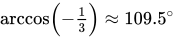
- the dihedral angle of an augmented pentagonal prism between two adjacent triangular faces is that of an equilateral square pyramid between two adjacent triangular faces, ,
- the dihedral angle of an augmented pentagonal prism between two adjacent square faces is the internal angle of a regular pentagon .
- the dihedral angle of an augmented pentagonal prism between square-to-pentagon is that of a regular pentagonal prism between its base and its lateral faces .
- the dihedral angle of an augmented pentagonal prism between pentagon-to-triangle is , for which adding the dihedral angle of an equilateral square pyramid between its base and its lateral face , and the dihedral angle of a regular pentagonal prism between its base and its lateral face.
- the dihedral angle of an augmented pentagonal prism between square-to-triangle is , for which adding the dihedral angle of an equilateral square pyramid between its base and its lateral face, and the dihedral angle of a regular pentagonal prism between two adjacent squares.