Sphenomegacorona
From Wikipedia, the free encyclopedia
| Sphenomegacorona | |
|---|---|
 | |
| Type | Johnson J87 – J88 – J89 |
| Faces | 16 triangles 2 squares |
| Edges | 28 |
| Vertices | 12 |
| Vertex configuration | 2(34) 2(32.42) 2×2(35) 4(34.4) |
| Symmetry group | C2v |
| Dual polyhedron | - |
| Properties | convex, elementary |
| Net | |
 | |

In geometry, the sphenomegacorona is a Johnson solid with 16 equilateral triangles and 2 squares as its faces.
The sphenomegacorona was named by Johnson (1966) in which he used the prefix spheno- referring to a wedge-like complex formed by two adjacent lunes—a square with equilateral triangles attached on its opposite sides. The suffix -megacorona refers to a crownlike complex of 12 triangles, contrasted with the smaller triangular complex that makes the sphenocorona.[1] By joining both complexes, the resulting polyhedron has 16 equilateral triangles and 2 squares, making 18 faces.[2] All of its faces are regular polygons, categorizing the sphenomegacorona as a Johnson solid—a convex polyhedron in which all of the faces are regular polygons—enumerated as the 88th Johnson solid .[3] It is an elementary polyhedron, meaning it cannot be separated by a plane into two small regular-faced polyhedra.[4]

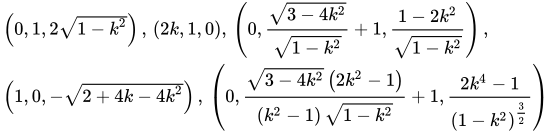
The surface area of a sphenomegacorona is the total of polygonal faces' area—16 equilateral triangles and 2 squares. The volume of a sphenomegacorona is obtained by finding the root of a polynomial, and its decimal expansion—denoted as —is given by A334114. With edge length , its surface area and volume can be formulated as:[2][5]