Chowk poorana
From Wikipedia, the free encyclopedia

| Part of a series on |
| Punjabis |
|---|
 |
 Punjab portal |
Chowk-poorana or Chowkpurana is folk art practised in Punjab, Haryana, Himachal Pradesh, Madhya Pradesh, Rajasthan and Uttar Pradesh.[1] In Uttar Pradesh, the term chowk-poorana refers to decorating the floor with various designs using flour and rice[2] and also the walls using designs specific to the region.[3]
Similarly, according to Aryan (1983), the term chowk-poorana in Punjab refers to floor art and mud wall painting. This art is primarily practised by women and is a folk tradition.[4] In Punjab, during festivals such as Holi, Karva Chauth and Diwali, walls and courtyards of rural houses are enhanced with drawings and paintings similar to rangoli in South India, mandana in Rajasthan, and rural arts in other parts of India. Chowk-poorana mud wall art in Punjab is given shape by the peasant women of the state. In courtyards, this art is drawn using a piece cloth. The art includes drawing tree motifs, flowers, ferns, creepers, plants, peacocks, palanquins, geometric patterns along with vertical, horizontal and oblique lines. These arts add to the festive atmosphere.[5]
The term chowk-poorana is made up of two words: Chowk means square and poorana means to fill. The art represents folk mud wall art of the Punjab drawn for decoration or festivals. Hasan (1998) records that during 1849–1949 A.D. decorative designs were painted on mud walls with the occasional bird or animal.[6] Gall et al. (2009) writing in the Worldmark Encyclopedia of Cultures and Daily Life: Asia and Oceania states that the folk art of Punjab may be thousands of years old, noting similarities between village potters clay toys and Harappan figurines. Women paint intricate designs on mud walls on festivals continuing a long tradition.[7]
Similarly, the Haryana Review (1981) states that artists plaster the mud walls with cow-dung which is then whitewashed. Lines are then drawn which create symbolic paintings representing "profit, fortune and prosperity".[8] The Lalit Kala Akademi reported in 1968 on how artists in North India draw paintings noting that some artists "have a special gift for depicting colourful scenes from the epics: some work only in very fine line work in black ink and sindhur (rose-madder)". In the same publication, the prevalence of wall art on the festival of Sanjhi is described. The festival is celebrated annually during Navratri. Women in northern India comprising the area around Delhi, Uttar Pradesh, and the Punjab, plaster the walls and inner courtyards with mud and cowdung. Then geometrical designs are drawn together with circular or triangular clay discs.[9]
Mud wall painting
Kang (1988), in his study of wall art in Punjab, states that the basis of the paintings are to draw circular and triangular shapes which create branches and flowers".[10] According to Dhillon (1998), women create "geometrical figures like trees, birds, open hand, geometrical figures like square, triangles, and circles and sometimes abstract designs, human figures and deities".[11] Aryan (1983) emphasises "that despite its name, the decorative designs are never drawn on the threshold of the house" but on the walls.[12] However, according to Kohli (1983), Punjabi women draw chowkpurna "designs on their thresholds for the well-being and prosperity of their family members as well as to welcome the visitors".[13]
Bhatti (1981) describes the process employed by artists in Punjab in painting on mud walls. The base is mud and cowdung plaster. The artist uses finger-prints and palm marks for decoration. Chalk, yellow and red clay is used for pigments. Traditional and folk-motifs are drawn on the plaster.[14] Black colour is also utilised.[15]
Dhamija (1971) writes that the wall paintings are drawn with white rice paste. Sometimes ochre (clay) and a few colours are also used. The wall paintings display symbolic ritual designs, which are drawn to "celebrate special occasions—festivals such as Diwali or Dussehra; happy family celebrations such as birth of a child".[16] As the art is painted on mud walls, the paintings are drawn twice and perhaps even more times, a year. Sometimes the art can also be seen on brick walls which are plastered with lime. However, the tradition is waning due to cultural changes in the Punjab.[17] Nevertheless, Kang notes in 2018 that in some mud houses, traditional folk art can still be seen on the walls.[18] Similarly, Bedi (1978) notes that during Diwali, women plaster the walls with lime and then draw an image of Lakshmi.[19]
Manku (1986) in his study of Gujjar settlements, states that people in the sub-mountainous region of Punjab people wash the outer and inner walls with white clay called golu. On the inside of the walls, women paint religious motifs with rice powder mixed with water.[20]
Gallery
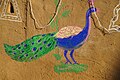 Virasti Mela, Bathinda (Punjabi Heritage Festival) Mud wall art
 Virasti Mela, Bathinda (Punjabi Heritage Festival) Peacock drawn using geometrical shapes
 Gadda (cart). Art on the wall and on the cart
 House Budha Khera, Kaithal, Haryana. Wall art using modern paint.
 Ghaffar House. Punjab, Pakistan. Motifs is modern paint and plaster.
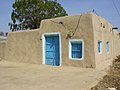 Traditional mud Punjabi home (Pakistan)
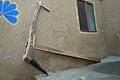 Virasti Mela, Bathinda Mud wall art
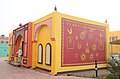 Sadda Pind Amritsar. Wall art
 Rural kutcha homes with folk art
 Drying Crop in rural Punjabi home
_(95).jpg)
_(36).jpg)


_(12).jpg)


Ortta/kandholi

A similar form of folk art is noted by Kang (2019) who states that engraving drawings onto walls was popular when mud houses were common in Punjab. Even after the construction of brick houses, the cooking area in the courtyard was enclosed by a mud wall called an 'Ortta' in Punjabi where women continued to parge motifs on the wall. However, having an Ortta has also declined which has affected the practice of traditional drawing.[21] Kohli (1983) assigns the art of "parge decoration, in mud, wrought on the walls of houses" to women.[22] Yellow clay was sometimes used as a base upon which motifs were parged.[23]
An Ortta is also called kandholi (wall) in Punjabi where women would paint drawings.[24] According to Mitawa (2004), the wall would be plastered with coloured clay and then drawn upon using white clay to draw flowers, peacocks and birds.[25] Kehal (2006) notes that shrubs, borders and children's pictures are also drawn on the walls.[26]
Gallery
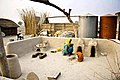 inside a Punjab village house (Pakistan)
 Punjabi style ventilator (Pakistan) showing parge work


Wall art on festivals

In Punjab, images are painted on walls on festivals such as Sanjhi and Hoi. A local festival on Navratri is observed whereby wheat or barley are planted on the first day and the seedlings are immersed in water on Dussehra. The seedlings are placed before an image of a Goddess on the wall. Similarly, images are painted on festive occasions in Haryana and Uttar Pradesh.


