December 22 (Eastern Orthodox liturgics)
Day in the Eastern Orthodox liturgical calendar
From Wikipedia, the free encyclopedia
December 21 - Eastern Orthodox liturgical calendar - December 23

All fixed commemorations below celebrated on January 4 by Eastern Orthodox Churches on the Old Calendar.[note 1]
For December 22nd, Orthodox Churches on the Old Calendar commemorate the Saints listed on December 9.
Feasts
Saints
- Great Martyr Anastasia of Rome and Sirmium, the Deliverer from Bonds and Poisons,[3] and:
- her teacher Martyr Chrysogonus,[4] and with them:
- the Martyrs Theodota,[5] Evodos (Evodus, Evodias, Evodius),[note 3] Eutychianus, Zoilos, and others,[note 4] who suffered under Diocletian (304)[1][6]
Pre-Schism Western saints
- Martyrs Demetrius, Honoratus and Florus, in Ostia in Italy[8] (see also: November 21)
- Thirty Holy Martyrs of Rome (c. 303)[8][note 6]
- Martyr Flavian, former Prefect of Rome (362)[8][note 7]
- Saint Hunger (Hungerus Frisus), Bishop of Utrecht in the Netherlands from 856; during the Norman invasion he fled to Prüm in Germany where he died (866)[8]
- Saint Amaswinthus of Málaga, Monk and Abbot for forty-two years at a monastery in Silva de Málaga in Spain (982)[8]
Post-Schism Orthodox saints
- Saint Boris Talantov of Kostroma, Soviet teacher, participant in the dissident movement in the USSR, church publicist and political prisoner (1970–1971)[1][note 8][note 9]
New martyrs and confessors
Other commemorations
- Commemoration of the Thyranoixia (consecration) of the "Great Church of Christ", the Hagia Sophia[11]
- Repose of Monk Dositheus, hermit of the Roslavl Forests and Optina Monastery (1828)[1]
Icon gallery
 Great Martyr Anastasia, Deliverer from Bonds.
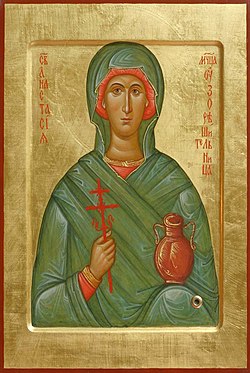 Great Martyr Anastasia, Deliverer from Bonds.
 St. Chrysogonus and St. Anastasia.
 St. Chrysogonus (Archiepiscopal Chapel, Ravenna)
 Mosaic of Virgin and Child with St. Chrysogonus (left) and St. James the Greater (right). (At the church of San Crisogono in Rome, c. 1273–1308)


Notes
- The notation Old Style or (OS) is sometimes used to indicate a date in the Julian Calendar (which is used by churches on the "Old Calendar").
The notation New Style or (NS), indicates a date in the Revised Julian calendar (which is used by churches on the "New Calendar"). - The Forefeast of the Nativity of the Lord begins on December 20. From now on, most of the liturgical hymns will be concerned with the birth of the Savior.[2]
- Saint Evodus was the eldest son of St. Theodota. He, his mother, and his two brothers stood bravely before the judge and endured beatings without protest. After lengthy torture, they were all thrown into a fiery furnace and so received the crown of martyrdom.
- One hundred and twenty men became Christians when they witnessed the miraculous deliverance of the Great Martyr Anastasia and St. Eutychianus from a sinking boat. St. Theodota appeared and steered the ship to shore. These 120 martyrs were baptized by St. Eutychianus and St. Anastasia, then were captured and put to death for confessing Christ.
- He suffered martyrdom under Diocletian, when together with the holy Virgin Martyrs Agape, Irene, and Chionia (see April 16), he recovered the relics of Saint Chrysogonous (whose memory is honored today) from the sea.[7]
- A group of thirty martyrs who suffered in Rome under Diocletian and were buried on the Via Lavicana.
- An ex-prefect of Rome, branded on the forehead as a slave and exiled to the village of Acquapendente in Tuscany in Italy by Julian the Apostate. He reposed there while in prayer.
- See also: (in Russian) Талантов, Борис Владимирович. Википедии. (Russian Wikipedia).
- Boris Talantov's essay on the subject of the Russian Orthodox Church under the Communist Yoke is available at the Orthodox Christian Information Center:
- Boris Talantov. The Moscow Patriarchate and Sergianism. August, 1967 (Signature: B. V. Talantov).
- IN: Ivan Andreyev. Russia's Catacomb Saints. Platina, CA: St. Herman of Alaska Press, 1982, 463–486. (pdf)