Diversity (mathematics)
From Wikipedia, the free encyclopedia
In mathematics, a diversity is a generalization of the concept of a metric space. The concept was introduced in 2012 by Bryant and Tupper,[1] who call diversities "a form of multi-way metric".[2] The concept finds application in nonlinear analysis.[3]
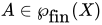
Given a set , let be the set of finite subsets of . A diversity is a pair consisting of a set and a function satisfying


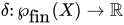
(D1) , with if and only if


and
(D2) if then .


Bryant and Tupper observe that these axioms imply monotonicity; that is, if , then . They state that the term "diversity" comes from the appearance of a special case of their definition in work on phylogenetic and ecological diversities. They give the following examples:


Let be a metric space. Setting for all defines a diversity.


L1 diversity
For all finite if we define then is a diversity.



Phylogenetic diversity
If T is a phylogenetic tree with taxon set X. For each finite , define as the length of the smallest subtree of T connecting taxa in A. Then is a (phylogenetic) diversity.


Steiner diversity
Let be a metric space. For each finite , let denote the minimum length of a Steiner tree within X connecting elements in A. Then is a diversity.



