We describe a space  with Hausdorff dimension
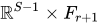
  . (For integer dimensions, Euclidean spaces satisfy the desired condition, and for any Hausdorff dimension S + r in the interval (S, S + 1), where S is an integer, we can take the space
  .) Let t ∈ (0, 1/2) be such that
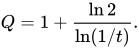 Then define K to be the Cantor set obtained by cutting out the middle 1 - 2t portion of an interval and iterating that construction. In other words, K can be defined as the subset of [0, 1] containing 0 and 1 and satisfying
 The space will be a quotient of I × K, where I is the unit interval and I × K is given the metric induced from ℝ2.
To save on notation, we now assume that t = 1/3, so that K is the usual middle thirds Cantor set. The general construction is similar but more complicated. Recall that the middle thirds Cantor set consists of all points in [0, 1] whose ternary expansion consists of only 0's and 2's. Given a string a of 0's and 2's, let Ka be the subset of points of K consisting of points whose ternary expansion starts with a. For example,
 Now let b = u/3k be a fraction in lowest terms. For every string a of 0's and 2's of length k - 1, and for every point x ∈ Ka0, we identify (b, x) with the point (b, x + 2/3k) ∈ {b} × Ka2.
We give the resulting quotient space the quotient metric:
 where each qi is identified with pi+1 and the infimum is taken over all finite sequences of this form.
In the general case, the numbers b (called wormhole levels) and their orders k are defined in a more complicated way so as to obtain a space with the right Hausdorff dimension, but the basic idea is the same.