Draft:Liberation of Thessaloniki
This is a prage i translated from greek to english and i want to publish it but i cant
From Wikipedia, the free encyclopedia
The Liberation of Thessaloniki took place on 27 and 28 October 1912 with the entry of Greek troops into the city after the victorious battles of the Greeks at Giannitsa and Sarantaporos. On 20 October, the Greek forces under the orders of the heir to the throne, Constantine, headed for Northern Epirus, to liberate it. However, after a strong disagreement between Eleftherios Venizelos and the heir, the prime minister 's order prevailed and the Greek troops were led to liberate Thessaloniki, in order to prevent the advance of the Bulgarians, who were interested in capturing the city in order to have access to the Aegean. After the aforementioned battles, the Greek troops captured the city and the heir Constantine entered Thessaloniki. The Ottoman general of Thessaloniki, Hasan Tahsin Pasha, surrendered the city to Greece, unconditionally and along with 25,000 prisoners, in an agreement signed in the village of Topsin (present-day Thessaloniki Bridge ).
 | Review waiting, please be patient.
This may take 2 months or more, since drafts are reviewed in no specific order. There are 4,473 pending submissions waiting for review.
Where to get help
How to improve a draft
You can also browse Wikipedia:Featured articles and Wikipedia:Good articles to find examples of Wikipedia's best writing on topics similar to your proposed article. Improving your odds of a speedy review To improve your odds of a faster review, tag your draft with relevant WikiProject tags using the button below. This will let reviewers know a new draft has been submitted in their area of interest. For instance, if you wrote about a female astronomer, you would want to add the Biography, Astronomy, and Women scientists tags. Editor resources
Reviewer tools
|
Submission declined on 20 April 2026 by Theroadislong (talk).
Where to get help
How to improve a draft
You can also browse Wikipedia:Featured articles and Wikipedia:Good articles to find examples of Wikipedia's best writing on topics similar to your proposed article. Improving your odds of a speedy review To improve your odds of a faster review, tag your draft with relevant WikiProject tags using the button below. This will let reviewers know a new draft has been submitted in their area of interest. For instance, if you wrote about a female astronomer, you would want to add the Biography, Astronomy, and Women scientists tags. Editor resources
This draft has been resubmitted and is currently awaiting re-review. |  |
 Comment: please read WP:REFB and add sources inline. Theroadislong (talk) 20:29, 20 April 2026 (UTC)

| Liberation of Thessaloniki | |||||||
|---|---|---|---|---|---|---|---|
| Part of First Balkan War | |||||||
 The entry of King George and Crown Prince Constantine into Thessaloniki (October 29, 1912) | |||||||
| |||||||
| Belligerents | |||||||
 Kingdom of Greece Kingdom of Greece |
 Ottoman Empire Ottoman Empire | ||||||
| Commanders and leaders | |||||||
|
George I of Greece |
Hasan Tahsin Pasha | ||||||
| Casualties and losses | |||||||
| 25,000 prisoners | |||||||
Advance towards Thessaloniki

With the outbreak of the First Balkan War, the countries of the Balkan League attacked the Ottoman Empire and began to advance into its territory. The Greeks, after managing to advance towards Macedonia, headed towards Thessaloniki, because at that time Macedonia was a point of conflict between Greeks and Bulgarians for dominance in the region. The Greek troops of Thessaly and Macedonia received orders from Prime Minister Eleftherios Venizelos and King George I to move rapidly towards Thessaloniki, before the Bulgarian military forces arrived. The Thessalian troops, under the orders of King George I, moved further north and after the Battle of Giannitsa they arrived outside Thessaloniki, while the Macedonian troops headed further south, under the orders of Venizelos and after the Battle of Sarantaporos they also arrived in Thessaloniki.[clarification needed] The Turkish forces, after the defeat at Sarantaporos, headed to Giannitsa, fighting a defensive battle to stop the Greek advance towards Thessaloniki, but the Greek army won the battle and advanced towards the city. On 25 October 1912, the Greek troops had surrounded the city.
City tradition
On 26 October, Hasan Tahsin Pasha agreed to discuss the terms of surrendering Thessaloniki to the Greeks, while Constantine assured the Bulgarian army, which was 20 kilometres outside Thessaloniki, that the Greeks would enter the city that day and advised them to change direction.[1]
On the afternoon of the 26th, news reached Athens via an unsigned telegram to the Ministry of War from the king's telegraph service, based in Gida (now Alexandria), that the Greek army had entered Thessaloniki. The news spread throughout Athens, provoking joyous celebrations with the ringing of bells, hymns and prayers in churches, demonstrations in the city centre and the decoration and illumination of the city by order of the mayor, Spyridon Mercouris. As the telegram was unsigned and he himself could not verify it, Venizelos refused to appear before the cheering crowd and in the evening informed representatives of the trade associations that the city had not yet come under Greek rule, while he promised them that, as soon as he received relevant information, one hundred and one cannon shots would be fired from the Pnyx. A government statement at 3 am on the 27th denied the news of the capture of the city, resulting in the cancellation of the planned doxology at the Metropolis.
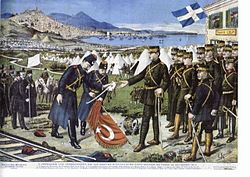 Lithograph by Sotiris Christidis
 Lithograph by Karl Haupt


On 27 October, due to the threat from the Bulgarians, Hasan Tahsin Pasha was forced to sign the protocol of surrender of Thessaloniki to the Greeks, which was backdated to the 26th to mislead the Bulgarian side.[2] Tahsin surrendered the city to the Greeks unconditionally and gave 25,000 prisoners.[citation needed] In the afternoon, a detachment of Greek soldiers crossed the deserted coastal avenue and camped outside the city[2], while in the evening the Bulgarian general Todorov, after being informed of the surrender of the city and realizing the Greek-Turkish cooperation, requested a surrender protocol from Tahsin Pasha, who referred him to the Greek side.[2] As, however, the city remained under Turkish control, Todorov decided to capture it the next morning.[3]
To forestall the Bulgarian army's entry, Constantine was transported by train to the city's railway station and from there to the Commanding General before dawn on 28 October. He received the 1st Division from the railway station and attended a doxology. Fulfilling Venizelos' promise, at 9:30 on the morning of 28 October, one hundred and one cannon shots were fired from the Pnyx.[4]
On 29 October, an official changing of the guard ceremony was held with a grand parade led by King George, who came from Gida, and Constantine, while the Greek flag was raised on the White Tower.
The Greek territory in Macedonia was the cause of the Second Balkan War because the Bulgarians were not satisfied with the territories they occupied.


- provide significant coverage: discuss the subject in detail, not just brief mentions or routine announcements;
- are reliable: from reputable outlets with editorial oversight;
- are independent: not connected to the subject, such as interviews, press releases, the subject's own website, or sponsored content.
Please add references that meet all three of these criteria. If none exist, the subject is not yet suitable for Wikipedia.